


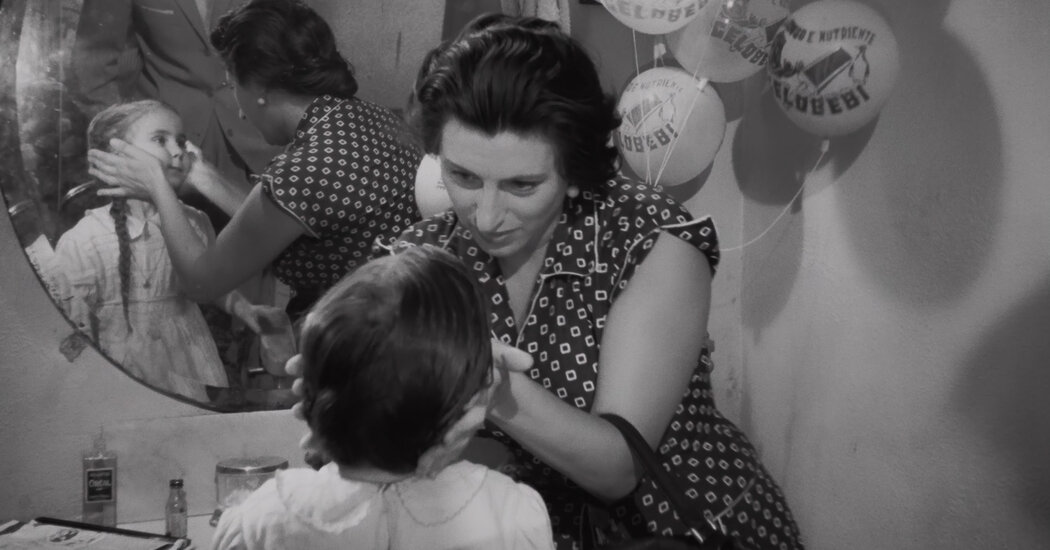
Anna Magnani, who died in 1973, was less an actress than a force of nature. Cast as Maddalena, the working-class stage mother who animates Luchino Visconti’s 1951 “Bellissima,” this donna del popolo (woman of the people) turned diva could give chutzpah lessons to Mama Rose, her stage-struck counterpart in the musical “Gypsy.”
“Bellissima,” at Film Forum through May 7 in a new 4K restoration, is a case study in maternal obsession, a comic opera with nonmusical solos, and a satire of the Italian movie industry. Above all it’s a Pirandellian meta performance by Magnani. Visconti’s break with the neorealist movement he helped initiate with “Ossessione” (1943) and “La Terra Trema” (1948) is made evident with the movie’s “overture” — an aria from a 19th-century opera, soon revealed as a ploy by a radio show to promote a contest to find the most beautiful child in Rome for a starring role in a movie by the director Alessandro Blasetti.
The audition, held at Cinecittà, is mobbed. Blasetti plays himself. So, in a sense, does Magnani, pushing her way onstage with a young child, Maria (Tina Apicella, also perhaps playing herself). Maddalena is less refined than the other mothers, but more determined. A true believer in the magic of movies (inundated by the sounds of an open-air movie theater next door to her apartment), she pillages her family savings to provide Maria with professional head shots, an acting coach, ballet classes, a tonsorial makeover and new clothes, as well as a bribe for Blasetti’s smooth-talking assistant.
“Bellissima” likely inspired two younger directors, Federico Fellini and Michelangelo Antonioni, to address the film industry in their movies “The White Sheik” (1952) and “The Lady Without Camelias” (1953). Neither delved as deeply as Visconti and Magnani into the nature of acting. Maddalena rarely stops talking. Staring into a mirror she declares, “I could have been an actress, if I wanted to.” Her arguments with her husband (Gastone Renzelli) are arias in themselves. “Stop this play acting!” he demands in vain. After she makes her point, she does stop, signaling to an audience of neighbors that her performance had its desired effect.
In a favorable review written for The New York Times when “Bellissima” opened here in 1953, A.H. Weiler called the movie “as compassionate and incisive a portrait of mother love as any.” That’s one way to describe Maddalena’s mania, particularly once you grasp that her child is neither beautiful nor talented.
Maddalena’s awakening is as convulsive as her angst-fueled micromanaging. After learning a hard truth about the movie business from a former bit player, she smuggles herself into the projection booth to watch Maria’s screen test. The scene is simultaneously absurd, cruel and heart-wrenching — yet Visconti has a few further twists, a surprise “Hollywood” ending (and then another) to complete the film’s Möbius strip.
Even the kicker is uncanny. Maddalena hears a bit of dialogue from the movie next door and identifies the voice of Burt Lancaster — Magnani’s future co-star in her Hollywood debut, “The Rose Tattoo,” for which she would win an Oscar and Time would title its review, with scare quotes, “World’s Greatest Actress.”
Bellissima
Through May 7 at Film Forum in Manhattan, filmforum.org.
https://www.nytimes.com/2026/04/29/movies/bellissima-film-forum.html
