








“We got our Big Sur buddies back,” said Brian Flaten, stirring a Negroni beneath a mounted moose head at Legends Bar in Morro Bay, Calif. At midnight on a recent evening, the dimly lit bar where Mr. Flaten is a bartender, beckoned drivers off Highway 1, long after the rest of the world had gone to bed on this lonely stretch.
But there was something to celebrate. After three years, Highway 1 was open again. As of Feb. 14, drivers can once again travel the full length of the iconic road — which was included in The New York Times’s “52 Places to Go in 2026” list — after a series of landslides that began in 2023 severed the road 110 miles north of here.
Shawna Hawkins had just arrived at Legends Bar with her son and niece after driving south from San Francisco. “I wanted to feel the sand under my feet again,” she said. “It’s been too long.”
Outside, Morro Rock rose like a giant skull some 600 feet from the Pacific Ocean — a sort of bookend to the other epic formations along the coast that had seemed out of reach, unless drivers took long detours around the Santa Lucia Mountains.
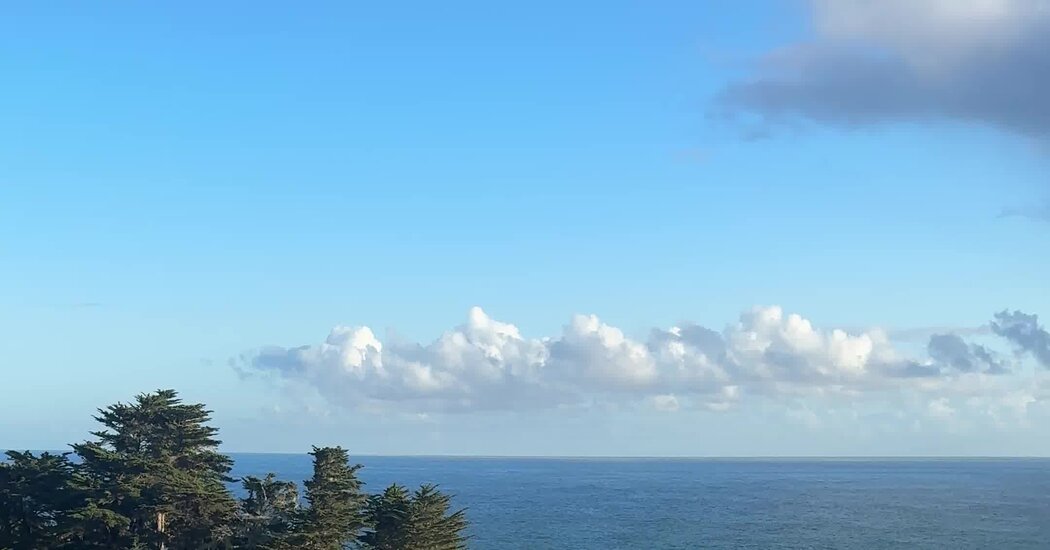
Highway 1, which lies between the restless Pacific and those steep mountains, is less a road than a narrative: a sequence of tightening curves, widening horizons and vertiginous reveals that make up one of the world’s greatest road trips, rhapsodized about by everyone from John Steinbeck to Jack Kerouac. As you drive north from Morro Bay, you may get the uneasy sense that the mountains and sea are only grudgingly allowing a road to pinch between them.
A Castle Above the Sea
On a recent morning I found the lack of traffic surprising. The highway felt almost private, something longtime drivers here can hardly remember.
Just 30 minutes north of Morro Bay, Hearst Castle rose from a mountain: an elaborate arrangement of towers and terraces. Built by the media tycoon William Randolph Hearst over three decades starting in 1919, the estate has always felt slightly detached from its surroundings — a European fantasia set above a Californian wilderness.
Before Highway 1’s closure, a visit usually required making a reservation days in advance. On a recent morning, walk-in tickets were readily available. I joined the “Upstairs Suites Tour” ($35) and found myself alone with a guide.
I had been here many times before. But this time, without the usual crowds, details emerged with unusual clarity: Hearst’s red velvet monogrammed slippers waiting in his closet; a pair of paintings of Napoleon Bonaparte by Jean-Léon Gérôme hanging in a remote anteroom; the newspaper hangers in the palatial office where editions from around the world were flown in daily so Hearst could guide his empire from this wilderness.
Attendance is up only slightly — about 13 percent above what it was last year — but Diana Binnewies, my guide, said she noticed the difference. “Before, it skewed heavily toward Southern California,” she said. “Now I see a lot more diversity in viewpoints and dress.”
Sea Lions and an Art Deco Bridge
North of Hearst Castle begins one of Highway 1’s most distinctive soundtracks: the barking of elephant seals. They flop along the shores and outcroppings along the highway, providing a contralto to the constant roll of the surf. One of the best places to see them is the Piedras Blancas Elephant Seal Rookery, where hundreds of seal elephants sprawl out on the sand like tourists on a package trip.
The soundtrack replaces cellphone service, which vanishes for the next 150 miles, as you head north. It hardly feels like a loss — conversation seems beside the point in the face of such vastness.
“Big Sur is a place of splendor, a savage beauty beyond words,” wrote Henry Miller, who lived here for nearly two decades. Farther up the highway, the Henry Miller Memorial Library echoes the lingering New Age energy that hums along this stretch of coast with poetry readings, tie-dyed patrons and pathways shaded by low, branch-woven canopies.
After the rookery, the lanes narrow and the drop-offs sharpen as the road approaches Big Sur. This is the Highway 1 of a million Instagram posts.
On the curves, the recent reopening of the highway was most obvious. There was very little traffic. For the entire stretch to Carmel, I hardly tailgated anyone, despite decades of memories of endless car chains that clogged the road where passing lanes are nonexistent.
At a Hitchcockian pullout 200 feet above the ocean, a half-dozen students from Claremont McKenna College parked to gape at the Bixby Bridge, an Art Deco marvel completed in 1932. With delicately curved trestles against the rough landscape, the bridge seems to have barely escaped disaster. At its southern edge, a three-football-field-wide streak of scraped, rainbow-colored debris rose against the cliffs all the way to the sea: The Regent’s Slide, which had held the road hostage for three years, was now largely cleaned out and tied down, Gulliver-like, by a thick skirt of mesh.
Excavators and bulldozers were still at work below the slide area when I drove through, and for the first time on this trip, I was forced to wait behind other vehicles as the road narrowed to a single lane. Laser equipment was being affixed to the cliffs to measure any movement.
Farther north, Nepenthe, Greek for “no sorrow,” is perched on a shelf above the surf. The restaurant has always been a mandatory stop. The property had once been owned by Orson Welles and his wife Rita Hayworth; later the Fassett family built a broad orange terrace with a sculptural restaurant designed by Rowan Maiden, a student of Frank Lloyd Wright. Ever since, it has been a bohemian gathering spot for drum circles, dances and great meals. Ordering a beet salad ($26) on the terrace, I asked the waitress if anything had altered during the three years the place had been mostly out of reach.
“Yeah,” she said, “we replaced some of the old chairs on the patio.”
A Famous Inn and a Gorgeous Beach
Post Ranch Inn is another beacon of stability on an unstable road. Originally homesteaded by the Post family in the 1860s, the inn lies about 1,000 or so feet above the waves, across 98 acres that are now dotted with tree houses, bungalows and sculptural glass-and-metal cabins. Post Ranch even has a resident shaman. When storms closed the highway north of the property in 2024, guests were flown in by helicopter. Now they’re returning in droves and the place was booked solid for the next two weeks.
Although the typically $2,100-to-$3,300-a-night price tag is daunting, the inn’s restaurant, Sierra Mar (prix fixe lunch, $85), is more accessible and provides a glimpse beneath the centuries-old redwood trees into the compound that has been visited by the likes of Jake Gyllenhaal, Taylor Swift and George Clooney.
The restaurant’s kitchen was completely rebuilt during the road closure and the results are paying off. “The giant has awoken,” said Reylon Agustin, the inn’s culinary director, as he surveyed the sunny terrace where visitors were tucking into smashburgers with ingredients grown in the inn’s garden.
Three miles up, on a steep road that descends from the highway, Paul Amend was directing traffic to Pfeiffer Beach, one of the most photographed shores in California.
“This might be the most difficult job on Highway 1,” he said. Before the closure, travelers would drive two miles down the narrow road to five dozen parking spots in the beachside parking lot ($15 entry) — or simply park illegally, clogging up driveways and creating bottlenecks. Now staff members have been stationed at the top of the road to force cars to wait for spots to open. “Best to get here before 8 a.m.,” Mr. Amend said.
I came late in the day and was lucky enough to snag a spot. The cliff formations along the wide sand beach were riddled with holes and crannies, and a few — much fewer now that parking is enforced — souls braved the riptides to take a dip. No lifeguards were on duty.
As the sun set, I noted a man precariously leaning his iPhone onto one of the cliff’s handholds, and then running over to his girlfriend to kneel and propose. It looked like an enthusiastic ‘yes.’ In this setting, a ‘no’ would be hard.
By the time Highway 1 reached the bucolic village of Carmel-by-the-Sea, the landscape had softened. Cliffs eased into rolling hills and the ocean retreated behind grassy fields streaked yellow and purple with lupines and poppies in the fading light.
After three years, I was grateful to have performed in rare solitude the ritual of one of America’s greatest road trips. But it’s impossible to take anything for granted on this wild coast, and that’s part of its allure.
Follow New York Times Travel on Instagram and sign up for our Travel Dispatch newsletter to get expert tips on traveling smarter and inspiration for your next vacation. Dreaming up a future getaway or just armchair traveling? Check out our 52 Places to Go in 2026.


