







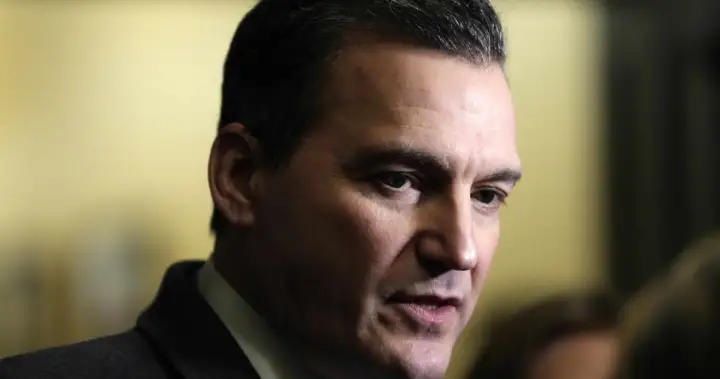
In the year since he was named Canada’s first federal minister of artificial intelligence, Evan Solomon has spoken often about the possibilities of AI and Canada’s potential to become a global leader.


Some AI industry and research leaders, however, are wondering when that talk will turn into action.
In an interview with Global News on Monday, Solomon said work is ongoing to set Canada up for the AI future, but understands why people are looking for answers to the seemingly endless questions that are being raised.
“I know there’s a lot of expectation about it, which is good — we want people to be engaged,” he said.
Of particular concern is when the government will release its long-promised and long-delayed “refreshed” national AI strategy, a roadmap expected to lay out Canada’s updated vision for widespread AI adoption across the public and private sectors, establishing digital sovereignty, and addressing growing safety, copyright and privacy issues.
A spokesperson for the minister’s office told Global News the strategy — which Solomon last promised would be released in the first quarter of this year — was coming “soon.” Solomon wouldn’t give a more specific timeline.
“You’ll see in the next month … there’s been a bunch of different strategies released, you will very soon see our AI national strategy,” he said.
“We’re going to get it right.”
In interviews with Global News this month, researchers and industry leaders — some of whom have sat on Ottawa’s AI advisory council — were mixed on whether the strategy delays were impacting their work. Canada’s main research institutes are recruiting talent and pursuing projects, and grant and investment money is flowing at what those experts say is an accelerated pace.
But those same people, to varying degrees, also say it’s becoming difficult to set long-term plans of their own without a clear roadmap or sense of where regulation will go. They noted, too, that international allies and competitors alike are keeping a close eye on where Canada aims to go with AI.
“We need a strong signal from government,” said Julien Billot, CEO of Scale AI, which is focused on accelerating AI adoption through business investment.
“We are still waiting for the signal.”
Reckoning with a changing AI landscape
To hear Solomon explain it, the government is already executing on Canada’s initial AI strategy from 2017, which was primarily focused on recruiting top-tier research talent to help grow the industry and Canadian-built AI systems and infrastructure.
The explosion of generative AI since 2022 forced the government to speed up its timeline on revamping that strategy, which now has to contend with the dizzying advancement of both the technology and its associated risks.
“The first strategy was really a vertical strategy,” Solomon said. “What happened in the last year is that it has gone also totally horizontal.
“The prime minister rightly sensed that we are in a unique transformative moment where the geopolitical realignment that was accelerating, was happening at the same time as a technological revolution. And so he thought we need someone specifically focused on these two giant dynamics that are changing.”
Solomon’s office said the minister is regularly engaged with the AI industry and research institutes, and both his ministry and the larger department of Innovation, Science and Economic Development Canada have AI experts on staff. The federal AI task force and the Canadian AI Safety Institute also provide guidance to policymakers.
In keeping with Prime Minister Mark Carney’s overall strategy, Solomon has turned to Europe and the Persian Gulf for co-operation and investment. The government has signed AI collaboration agreements with the United Kingdom, European Union, Germany, the United Arab Emirates and Qatar that Ottawa says will lead to support for Canadian industry, innovation and jobs.
Asked for a list of accomplishments from his first year, Solomon’s office pointed to those agreements and highlighted a combined $417 million in investments toward AI adoption for businesses, new research initiatives and building up quantum computing.
The most recent federal budget also allocates nearly $1 billion toward the building of AI data centres over several years, including the sovereign AI supercomputer Solomon is currently championing. Most of that money is being drawn from past budget allocations for AI infrastructure.


Get daily National news
Get daily Canada news delivered to your inbox so you’ll never miss the day’s top stories.
Brian McQuinn, an associate professor at the University of Regina and co-director of the Centre for Artificial Intelligence, Data, and Conflict, said that money “is fairly small considering how expensive it is to stand up AI data centres” and speaks to the challenge Canada faces as a middle power in winning the AI race.
Still, he said Solomon has been “a really good cheerleader” for AI as a public good, and for the importance of ensuring Canada isn’t reliant on countries like the U.S. for supply chains and intellectual property.
“I think he’s clearly passionate, and clearly he is a champion of the companies and our AI sovereignty,” he said. “You need that; that is a necessary — but not sufficient — condition for us to navigate all of this properly.
“The question becomes … how can we put up these guardrails (that are necessary)? And it’s not about controlling. It’s about trying to mitigate the negative consequences, foreseen and unforeseen, that are coming.”
Canadians skeptical about AI
The strategy also needs to convince a Canadian population that has expressed deep skepticism about AI.
A 30-country Ipsos survey on AI attitudes released last June found Canada was the least enthusiastic about products and services using AI, with just 31 per cent of Canadians saying they are excited about it. Two-thirds said the idea made them nervous, one of the highest scores among the countries surveyed.
The government’s own report from a Solomon-mandated “30-day national sprint” of public consultations last October meant to inform the upcoming strategy found a deep split between regular Canadians’ concerns about AI’s risks and calls for “strong” regulation, and industry and scientific stakeholders’ optimism for AI’s potential.
Finding a balance between addressing those two perspectives is a key challenge that Solomon says he has been grappling with.
“We are making sure that we are talking to people in every stakeholder group and citizens before the strategy (is finalized),” he said. “That’s really important because it’s changing so quickly.”
The Ipsos report also found Canadians were among the least knowledgeable about AI, with 59 per cent saying they had a “good understanding” about what artificial intelligence is — nearly 10 points below the 30-country average.
Billot, the Scale AI CEO, noted Solomon faces a difficult task of convincing a skeptical public that AI is as positive as both the government and the industry says it is.
“It’s easy to have people being afraid, it’s less easy to regain trust,” he said.
“You need to convince them that AI is not going to be ‘Terminator,’ but it’s more going to be ‘Iron Man.’ You need to demonstrate how AI is successful and how AI can help.”
Cam Linke, CEO of Alberta’s AI institute Amii, said he believes having a “go-to person” like an AI minister in government will play a huge role in signalling to both the industry and the public that AI is being considered with the seriousness it deserves.
“Having that focal point, I think, has been very beneficial in the last year,” he said. “And I think it’s going to continue to have a positive impact going forward as the field continues to change.”
But other experts say Solomon has not yet proven himself to be that go-to figure the public needs to soothe their anxieties.
“He should be the point person” on all things AI, not just its economic potential, said Wendy Wong, a professor at the University of British Columbia Okanagan who studies the intersection of AI and human rights.
“It’s very telling that the (public consultation) report front-loads the economic benefits and how we’re going to buy and build. That’s great … but then it sort of felt like education and citizen engagement, security, are secondary thoughts.”
Solomon says he has been engaging with nearly every other federal department that has a role to play in shaping the government’s AI approach, from energy to justice to public safety.
A particularly important partnership is with the ministry of Canadian identity and culture, which is responsible for regulating online platforms and digital safety.
Last month, Solomon and Identity and Culture Minister Marc Miller launched a new joint Advisory Council on AI and Culture to help government and creative industries navigate AI-driven changes. Its members have yet to be announced.
But the crossover between those two portfolios has meant Solomon — who now oversees Canada’s privacy law PIPEDA — will often defer questions about issues like age restrictions for AI chatbots to Miller, who is working on updated online harms legislation that will cover AI platforms.
Similarly, legislation introduced by Justice Minister Sean Fraser last year that strengthens penalties for gender-based violence and child sexual offences includes criminalizing non-consensual sexualized images such as AI-generated deepfakes.
Solomon has also said the Competition Bureau, not his office, would handle regulating consumer AI issues like algorithmic pricing, though he has said the broader issue over how personal data is collected and used will be addressed in legislation to modernize PIPEDA — a bill that will be introduced at an unspecified future date.
“I do try to always have an answer” for AI issues that may fall in another federal jurisdiction, he said.
“I just try not to answer for another minister.”
Solomon says he sought to take the lead on high-profile cases, particularly after it was revealed that OpenAI knew about the chatbot activity of the Tumbler Ridge, B.C., mass shooter months before the tragedy but did not inform the RCMP.
The minister summoned executives from OpenAI to Ottawa for a meeting with himself and Miller, Fraser and Public Safety Minister Gary Anandasangaree, and is continuing to follow up with that company and others on strengthening reporting and safety collaboration with Canadian authorities.
But experts Global News spoke to said it remains unclear exactly how Solomon plans to hold U.S.-based companies like AI to account and ensure they follow through with their commitments.
“One of the things (I’ve heard Solomon say) is, ‘Our adoption of AI is going to be principled,’” Wong said. “Based on what? What are these principles? I’d like to know.”
Last year, Solomon made headlines by suggesting the federal government doesn’t want to “over-index” on regulating AI.
Pressed in February on whether that remained Ottawa’s approach, the minister said the goal was to find a balance between “keeping Canadians safe” and ensuring “the right type of regulations” that “allow for innovation.”
He has recently begun emphasizing what he calls a guiding principle of “AI for all” — a phrase Solomon’s office suggested may be the title of the forthcoming national strategy — which the minister explained at this month’s Liberal party convention means “AI to serve Canadians, not the other way around.”
“It has to reflect our values,” he told the crowd of Liberal supporters. “No matter who you vote for, how you identify, AI should be a place and a tool that is safe, responsible, accountable, Canadian, and useful. And that is our goal.”
Valerie Pisano, the CEO of the Quebec AI institute Mila who was sitting beside Solomon during that panel discussion, believes it’s possible to achieve the proper balance between innovation and regulation, calling suggestions one must be sacrificed for the other “a fake polarity.”
But she acknowledged that, while it’s “more important to get it right than to get it fast,” time is starting to run out.
“We entered into this AI-powered world with already an incredible gap between the trajectory of the technology, its development and deployment, and our ability to respond to it in terms of all of these elements — whether it’s governance, policy, investment,” she said. “With every week, that gap gets wider.
“So the sooner the better, but most importantly, we need to get right.”
McQuinn, the University of Regina professor, said some sort of action is better than none at all.
“The idea of, ‘Oh, this technology is moving so fast, the laws can’t keep up’ — how about we just start, at least?”
Solomon told Global News that while his first year as AI minister was focused on establishing the ministry, building partnerships and engaging on the new AI strategy, the coming year will see Canada “triple down” on establishing its digital sovereignty and international partnerships while “protecting Canadian citizens’ data and jobs and skills training.”
“I think the public is ready to see how Canada is going to keep this country safe, sovereign and secure, and transparent about the plan, and that’s what the year ahead is all about,” he said.
“We’re super excited about it.”
In his first year as AI minister, what has Evan Solomon accomplished?


