








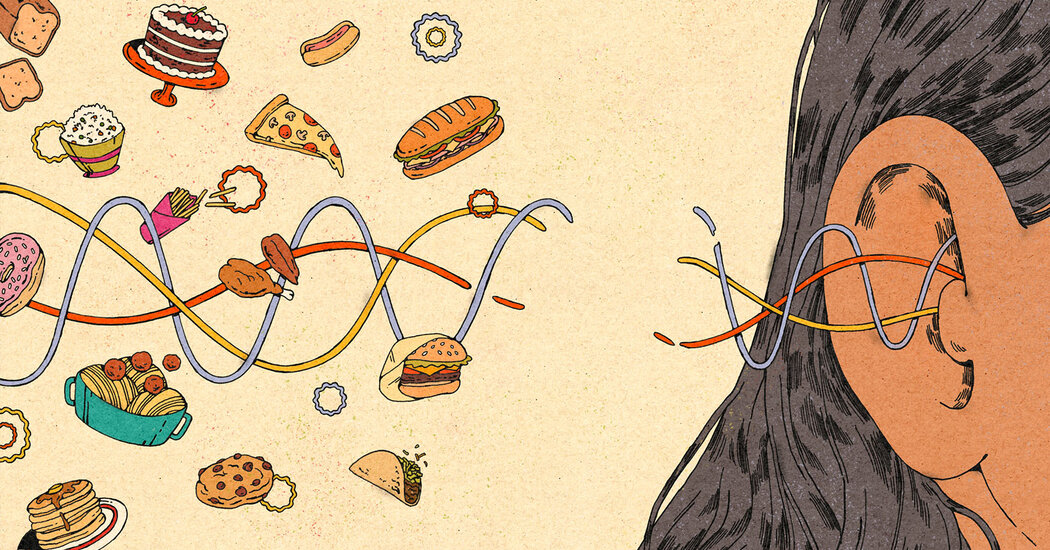
Before the new obesity drugs came on the market, almost no one used the term food noise.
Researchers studying and developing drugs like Ozempic, Wegovy, Mounjaro and Zepbound analyzed doses, side effects, weight loss and improvements in conditions such as diabetes, heart disease and sleep apnea. Incessant thoughts about food and internal dialogues about what to eat, what not to eat, when to eat, how to resist eating — these were not on the research agenda.
But if the obesity-drug researchers weren’t talking about food noise, people taking GLP-1s had a lot to say about it. For as long as they could remember, users of the drugs said, they had been plagued by food noise. But they thought it was just a normal part of life. They thought everyone had it.
Until they took one of the new drugs.
Suddenly, food noise was silenced.
And that effect is leading to new questions about the drugs. If researchers can clarify the source of this inner buzz and what makes it go away, that could lead to a clearer understanding of what causes obesity in the first place.
‘You Don’t Want the Salad’
People who struggle with their weight describe relentless thoughts of food.
Lena Smith Parker, 53, of Hamden, Conn., spent decades dieting and regaining weight. All the while, she said, she was plagued by internal voices urging her to eat and shaming her for eating.
One, she said, is like a relentless auctioneer. “You know there’s cake in the kitchen. Hey, there’s cake in the kitchen. Don’t you want the cake in the kitchen?”
Another, she said, is like “a really bad used-car salesman.”
“You don’t want the salad. You don’t want the carrots,” the voice says. “You want the cake.”
Then, there’s the bully. “You are so fat. I can’t stand you.”
Finally, there’s the advance planner. “Can I get to the store next Tuesday to get the special cupcakes so I can eat them in the car before I get home?” it asks.
But why would people like Ms. Parker have such thoughts?
Researchers suspect the answer lies in an elusive concept called the set point.
The idea arose from studies in the 1940s. Researchers discovered that if they got rodents to gain or lose weight, the animals would quickly return to their starting weight when the study ended. The same thing seemed to happen with people.
That led to the concept that became known as the set point. It says that each person has a weight their body naturally gravitates toward — their set point. It can change over a person’s lifetime. For some, the set point may malfunction, reaching such a high level that a person’s health is affected by excess weight.
“Obesity results from the initial elevation of the set point to an abnormal level,” said Dr. Lee Kaplan, director of the Obesity and Metabolism Institute in Boston. Dr. Kaplan consults for a number of pharmaceutical companies.
Any time a person tries to get their weight much below their set point, researchers have observed, food noise will kick in. That may be part of a physiological process. When weight is lost, the body’s metabolism slows so a person needs less food than would be expected to maintain their weight. At the same time, the researchers have noticed, food noise kicks in, compelling a person to eat more calories than the body can handle without storing some as fat. That’s why diets almost always fail in the long run.
And food noise is not restricted to people with obesity, researchers stress. Anyone can have it if their weight falls below the body’s preferred set point.
Dr. Jules Hirsch at Rockefeller University and his colleagues Dr. Rudolph Leibel and Dr. Michael Rosenbaum at Columbia saw that effect decades ago when they studied the metabolic and behavioral changes that occurred when people lost weight.
Their subjects lived at the Rockefeller hospital and stayed on a low-calorie diet until they lost at least 10 percent of their weight. Some studies involved people with obesity but others involved people of normal weight.
But although the participants’ weights were lower when they left the hospital, they had the physiological signs of starving people. Their metabolisms were low, and they dreamed and fantasized about food. And they binged when they were no longer subjected to an enforced diet. It was a condition so extreme it became called “semi-starvation neurosis.”
The situation was, Dr. Leibel said, “a perfect storm for weight regain.”
‘My Brain Is Empty’
Ms. Smith Parker thought that food noise was normal, that everyone had it.
Then, she went to a weight-loss clinic at Yale run by Dr. Ania Jastreboff who enrolled her in a clinical trial of tirzepatide, one of the new obesity drugs that was marketed as Zepbound.
Suddenly, the food noise was gone.
When the study ended, however, she no longer had access to the drug because it was not yet approved by the Food and Drug Administration.
“The food noise came roaring back with a vengeance,” Ms. Smith Parker said. “I gained back 40 pounds pretty much by eating spaghetti nonstop, and chocolate cupcakes.”
So Dr. Jastreboff prescribed Wegovy — which was approved — for Ms. Smith Parker, and those voices in her head telling her to eat were gone.
“I was like, Wait. My brain is empty,” Ms. Smith Parker said.
Dr. Jastreboff, who conducts clinical trials for makers of obesity drugs and is on multiple scientific advisory boards for pharmaceutical companies, thinks there’s an explanation for what happened to Ms. Smith Parker and her other patients. The new obesity drugs seem to be resetting the set point at a lower level. As a result, people still can get hungry, but she says they no longer have a running internal dialogue about food that drives them to continue eating.
But Dr. Jastreboff and other researchers say the drugs only change the set point while people are taking them. The original set point seems to return if people stop taking the drugs. So does food noise, followed by increased eating and regained weight.
Dr. Leibel, who consults for makers of obesity drugs, likens the effects of the drugs on food noise to the effects of aspirin on a fever. Aspirin, he noted, “will suppress a fever without curing the underlying cause.”
But if the new obesity drugs reset the set point, how do they do it?
“What’s the thing that’s set and what’s reading that as set?” asked Dr. Daniel Drucker, a University of Toronto researcher who helped develop the new obesity drugs decades ago.
And how exactly are the GLP-1s and similar drugs affecting set points?
“That’s the million or billion dollar question,” he added.
Understanding the mechanism might help explain why the disease of obesity is characterized by a set point that is so high and perhaps suggest new ways of lowering it.
For people like Oprah Winfrey, life without food noise has been remarkable. In a book she published this year and co-wrote with Dr. Jastreboff, she said until hers was silenced by one of the obesity drugs she thought everyone had food noise, that it was normal.
“The single biggest surprise of taking the medications was waking up and not thinking about the very first thing I wanted to eat … or the healthier thing I should have wanted … or the bargain I could make with myself so I could eat first thing,” she wrote.
Dr. Drucker said there was a lesson here about food noise for those who do not experience it.
“People who are not struggling with their weight can be very judgmental,” he said. “They never had their brains driving their behavior.”
https://www.nytimes.com/2026/04/27/health/food-noise-obesity-drugs-glp-1.html


