






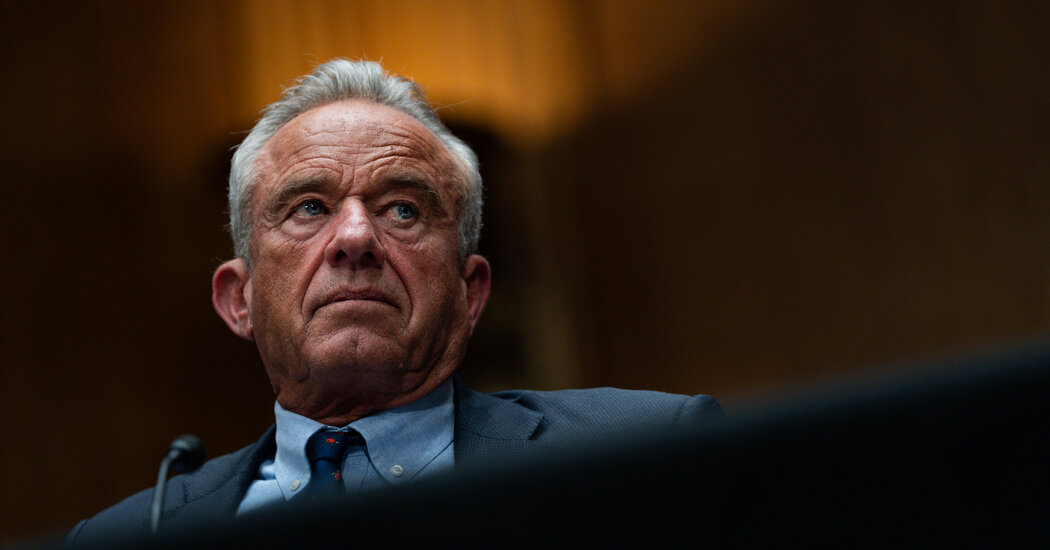
He was combative, defensive and occasionally contrite. He vehemently denied, then halfheartedly apologized for suggesting in 2024 that Black children would benefit from being “re-parented.” He shouted at Democratic senators, accusing them of “grandstanding” and “selective indignation.” He insisted he had delivered “historic wins” for the health of the American people.
In the end, after four days of testimony during seven separate congressional hearings on President Trump’s budget, Health Secretary Robert F. Kennedy Jr. walked a fine line, trying to please both his base and the White House at the same time.
If there was any takeaway from Mr. Kennedy’s Capitol Hill marathon, it was that vaccination — the topic that drove Mr. Kennedy for more than a decade and catapulted him to national prominence during the coronavirus pandemic — remains the defining issue of his tenure, even as the White House, for political reasons, tries to get him to deflect attention from it.
The measles epidemic, which began last year in Texas and has killed three Americans — the first deaths from the disease in a decade — dominated the discussion. Mr. Kennedy repeatedly defended his handling of it, but appeared to back further and further away from his past criticism of the measles vaccine.
On Wednesday, under persistent questioning, he made his strongest statement yet, saying that his department “has advised every child” to get the shot. (Notably, he did not attribute that advice to himself.)
“On the whole vaccine thing, he’s trying to backpedal and hide and duck,” said Dr. Ezekiel J. Emanuel, a vice provost and public health professor at the University of Pennsylvania, who advised Democratic presidents, including Joseph R. Biden Jr. and Barack Obama, and met with Mr. Trump.
“The White House is clearly upset because his stance is not popular,” Dr. Emanuel said. “but he has not fundamentally moved his stance on vaccines.”
Indeed, Mr. Kennedy also insisted that hygiene and sanitation — and not vaccination — were responsible for the drop in deaths from infectious diseases during the 20th century, citing a 2000 study as proof. Senator Bill Cassidy of Louisiana, the Republican chairman of the Health Committee who is also a physician and has tangled repeatedly with Mr. Kennedy on vaccines, pushed back, telling the secretary he had cited the study out of context.
Mr. Cassidy, who voted to confirm Mr. Kennedy only reluctantly — and only after the secretary made a series of promises to secure the senator’s vote — seemed irritated by Mr. Kennedy’s emphasis on chronic disease over infectious disease. Mr. Kennedy noted that three Americans died of measles over the past decade, while roughly two million die from chronic disease each year.
But after the hearing, Mr. Cassidy lamented the measles deaths, saying there should be a focus on infectious disease. “We are a first-world country, and speaking as a physician that knows this can be prevented, it grieves me,” he said. “It grieves me.”
The senator himself is walking a fine line. He is facing a tough primary election next month; Mr. Trump has endorsed his challenger, as has the Make America Healthy Again PAC, which is aligned with Mr. Kennedy. Asked by a reporter whether the secretary had lived up to the promises he made, Mr. Cassidy declined to answer. “We’ll talk later,” he said.
During the hearings, which began in the House last Thursday, Mr. Kennedy revealed that after firing or laying off close to 20,000 employees at the Department of Health and Human Services last year, he was now hiring 12,000 new workers to replace them. He told lawmakers on Tuesday that he needed to “make sure that we have people to do every job.”
The about-face was infuriating, said Elizabeth Jacobs, a professor emeritus of epidemiology from the University of Arizona and a founding member of Defend Public Health, a grass-roots group formed to push back on recent challenges to public health.
“We have lost so many exceptional scientists and other employees of H.H.S., the just decades of institutional knowledge that we have lost is absolutely devastating,” she said, adding: “The estimates are it’s going to take a decade or a generation to rebuild the massive medical science juggernaut that we once had.”
Imminent cuts to Medicaid were a potent flashpoint during Mr. Kennedy’s testimony. “There are no cuts to Medicaid!” he shouted on Wednesday to the Senate Finance Committee as Democrats insisted there were.
The sweeping domestic policy bill that Mr. Trump signed into law last year is estimated to cut Medicaid by amounts ranging from $665 billion to nearly $1 trillion over the next decade — but starting after the midterm elections. But those are cuts to the projected growth of the program; Medicaid spending will still increase, but by far less than it would have without the legislation.
The cuts are estimated to result in 7.5 million people losing Medicaid coverage by 2034, according to the Center on Budget and Policy Priorities, a left-leaning think tank.
TrumpRx, the website that Mr. Trump touts as offering Americans the lowest drug prices in the world, was also at issue. The site connects consumers with pharmaceutical companies that, after negotiations with the Trump administration, have agreed to sell roughly 80 brand-name medications at discount prices comparable to those in Europe.
But those prices are vastly higher than the price of comparable generic drugs. Senator Elizabeth Warren, Democrat of Massachusetts, called them “scam discounts,” noting that a drug that sold for several hundred dollars on TrumpRx could be bought for $16 in generic form.
The hearings put a spotlight on a comment that Mr. Kennedy made during an interview two years ago with the motivational speaker 19Keys, who focuses on empowering Black men. Mr. Kennedy, then running for president, proposed weaning American children off psychiatric medications, including for A.D.H.D. and depression, by sending them to “wellness farms,” where they would be free of cellphones and other distractions.
“Every Black kid is now just standard put on Adderall, on S.S.R.I.s, benzos, which are known to induce violence, and those kids are going to have a chance to go somewhere and get re-parented, to live in a community where there’ll be no cellphones, no screens” Mr. Kennedy said on the show.
Black Democrats, including Representative Terri A. Sewell of Alabama and Senator Angela Alsobrooks of Maryland, upbraided Mr. Kennedy for the remarks. He insisted he had not made them, then said he did not remember making them, then edged toward an apology.
“If I said it, I apologize, but I have to see the transcript,” he told Ms. Alsobrooks, who brought a huge placard bearing the quote to Wednesday’s health committee hearing.
The hearings came at a time of great flux for the secretary’s department. Last week, as Mr. Kennedy was in the middle of testifying in the House, Mr. Trump announced a four-person team to lead the Centers for Disease Control and Prevention. He nominated Dr. Erica Schwartz, whose supportive views on vaccines diverge sharply from Mr. Kennedy’s, to lead the agency, prompting questions about how much latitude the secretary would give her.
Mr. Kennedy told lawmakers he supported the nomination, but he refused to commit to accepting all of Dr. Schwartz’s decisions on vaccines. “I’m not going to make that kind of commitment,” he said on Tuesday.
When Wednesday’s hearing was over, Mr. Cassidy offered an oblique assessment of the secretary’s performance. “Things were illuminating,” he said.
https://www.nytimes.com/2026/04/22/us/politics/rfk-vaccines-measles-testimony.html


