








Four years ago, at the close of the biggest concert of his career in Paris, the French pianist Sofiane Pamart did something unexpected to the instrument that brought him to fame: He took a flamethrower and set it on fire.
Two years later, his instrument was aflame again as he played John Lennon’s “Imagine” while floating down the Seine river as part of the Paris Olympics opening ceremony.
The rock star move symbolizes what Pamart, 36, has sought to achieve since kicking off his solo career in 2019: making his instrumental music as popular, and spectacular, as possible.
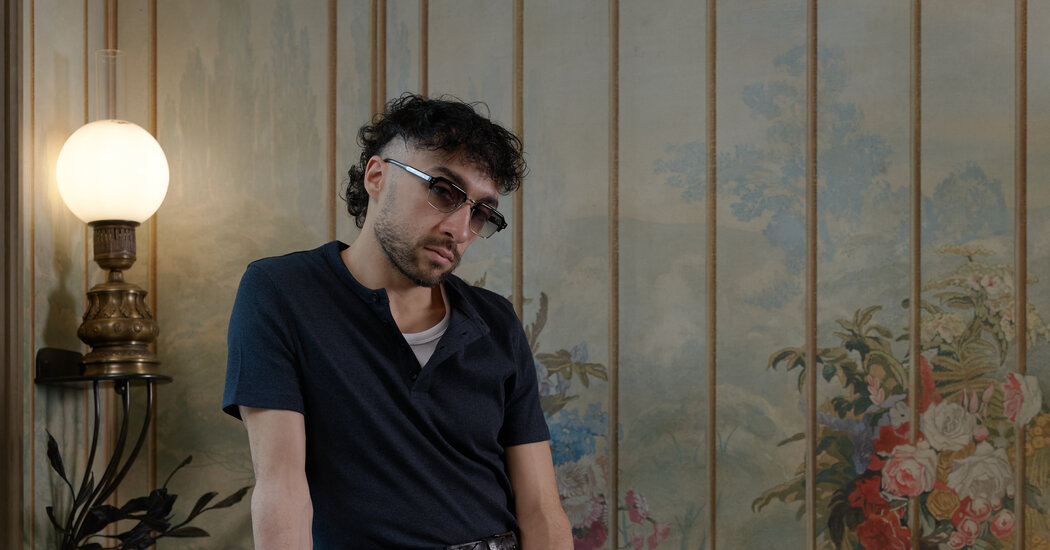
With his chunky silver rings and sunglasses, wide kimonos and high heels, the self-dubbed “Piano King” has made a name for himself in France’s rap and classical crossover scenes as a performer who knows how to put on a show.
The piano “has centuries of history behind it and represents a culture that is very, very strong,” Pamart said this week while visiting Paris to promote his fourth album. “Burning it is a way of resisting this.”
With “Movie,” the new solo album he composed from West Hollywood, Calif., where he now lives, Pamart is taking his quest to shake classical music’s rigid mores to new heights.
It came out in April and is envisioned like a film based on scenes from his life. The tracks feature an orchestra, choir and a string of international guest stars, including Sia, Nelly Furtado and J Balvin, adding depth to the melancholic melodies that are Pamart’s signature.
“Film music is something that has always appealed to me as a composer,” he said. “But I wanted my first time to be for a film where I’d have complete freedom.”
It was the soundtracks to movies and cartoons that first brought Pamart to the piano in Lille, northern France, where he grew up. When he was just 3, his mother, a literature teacher, noticed that he was reproducing the tunes of “The Godfather” and “E.T.” on a 12-key toy piano. When he turned 6, she enrolled him in music school and pushed him to become a musician.
Classical music was new to the household. Pamart’s father, who runs French language schools for international students, preferred chansons by artists like Georges Brassens and Léo Ferré. His mother, the daughter of Moroccan immigrants who moved to northern France to work in coal mines, felt both fascinated and removed from the classical music scene, Pamart said.
For her, Pamart added, classical music was “noble, classy and powerful, majestic.”
“I spent a lot of time chasing my mother’s dream,” he said.
Pamart said he and his two younger siblings, who followed him to music school, formed a sort of pact with their parents. “We realized very early on that a significant sacrifice had been made for us, and that the way to honor that was to achieve great success in whatever field we chose,” he said.
While his mother and teachers taught him theory and discipline, a rebellious uncle introduced him to a whole different world: that of the streets of Lille and its underground culture.
“That’s why I later blended rap and classical music,” Pamart said, “because, in fact, that was my story.”
When he graduated from music school, he already knew he wanted to make a career playing piano, but he didn’t want to become a classical pianist. So he started his own band, Rapsodie, with musicians and rappers from his hometown and took on any piano gig he could find to make ends meet.
Times were tough, and Pamart said he realized that his piano training had taught him a craft, but nothing about the music business. He signed up for a master’s program in economics and music management in Paris, telling himself, “Even if I don’t know the people currently in the music industry, I’ll surely meet the ones who will be shaping it in the future.”
Around that time, he met Guillaume Héritier, a like-minded entrepreneur who would eventually become his manager and business partner, and he began collaborating with rappers on acoustic versions of their tracks.
Pamart was also composing his own solo pieces, in which he sought to capture emotions, with simplicity as the ultimate goal. To do that, he said, he had to do away with much of the technique he had spent years learning, though he still found inspiration in classical composers, especially Chopin.
Scylla, a Belgian rapper who released an album with Pamart in 2018, described Pamart as a musician who “has that ability, that strength, to understand emotions without even needing to speak.”
Scylla said the stripped-back album they made was the result of a yearslong partnership — and it was bold. “People in my team all told me, ‘Wait, just a piano? Just a piano and a voice on an album? No, you really have to add some other stuff.’”
The record, called “Pleine Lune” (“Full Moon”), was the first time Pamart had his name on the cover. “That implied a pianist had just as much to say as a rapper,” Pamart said.
With the help of Héritier, his manager, Pamart brought out his first solo album, “Planet” — 12 introspective pieces, each with the name of a different city — which, according to Héritier, has been near the top of the classical charts ever since.
He toured the album to sold-out halls in Asia and Latin America, where he composed his second and third solo albums while expanding his range of collaborations, releasing music with the electronic DJ group Trinix, the singer Kimberose, and Charles Leclerc, the racing driver from Monaco who also plays piano.
Pamart has also worked with most top artists in France’s rap scene, including SCH, Oxmo Puccino and Médine, who called Pamart “the rappers’ pianist.”
Speaking in French in the interview, Pamart said he wanted his music to be “populaire,” which means “popular” in the sense of being well-liked, and also “belonging to the people” as opposed to the elite.
“I want my piano to be unifying and to create bonds between all generations, all social classes,” Pamart said.
“Populaire” can also have a down-market, pejorative connotation, and some critics have likened Pamart’s tracks to elevator music. But Pamart said he didn’t care. He never made compromises to be accessible, he said, adding, “I feel like I’m telling the story of the music of my time.”
Next April, he will perform for 80,000 people at the Stade de France, the country’s largest stadium. After that, he said, he hopes to conquer the rest of the world. “I need to embody this popular movement,” he said, “on the international stage.”
https://www.nytimes.com/2026/05/01/arts/music/sofiane-pamart.html


