








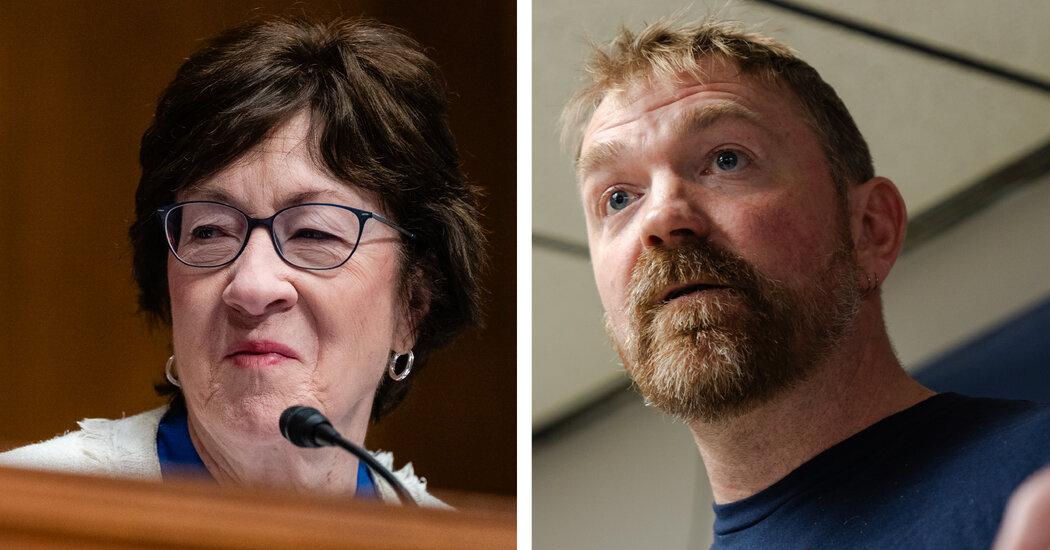
The abrupt exit of Gov. Janet Mills from the Senate race in Maine has propelled one of the nation’s marquee contests into the general-election phase, effectively crowning Graham Platner, a progressive political newcomer, as the Democratic nominee.
Ms. Mills’s decision to withdraw from the race on Thursday was a tacit recognition that the two-term governor, 78, who has spent decades in elected office, lacked the funding and support to defeat Mr. Platner, 41, an oysterman from Downeast Maine. Next will come a tough, expensive contest to defeat Senator Susan Collins, 73, a Republican who has overcome Democrats’ attempts to defeat her for three decades.
The political implications of Ms. Mills’s departure are already reverberating through Democratic primary contests across the country. Mr. Platner’s ascension quickly became a powerful signal that the Democratic base has grown impatient with the party’s establishment and is eager to embrace a new generation of leaders.
Here are five takeaways from the shake-up in Maine’s Senate race:
Democrats are in a fighting mood.
Ms. Mills’s struggles to gain traction made at least one thing clear. Democratic primary voters are in no mood to take suggestions — much less orders — from party leadership in Washington.
Ms. Mills had the support of Senator Chuck Schumer, the Democratic minority leader. But in the eyes of some voters, that was a drawback, not an asset.
Instead, they wanted someone younger, a political outsider who was willing to take the fight to both President Trump and a Democratic establishment they saw as timid, sclerotic and simply too old.
One thing to watch now: How much time do Democrats spend fighting with one another over Mr. Platner, versus swallowing the reservations some of them quietly have about him and turning their attention to Ms. Collins?
Plenty of Democrats, including Mr. Schumer, quickly expressed support on Thursday for Mr. Platner’s candidacy. Ms. Mills, notably, did not. Her spokesman said in a statement that she would not support Ms. Collins — and that she would “continue to hear and watch how Graham Platner works to earn the support of Maine voters.”
Trump vs. the tattoo: The race will test political baggage.
There is no question that Ms. Collins has a challenging race on her hands. She is running for re-election in a state that supported Kamala Harris over Mr. Trump by about seven percentage points in 2024. And since Mr. Trump’s victory that fall, Democratic voters have grown more energized to defeat Republicans at every level of government.
But Ms. Collins is an incumbent who has repeatedly won tough races, and Republicans believe they have an unusually flawed opponent in Mr. Platner.
He has a long record of making incendiary remarks online, many of which he has apologized for, and also had a chest tattoo that resembled a Nazi symbol before he had it covered up last fall (he has said he hadn’t realized its meaning).
Eager to jump on those vulnerabilities, Republicans have already started the attack ads against Mr. Platner.
Will those efforts break through — or end up mattering — in a political environment dominated, as always, by Mr. Trump?
Mr. Platner is betting they will not.
“Republicans are preparing to run a scorched-earth campaign, and we’re ready for that,” he told reporters on a call on Thursday afternoon. “Mainers have turned the page on the empty politics of personal attacks.”
Platner is betting that experience is a liability.
Much of the general-election fight may turn on a simple question: Does experience matter?
Republicans are already casting Ms. Collins, who is running for her sixth term in the Senate, as an experienced leader with a lengthy track record of getting things done for the people of Maine.
That argument has worked for her in the past. In 2020, she defeated Sara Gideon, a Democrat, by nearly nine points even as Mr. Trump lost the state to Joseph R. Biden Jr. by nine points.
Mr. Platner, whose experience in public office consists of serving as harbormaster and leading the planning board of his small town, is hoping to turn that strength of Ms. Collins’s into a liability. He is arguing that Maine needs a new, fiery populist champion in Washington who is willing to battle corporate interests, wealthy donors and the Trump administration.
Whether voters agree — or see Ms. Collins as better for bringing home the bacon — could well determine who next represents their state in the Senate.
Collins may be tough to beat.
Ms. Collins is widely seen as one of this year’s most vulnerable Republican Senate incumbents, and her votes for some of Mr. Trump’s cabinet and Supreme Court nominees could hurt her with Maine voters. Now in her 70s, she is running for another six-year term at a time when many voters appear fed up with America’s gerontocracy.
But all of that hardly means she’s a weak candidate.
Beyond her record of bringing home benefits to Maine, Ms. Collins — the chair of the powerful Appropriations Committee — has spent decades cultivating an image as a fiercely independent politician. Democrats will try to tie her to Mr. Trump and the unfavorable national environment for Republicans, but it won’t be simple.
She’ll also have plenty of money to make her case. While Mr. Platner outraised her during the first part of the year, Ms. Collins has maintained a cash advantage with more than $10 million in the bank.
She’s also likely to benefit from a flood of outside money. In January, the main super PAC for Senate Republicans announced its largest-ever investment in Maine — $42 million — to support Ms. Collins. Another super PAC backing her bid began running ads attacking Mr. Platner this week, days before Ms. Mills left the race.
The messiest Democratic primary is now in Michigan.
The Democratic primary race in Maine may have been short, but it was brutal.
In the final stretch, Ms. Mills released scathing ads highlighting Mr. Platner’s past remarks about rape (for which he has apologized), and tried — and failed — to make questions about his character central to the campaign.
Now Michigan has the dubious distinction of being home to the roughest Democratic Senate primary still on the calendar.
The race there, set for Aug. 4, is in many ways a microcosm of all of the tensions roiling the Democratic Party, over issues of ideology, foreign policy and ties to the party establishment.
The contest has already become heated between Representative Haley Stevens, the favorite of party leaders in Washington; Dr. Abdul El-Sayed, a progressive former public health official; and State Senator Mallory McMorrow, who is trying to occupy a middle ground in the contest.
Soon after Ms. Mills exited the race in Maine, the El-Sayed campaign raced out a fund-raising appeal linking its candidate to Mr. Platner.
“Abdul is that candidate here in Michigan,” the email read. “He’s not backed by the establishment.”
Ms. McMorrow, for her part, shared a video on social media on Thursday afternoon that highlighted her call for new Democratic leadership.
“The party establishment in D.C. doesn’t get to pick our next senator,” she wrote. “We do.”
https://www.nytimes.com/2026/05/01/us/politics/maine-senate-race-platner-collins-mills-takeaways.html


