







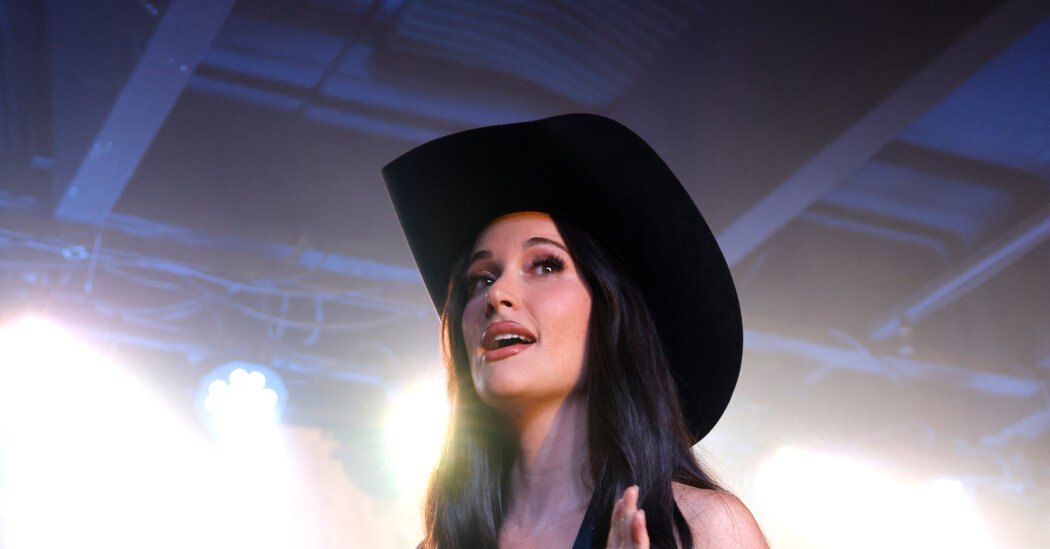
But unlike her 2021 release “Star Crossed,” which chronicled the dissolution of Musgraves’s marriage to the singer-songwriter Ruston Kelly, “Middle of Nowhere” can’t be classified solely as a breakup album. It is instead a meditation on the differences between the ache of loneliness and the contentment of solitude, a journey of self-discovery that digs for something more realistic — and, on the twinkling “Rhinestoned,” more weed-positive — than the new-age truisms of “Deeper Well.”
“No service on the phone, and I’m alone, but it honestly feels good,” Musgraves sings on the title track. The mid-tempo soft-rocker “Loneliest Girl” finds comfort in stasis: “I’m happy to be the loneliest girl in the world,” she sings. Despite her not being (as she recently put it) a “finger on the ear, finger waving in the air, Mariah Carey-style” singer, Musgraves’s voice is nonetheless a beautiful, remarkably multifaceted instrument, able to convey a range of emotions and often glowing, as if from within, with a kind of prismatic incandescence.
Though the album contemplates and often celebrates solitude, it features more guests than any of Musgraves’s previous releases, including the bluegrass guitarist Billy Strings and the folk troubadour Gregory Alan Isakov. About half of the songs were written and produced with Ian Fitchuk and Daniel Tashian, the team who worked on her previous three albums, and on the rest she reunites with Luke Laird and Shane McAnally, the Nashville musicians who helped Musgraves inject her fiery personality into more traditional country structures on her first two excellent albums, “Same Trailer Different Park” and “Pageant Material.”
The album’s most memorable collaborator, though, is another outspoken country queen from middle-of-nowhere, Texas: Miranda Lambert, who joins Musgraves for the hilarious and gorgeously lush duet “Horses and Divorces.” Confirming a longtime rumor, Musgraves recently admitted that she and Lambert previously had beef (“grass-fed, grade A,” she told Variety), and said that the idea for the song came to her when she saw an Instagram photo of Lambert and one of her equine companions and thought to herself, “Well, I guess we have two things in common: horses and divorces.”
That line was clearly destined to inspire a song, and Musgraves invited Lambert to write and sing it with her. The two women trade knowing barbs (“I could ride in on my high horse, but you’d still be higher,” Lambert offers, while Musgraves replies, “And a few years ago you’d have set me on fire”), ultimately realizing, from the bottom of a shared bottle, “Maybe we’re more alike than we think.” The actual, admitted antagonism, and the fact that we are hearing two people work it out on the remix, so to speak, gives the song a special charge.
https://www.nytimes.com/2026/05/01/arts/music/kacey-musgraves-middle-of-nowhere-review.html


