


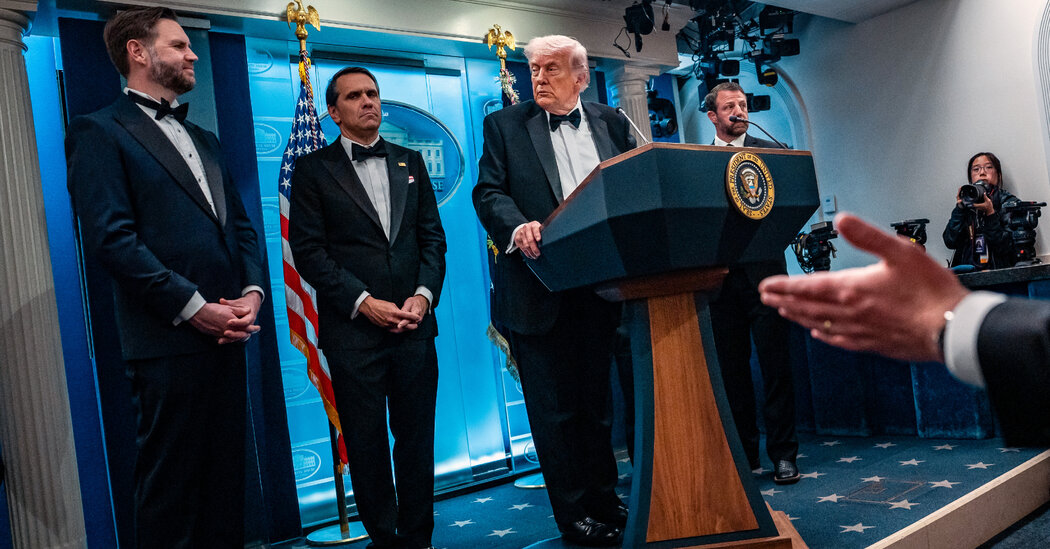
A gunman’s breach of a Washington hotel where President Trump had gathered with hundreds of journalists over the weekend has reignited the debate over which political faction is more violent and which faces more threats.
On Saturday night, a man who officials said was carrying a shotgun, a pistol and knives raced past a security checkpoint before he was brought down and disarmed a floor above the ballroom where the White House correspondents’ dinner was held. The suspect was charged on Monday with trying to assassinate Mr. Trump.
Since then, Republican officials and commentators have argued, incorrectly, that political violence is largely a left-wing problem. Liberals have countered by citing the number of threats made against former President Barack Obama.
Here is how best to understand those claims.
Most political violence in recent decades has come from the far right, but far-left violence is rising.
A body of research shows that over four decades, attacks by people and groups espousing far-right ideology in the United States have been more violent than those by counterparts with far-left beliefs. But political violence by the far left has been rising in recent years.
Political violence ebbs and flows based on the presence of a charismatic leader, seismic shifts like a war or election, or cultural and societal changes. In the 1970s, the far left was more active and violent, driven by anti-war, anti-capitalist and Black nationalist perpetrators. In the decades after, the far right became more active and violent, driven by anti-government perpetrators, white supremacists, religious extremists and anti-abortion activists. Left-wing ecoterrorism surged in the 2000s followed by right-wing violence in the 2010s.
Overall, from 1948 to 2018, the probability of a violent right-wing attack was almost twice as high as that of a left-wing attack in the United States, according to a comprehensive 2022 study by extremism experts.
There are a few possible explanations for this gap. Left-wing extremists often seek to inflict property damage rather than bodily harm, focus on specific people or choose tactics like arson that do not lead to mass casualties. James Piazza, a political science professor at Pennsylvania State University who is a co-author of the study, also noted that their targets tend to have better security.
“Far-left terrorists historically tend to select targets that symbolize the status quo,” he said. “They tend to attack government and law enforcement targets, and these targets tend to be better defended, yielding (thankfully) lower casualty rates. In contrast, far-right terrorists tend to target individuals who are members of racial, religious and other minorities, and this yields higher casualty rates.”
An analysis in September of terrorist attacks from the 1990s through July 2025 by the Center for Strategic and International Studies, a Washington think tank, found a similar trend: Right-wing terrorist attacks outpaced left-wing attacks from the 1990s to 2024. But, the analysis noted, 2025 was the first time in 30 years in which left-wing attacks outnumbered far-right attacks. That finding remained true through the end of 2025, the authors of the analysis said in an interview.
But they cautioned that it can be difficult to categorize the motivations of attackers as right wing or left wing. Many perpetrators have mental health issues, with indecipherable motives or conflicting beliefs. Attackers may also be driven by personal animus or a desire to seek fame, not necessarily a political goal.
For example, the assassination attempt on Mr. Trump in July 2024 at a rally in Butler, Pa., defied categorization, said Daniel Byman, one of the authors and a professor at Georgetown University. “We don’t code it as terrorism because the individual didn’t seem to have a political motive.”
Similarly, an attack on a Jewish community center may be motivated by white supremacy, suggesting far-right ideology, or opposition to Israel’s war in Gaza, suggesting far-left ideology. An attack on an abortion clinic may be motivated by anti-abortion beliefs or a personal dispute with a worker.
“Perpetrators of terrorism frequently exhibit a mishmash of political ideologies that blend together far-left and far-right tropes,” Mr. Piazza said. “They often have fairly incoherent political ideologies.”
Nonetheless, the data show a rise in left-wing attacks, though experts also said it was impossible to predict whether the trend would continue, or if 2025 was merely a blip. Since Mr. Trump began his second term, right-wing extremists like the Proud Boys or Oath Keepers may feel as though their political aims around, say, immigration are being addressed and thus see less need to resort to violence. In contrast, Mr. Trump’s opponents may feel more urgency to act.
“A classic question for terrorism, across the world, is, ‘Do people think the system is working?’” Mr. Byman said, adding that the answer would change depending on what events unfolded.
All presidents faced threats, but Trump has faced more direct assassination attempts than recent predecessors.
While Mr. Obama faced a number of high-profile security breaches and threats, Mr. Trump is the only president since President Ronald Reagan to face a direct assassination attempt.
It is difficult to quantify the threat level faced by different presidents, as the Secret Service does not publicly disclose this information. A 2009 book by Ronald Kessler, a former reporter for The Washington Post, reported that Mr. Obama faced a 400 percent increase in the number of threats compared with his predecessor, George W. Bush. But the director of the Secret Service disputed this figure in congressional testimony in late 2009, adding that the level of threat was similar to Mr. Obama’s predecessors. In June 2017, the director of the Secret Service said in a news briefing that the agency tracked six to eight threats against Mr. Trump daily in the first six months of his first term, about the same as Mr. Obama and Mr. Bush.
A vast majority of threats made against presidents do not draw public attention. An Associated Press examination of court records found that the federal government prosecuted 343 cases of threats under President Bill Clinton, 383 cases under Mr. Bush, 213 under Mr. Obama and 68 cases in Mr. Trump’s first term.
Mr. Obama faced a number of high-profile security incidents, including a man shooting at the White House in 2011 and a man carrying a knife who jumped over the White House fence. (Mr. Obama was not home in either case.) Mr. Obama was also the target of a number of assassination plots, but the would-be perpetrators did not make direct contact.
In contrast, a gunman fired shots at Mr. Trump during the campaign rally in Butler, grazing Mr. Trump’s ear. Later that year, another man stood with a rifle on the perimeter of a golf course where Mr. Trump was golfing; he was found guilty of trying to assassinate Mr. Trump.
“Clearly, Donald Trump has been one of the most threatened presidents overall, alongside Abraham Lincoln and Barack Obama,” said Ronald Feinman, a retired professor at Florida Atlantic University and the author of “Assassinations, Threats and the American Presidency.”
Mr. Feinman added that the threat level was metastasizing with more sophisticated methods to threaten the top government leaders, an assessment shared by Secret Service officials.
“The heightened threat environment and expanding protection requirements require a paradigm shift,” the acting director of the agency said after the Butler shooting.
https://www.nytimes.com/2026/05/01/us/trump-shooting-political-violence-us.html
