


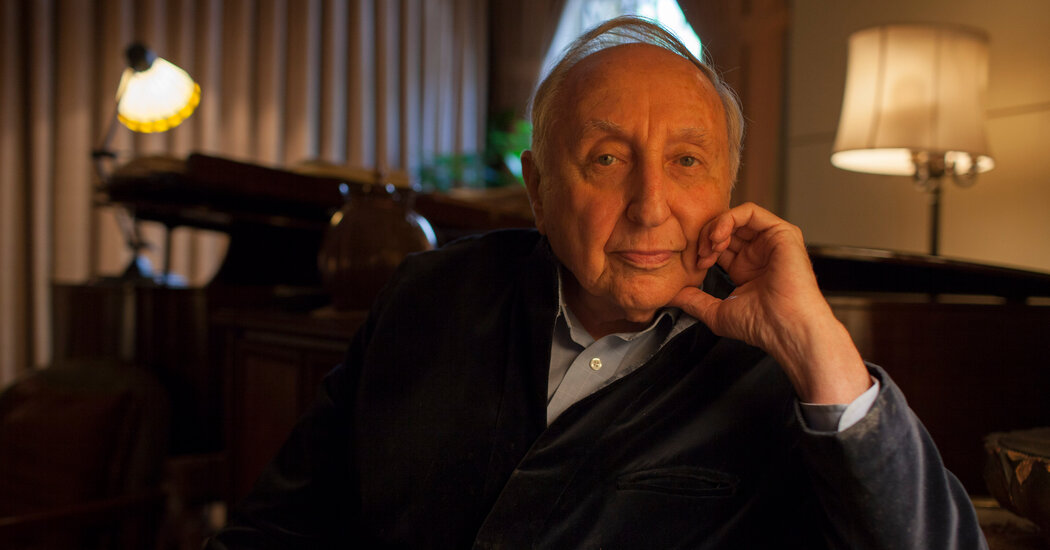
Seymour Bernstein, an acclaimed pianist who struggled to overcome a stage fright so severe that he cut short his performing career and shifting into teaching and composing, died on Thursday in Damariscotta, Maine. He was 99.
His death, at an assisted-living facility, was confirmed by Bill Finizio, a friend.
In the 1950s, when he was a rising artist, Mr. Bernstein was described in The New York Times as “potentially a big talent.” The headline on the Times review of a 1969 recital he gave at Lincoln Center was “Seymour Bernstein Triumphs at Piano.”
“If his recital yesterday afternoon at Alice Tully Hall was not merely one of those freakishly great days that good pianists sometimes enjoy,” the critic Donal Henahan wrote in that review, “Seymour Bernstein is ready to break out into a wider circle of attention.”
But Mr. Bernstein was never comfortable in the limelight.
“I hated the commercial aspect,” he said in “Seymour: An Introduction,” a 2014 documentary directed by the actor Ethan Hawke. “I hated the nerves.”
Even rave reviews, he added, “didn’t help allay the horror I felt before and during a concert.”
Although he managed to perform well despite his stage fright, Mr. Bernstein eventually decided to quit. He gave his final public concert in 1977, at the age of 50.
The Times critic Joseph Horowitz — unaware that Mr. Bernstein had set his mind on retiring — described that concert, at the 92nd Street Y, as “a marvelous solo recital,” noting “the subtlety of his art” and commending him for “his bristling intelligence, liquid phrasing and extraordinary control of the quietest dynamic levels.”
Soft-spoken, with a gentle demeanor, Mr. Bernstein found his true calling as a teacher. One of his students, the New York Times architecture critic Michael Kimmelman, once described him as “the most intense, unequivocal teacher imaginable.”
From his home on the coast of Maine, Mr. Bernstein would occasionally share videos of himself on YouTube performing Bach, reading poems he had written and feeding by hand the “darling critters who are my friends,” namely squirrels and chipmunks, who inspired him to write pieces with titles such as “Belinda the Chipmunk.”
Mr. Bernstein’s catalog of compositions also included the choral work “Song of Nature” (1996), based on an essay by Ralph Waldo Emerson, and two books for solo piano titled “Birds.” Peter G. Davis, reviewing Mr. Bernstein’s 1974 performance of his own work, called him “a vivid pictorialist and a master of the pithy vignette.”
Though he escaped the public eye well into his 80s, he had to face his anxieties about publicity once again when Mr. Hawke, who had confided in Mr. Bernstein about his own stage fright, approached him about making a documentary. Mr. Bernstein told The Guardian that he was scared out of his wits and blacked out when the cameras first started rolling.
But he appears quietly confident onscreen, and is an enthralling storyteller. In one tale, he recalls a peculiar patron of his early career: a wealthy spiritualist named Mildred Boos who sponsored his debuts in Europe, showered him with gifts like silver tea sets and velvet smoking jackets, and even gave him the keys to one of her homes, a Tudor mansion in Scarsdale, N.Y., where he found pictures of himself on every table. He lived there for a year before he started to feel trapped.
In the 1950s, he moved into a studio apartment on the Upper West Side of Manhattan. He began to divide his time between New York and a house in South Bristol, Maine, before moving full time to Maine a few years ago.
In New York, he slept on a pullout sofa bed near his grand piano, surrounded by artifacts like a teakettle said to have belonged to Clara Schumann.
“I have to be by myself in order to sort out all the thoughts that course through my mind,” he said. “Relationships are unpredictable, but art is predictable. When Beethoven puts down a B flat, it’s there forever. We have a sense of order, harmony and predictability, and something we can control.”
Toward the end of the film, with Mr. Hawke’s coaxing, he makes a return to the stage for a private recital. Mr. Bernstein later appeared at promotional events across the country and continued to play for small audiences after the film’s release.
Seymour Abraham Bernstein was born on April 24, 1927, in Newark, to Nellie Haberman, who moved to the United States from Poland with her family at the age of 3, and Max Bernstein, who emigrated from Russia at 15. His mother was a homemaker; his father was a businessman who sold burlap bags, used machinery and metals. Seymour had three sisters.
The family didn’t own any records, but when he was 3, Seymour visited an aunt who had an upright piano. In an interview with WNYC, he recalled toddling over to the piano, hitting a few keys and thinking, “I’ve discovered the secret of life.”
He begged his mother for a piano and began lessons at 6. When he was 15, he started taking on young students.
Later, he wrote to an idol, the British pianist Clifford Curzon, asking to study with him. Mr. Curzon agreed, and Mr. Bernstein flew to London to train for several months. He also studied under Nadia Boulanger and Alexander Brailowsky.
In the early 1950s, during the Korean War, Mr. Bernstein was drafted into the Army. Sent to Korea in the same unit as the violinist Kenneth Gordon, who later joined the New York Philharmonic, Mr. Bernstein asked their lieutenant if they could perform for the unit. They were informed that soldiers don’t like classical music, Mr. Bernstein later told the Korean War Legacy Foundation.
Undeterred, he borrowed a Yamaha piano from a local music school. He and Mr. Gordon gave several concerts a day for American and international troops, and the soldiers were often in tears by the end, he said. On one occasion, shells flew overhead while he was performing a Chopin polonaise.
After an eight-month stint in the military, Mr. Bernstein continued traveling and performing in South Korea. In 1960, he was whisked away by security officers minutes before a concert in Seoul because of large demonstrations during the April Revolution, which pushed out the country’s first president, Syngman Rhee. Mr. Bernstein managed to get a piano to a hospital so he could play for students who had been injured during the protests.
Two years later, he was one of two Americans to perform in northern Vietnam for the first time, an experience he recounted in a Times article titled “Misadventures Include Mothballs in Piano,” about a series of logistical mishaps during a mad-dash scramble to find a suitable instrument.
In 2002, Mr. Bernstein issued a two-disc set featuring performances of works by Barber, Beethoven, Chopin, Liszt, Mozart, Rachmaninoff, Schubert and Schumann. He taught at New York University and at his private studio.
He is survived by a sister, Evelyn Zorn.
Mr. Bernstein continued offering private lessons and master classes, and playing the piano, until he was well into his 90s. In an interview with “Living the Classical Life” in 2018, he advised others to ignore the stereotypes about old age.
“For me, life is beginning at 90,” he said. “I’m just learning to play the piano properly.”
Ash Wu contributed reporting.
https://www.nytimes.com/2026/05/01/arts/music/seymour-bernstein-dead.html
