






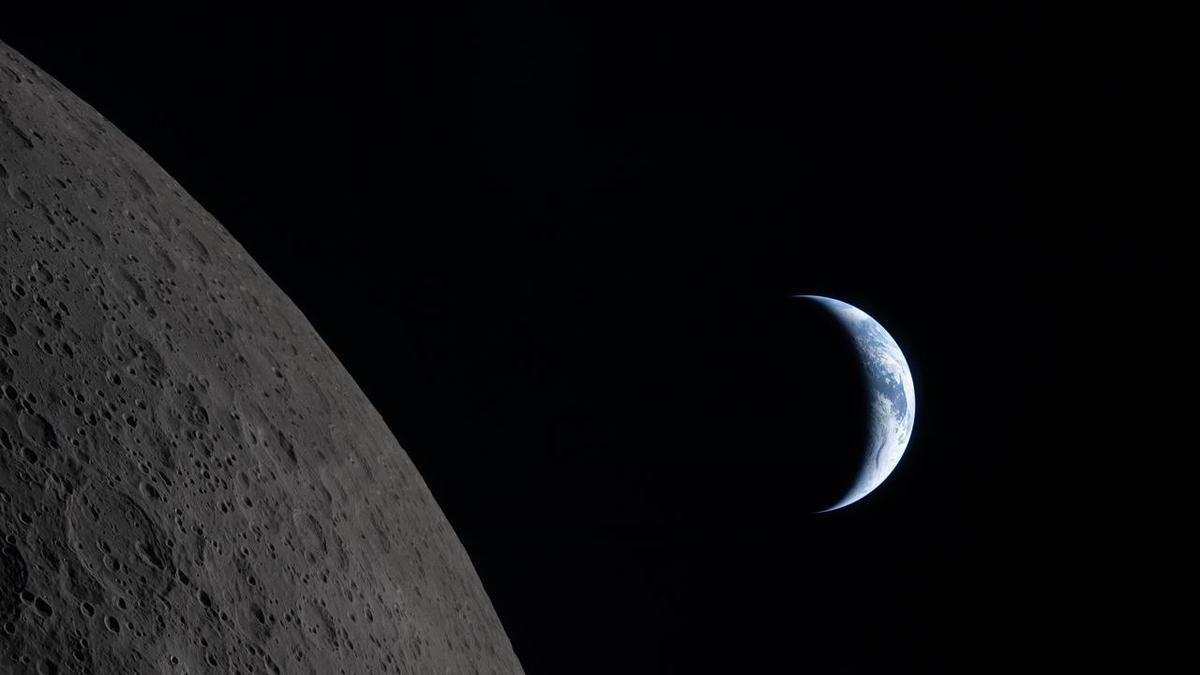
The four Artemis II astronauts, returning from the first crewed voyage around the moon in more than half a century, are hurtling back toward earth as they prepare their Orion spacecraft for the final phase of their descent and splashdown in the Pacific Ocean off California.
The autonomously piloted Orion crew capsule executed one last eight-second firing of its jet thrusters overnight to fine-tune the flight course, a critical manoeuvre to ensure a safe return.
NASA’s 10-day mission was expected to culminate with the gumdrop-shaped Orion vehicle jettisoning the service module housing its main rocket system, followed by a fiery re-entry through earth’s atmosphere and a six-minute radio blackout before the capsule parachutes into the sea.
If all goes well, US astronauts Reid Wiseman, Victor Glover and Christina Koch, along with Canadian astronaut Jeremy Hansen, will end up bobbing safely in the ocean aboard their Orion capsule, dubbed Integrity, about 8.07pm ET (10.07am AEST on Saturday) off the coast of San Diego.
The quartet blasted off from Cape Canaveral, Florida, on April 1, lofted into an initial earth orbit by NASA’s giant Space Launch System rocket before sailing on around the far side of the moon, venturing deeper into space than any humans before them.
They became the first astronauts to fly in the vicinity of the moon since the Apollo program of the 1960s and ’70s.
The voyage, following the uncrewed Artemis I test flight around the moon by the Orion spacecraft in 2022, marked a critical dress rehearsal for a planned attempt later this decade to land astronauts on the lunar surface for the first time since Apollo 17 in late 1972.
The ultimate goal of the Artemis program is to establish a long-term presence on the moon as a stepping stone to eventual human exploration of Mars.
The four Artemis astronauts spent much of the final 24 hours of the mission stowing equipment and configuring the crew cabin for the re-entry and splashdown to come.
The return to earth will put the Lockheed Martin-built Orion spacecraft through a critical test of its heat shield, which sustained an unexpected level of scorching and stress on re-entry during the 2022 test flight.
As a result, NASA engineers altered the descent trajectory for Artemis II in order to reduce heat build-up and lower the risk of the capsule burning up.
Still, with Orion plunging into the atmosphere at 38,625km/h, or about 32 times the speed of sound, temperatures outside the capsule are expected to soar to as high as 2760C.
As is typical in such return descents, the intensity of heat and air compression will form a red-hot sheath of ionized gas, or plasma, that engulfs the capsule, cutting off radio contact with the crew for several minutes at the start of re-entry.
Moments later, two sets of parachutes will be deployed from the nose of the free-falling capsule, slowing its descent to about 25km/h before Orion gently hits the water.
Just as critical as the performance of the heat shield and parachutes are several other factors, including achieving the spacecraft’s precise descent path and re-entry angle through a series of course-correction blasts of its jet guidance thrusters.
The last of three such jet thruster “burns” was conducted roughly five hours before splashdown.
A final angle adjustment of the spacecraft was to take place as the vehicle nears the top of the atmosphere.
Once the capsule hits the top of the atmosphere, it takes less than 15 minutes before two sets of parachutes are deployed and the capsule floats into the sea.
NASA says it will take about another hour for recovery teams to secure Orion, assist the astronauts out of the capsule one by one and hoist them into helicopters hovering above.
https://thewest.com.au/news/world/artemis-astronauts-hurtle-home-toward-splashdown-c-22125491


