






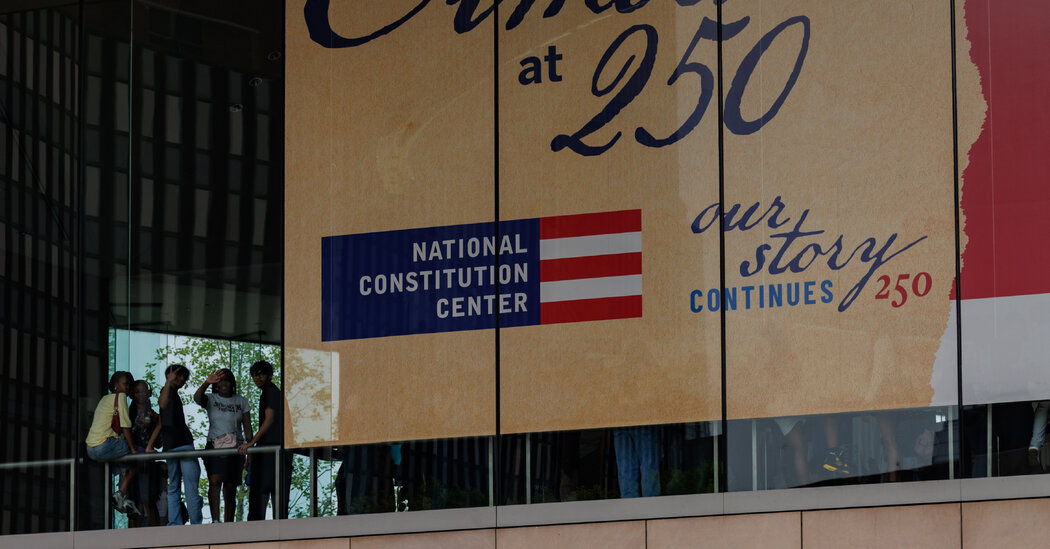
This summer, more than a million people are expected to descend on Philadelphia for the 250th anniversary of the Declaration of Independence. But over the weekend, several hundred historians showed up early.
At a hotel not far from Independence Hall, members of the Organization of American Historians gathered at their annual meeting for four days of panels, shop talk and gossip that often circled around two anxious questions: What do Americans want and need from the anniversary? And are historians able — or willing — to give it to them?
It had barely been a year since President Trump issued an executive order, “Restoring Truth and Sanity to American History,” that claimed a “revisionist movement” had sought to undermine the nation by “casting its founding principles and historical milestones in a negative light.”
Since then, scholars have scrambled to push back against efforts to bring federal cultural institutions in line with the president’s vision of “patriotic history.” But in Philadelphia, the mood was less five-alarm fire than sober determination, embodied by a rousing opening night appearance by Lonnie G. Bunch III, the embattled secretary of the Smithsonian Institution.
In an onstage interview with the group’s president, Annette Gordon-Reed, Bunch mixed wry don’t-want-to-talk-about-it jokes about his standoff with the Trump administration with calls for historians to stay the course, tell the truth and, crucially, show their work.
“We’re like the last great craft guild — we have secret nods and special handshakes,” Bunch said.
“We do not explain how we do the work we do,” he continued. “So part of this is on us to make the public understand this is not somebody’s whim, or somebody’s politics. This is somebody’s research and expertise.”
Still, the boundary between scholarship and politics can be blurry. In an interview before the conference, Gordon-Reed, a professor at Harvard, said this was an “all-hands-on-deck” moment, when historians needed to speak out more forcefully than some might be comfortable with.
In her presidential address, she offered an account of how Black Americans and others excluded from the founding fathers’ idea of “the people” had fought to claim full citizenship. Without using his name, she took aim at Vice President JD Vance’s argument that America is not a nation defined by a creed, but a “homeland” for a “particular people.”
In recent decades, “even people who didn’t believe the Declaration’s words about equality knew that they were supposed to act as if they did,” Gordon-Reed said. “Today that mask has been dropped.”
Who owns the American Revolution, and how to chronicle it, has been contested almost since it ended. In recent decades, historical scholarship has eschewed nationalist affirmation in favor of a coolly antiheroic view, interpreting it not as a liberty struggle driven by high-flown principle but as a hyper-violent civil war that divided communities and left many enslaved people and Native Americans worse off.
But increasingly, historians are asking if they need to do more to meet the public’s hunger for meaning and inspiration.
Serena Zabin, a professor at Carleton College who led a session on the state of scholarship on the Revolution, said she had noticed a change in student interest over the past year.
“For the first time, I had students, from a wide range of political positions, who were hungry, hungry, hungry for the politics of the Revolution and the early Republic,” she said.
Johann Neem, a professor at Western Washington University, has criticized what he calls the “post-American turn” among progressive historians, whom he faults for telling a negative story about the founding that leaves little room for shared national identity.
But in the second Trump administration, Neem said, even talking in a factual way about the colonists’ grievances against King George III or the founders’ fears about unchecked power can seem political.
“How do you talk about all that’s happening and not be in a sense a partisan, when part of what is happening is one of the parties has turned against democracy?” Neem said.
“To say that makes you sound like you have ‘Trump derangement syndrome,’ or you hate conservatives,” he continued. “Public historians are really struggling with that.”
Much current scholarship on the Revolution focuses on Native Americans, who are seen not as bystanders or victims but as members of powerful nations seeking to defend their own liberty against the expansionist aims of the emerging United States.
At a panel on Native people and the Declaration, Philip J. Deloria, a historian at Harvard, noted that most panelists had talked more about the Constitution, which acknowledges tribes as political entities, than about the Declaration, which refers to them only as “merciless Indian savages.”
Today, the phrase is emblazoned on defiant T-shirts some Native people wear on the Fourth of July. And it adds an awkward complication to discussions of the Declaration’s soaring rhetoric of universal rights.
Eric Slauter, a professor at the University of Chicago and a curator of a new exhibition at the Newberry Library focused on key phrases in the Declaration, said that while the slur is discussed in the exhibition, it was left out of the promotional graphics.
“No one wanted to see that on a side of a C.T.A. bus,” he said.
At another session, Marc Stein, a professor at San Francisco State University and the author of a new book about the 1976 Bicentennial, noted that the anniversary had inspired many grass-roots “counter-bicentennials” emphasizing Black, Indigenous, L.G.B.T.Q. and other perspectives.
Those efforts powerfully changed popular understandings of the Revolution. But the broadening of history — including who gets to write it — has also posed a challenge for the profession.
In a panel called “Who Counts as a Historian?,” M.J. Rymsza-Pawlowska, a historian at American University, said the field needed to grapple with the explosion of ordinary people doing history on social media sites like TikTok — often very well.
“History is everywhere, as are people who self-identify as historians,” she said.
At another panel, Nicholas Guyatt, a professor at the University of Cambridge and the editor of the forthcoming “Oxford Illustrated History of the United States,” brought up the “Freedom Trucks,” a mobile history exhibit supported by the Trump administration, and Glenn Beck’s interviews with an A.I.-generated George Washington.
Can books like the new Oxford volume have a real civic impact, he asked. “Or are we just dinosaurs who haven’t realized the history profession is doomed?”
The profession, he said in an interview, is facing “fraying authority” as the public becomes increasingly skeptical of top-down narratives coming from whichever perceived political direction.
“We may think we have the better narrative, but these guys have the penetration,” Guyatt said, referring to efforts like the Freedom Trucks.
Many at the conference said they were encouraged by continuing protests against the Trump administration’s removal of signage from the President’s House, a site near Independence Hall that focused on George Washington’s ownership of slaves. And recent research shows that Americans across the political spectrum are more open to complex history than headlines about the “history wars” might suggest.
Andrew Davenport, the vice president for research at Monticello, Thomas Jefferson’s home, said the 250th anniversary called for leaning into both the paradoxes and the promise of the Declaration.
“People are yearning for nuance, but also for connection,” he said.
“This is a generational moment,” he added. “If we miss it, it’s gone.”
https://www.nytimes.com/2026/04/21/arts/history-america-250-trump.html


