






Bertjan Pot was inspired by a kettle. When invited to make a birdhouse for an exhibition, Pot, a Dutch designer, thought back to his grandmother’s garden.
“She used to live on a farm, and there was always this kettle hanging from a tree,” Pot said. Small birds would enter through the spout and use it, showing him that “anything can be a birdhouse.”
Pot made a series of cone-shaped works in colorful rope, with different hole sizes to accommodate various bird species. A yellow-and-black version, designed for a coal tit (a small bird common in Europe) features in “Home Sweet Home” at the MAD Brussels museum (through Saturday), a show of 83 birdhouses from international designers. They span the practical to the fantastical.
It is the latest creative focus on the humble birdhouse, a boxlike object providing space for nesting. Long seen as a twee, perhaps staid, element of traditional gardens and unassuming green spaces, the birdhouse is entering a new era. Now, as well as offering shelter for bird populations — which recent studies have shown are in decline — it is a vehicle for contemporary design and artistic expression, as evidenced by several shows in Europe and the United States.
“I found out that nobody made a really good birdhouse,” said Connie Hüsser, the curator of “Home Sweet Home” and a Swiss interior stylist, speaking at the Brussels exhibition. So she invited a network of designer collaborators to create one, and gathered the results into this show. Hüsser was inspired by the thriving nature and wildlife in her hometown, Zurich, during the early days of the Covid pandemic.
“A lot of birds were coming back,” she said. (Research has indicated that bird numbers increased in and around cities during lockdowns.)
“Home Sweet Home” was first staged in 2024 at the Vitra Design Museum in Germany. For this latest edition in Brussels, Hüsser invited 45 more designers and artists to participate, essentially doubling its size. Among those new additions is the New York studio Stephen Burks Man Made, whose contribution is more of a playful aviary; a lightweight wooden matrix of dowels featuring colorful acrylic circles for birds to perch on or eat from.
Another new addition is the Danish duo Pettersen & Hein’s creation, a ceramic mounted birdhouse alongside a free-standing sculpture that can hold water and food, conceived as an “all-inclusive resort” for birds, the designers explained in an email. “What is usually a luxurious human environment is reimagined as a habitat for birds: a sculptural birdhouse modeled on the architecture of luxury resorts,” they said.
The Dutch maker Chris Kabel designed hanging miniature “tents” made from weatherproof fabric. “Many birds are migrants,” he wrote in an email, noting that they travel to optimal climates for survival. “Due to climate change, pollution and the destruction of their natural habitat they need to keep moving, constantly adapting to adversity.”
For Kabel, this echoes the situation of people around the world facing displacement and “forced to rely on temporary shelters and tents in refugee camps.”
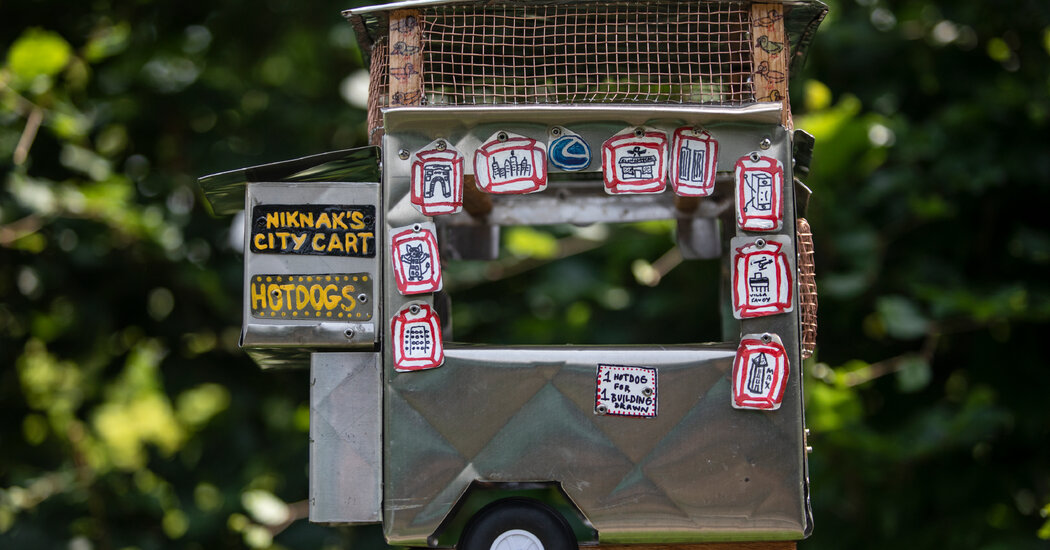
In Tivoli, N.Y., another showcase of creative birdhouses — this time a solo presentation from the artist Dan Ladd — is on through Sunday. Expressive assemblages made using wood and found objects, from a bicycle seat to a vintage pencil sharpener, emerge from Ladd’s long-term interest in nature and the outdoors.
Humans have made birdhouses for centuries, largely mixing an appreciation of the animals with a desire for outdoor decoration. Many designs adopt miniature architectural forms, applying human construction to bird life.
It is partly the extent of human construction, however — along with industrial agriculture, pollution and climate change — that has contributed to the loss of natural habitat for birds, and concurrent population decline. A study in 2019, published in the journal Science, found that the number of birds in the United States and Canada had fallen by 2.9 billion, or 29 percent, since 1970. A global assessment in 2025 suggested that more than half of all bird species are in decline.
While birdhouses do not reverse habitat loss, they can provide more opportunities for birds to nest — and provide delight for humans in the process. Perhaps because of this, birdhouse fever seems to have gripped the design world.
In October 2025, “Architects for the Birds,” an exhibition and auction at Christie’s in London in support of the Tessa Jowell Foundation, a charity devoted to helping people with brain cancer, invited nine architects and architecture practices to make birdhouses. The Japanese architect Sou Fujimoto created a treelike structure of geometric wooden blocks hollowed out to hold food and water, while the Mexican architect Frida Escobedo made a white oak framework with biodegradable trays for holding food or nests.
Another London exhibition, “Dwellings,” featured birdhouses from over 20 emerging designers at the South London Gallery garden in 2024, organized by the design collective Computer Room with the bird-watching group Flock Together. A selection of those birdhouses is now installed across town, in Kensington, in the public garden of the Design Museum until June 2027.
Jesse Butterfield, a designer and co-founder of Computer Room, explained over coffee in east London that the show centered on birdhouses because they were “selfless” objects. Plus, he said, “we wanted to do something that designers don’t get the chance to design that often.”
His own creation, “Bird Metropolis,” which is currently on show at the Design Museum, is a Douglas fir structure inspired by Modernist architecture that invites house sparrows to perch, nest, feed and play. Small birds common to many parts of the world, house sparrows have faced population decline in Europe in particular. As they like to nest together rather than alone, “Bird Metropolis” is designed to be large enough for eight nesting couples.
Another birdhouse on show in the Design Museum garden, by Dharma Taylor, is a geometric sculptural creation in birch wood, painted bright red. As Taylor explained in an email, the work developed from a large-scale rug she had previously designed, which was inspired by childhood memories of growing up in Greenwich, southeast London.
“I remember sitting high up in an apartment, watching the architecture stretch into the distance as the sun began to set, noticing how the light caught the windowpanes and flickered across the buildings,” she said. That “interplay of structure and glow” became the foundation of the original textile piece, and then the wooden birdhouse.
The form of the birdhouse also drew inspiration from a chair that Taylor designed during one of the Covid lockdowns in Britain. “There’s something meaningful to me about that shift in scale, from grand tapestries and furniture built to hold the weight of a human body, to a dwelling delicate enough for a bird,” she said. While the entrance opening is sized for small birds found in London such as blue tits, wrens or robins, Taylor imagines that each visiting bird brings “its own character” to the work.
At the Brooklyn Botanic Garden, architects, artists and designers created 33 birdhouses for the 2022 exhibition “For the Birds.” Contributions included a blue bodega-inspired structure from the Brooklyn artist Olalekan Jeyifous, and an egg-shaped papier-mâché and brass sculpture from the architect Suchi Reddy, who lives and works in New York.
But specialized houses and feeders are not the only way that green spaces can be made more bird-friendly through design. Molly Sedlacek, a landscape designer who lives and works in Los Angeles, believes that birds are “very similar” to humans in that they need food, shelter and water. So an outdoor space “really has to hit those three prongs” to have balance in wildlife and habitat, she said.
With her firm Orca, Sedlacek designs residential gardens across California that center native plants — such as pitcher sage, western sycamore and apricot mallow — in the knowledge that local birds rely on this vegetation for food and security.
Orca also designs cedar birdhouses with petite shingled roofs and large, shallow copper water basins, integrating these in projects. In one Los Angeles garden, the studio made a black granite water fountain in collaboration with the builder Rob Diaz, intended as a “bird sanctuary,” Sedlacek said.
Creativity might provide a vehicle to support birds in ways that satisfy human visual appetites, but the animals do not necessarily need our art. Bertjan Pot, the Dutch designer, has a garden of his own in Rotterdam. He used to have a few birdhouses in it, he said, but now has a dense hedge that provides plenty of space for birds to make nests in. “They don’t need a special house with a hole,” he added.
The careful dance between humans and birds continues.
https://www.nytimes.com/2026/04/20/arts/design/design-birdhouse.html


