






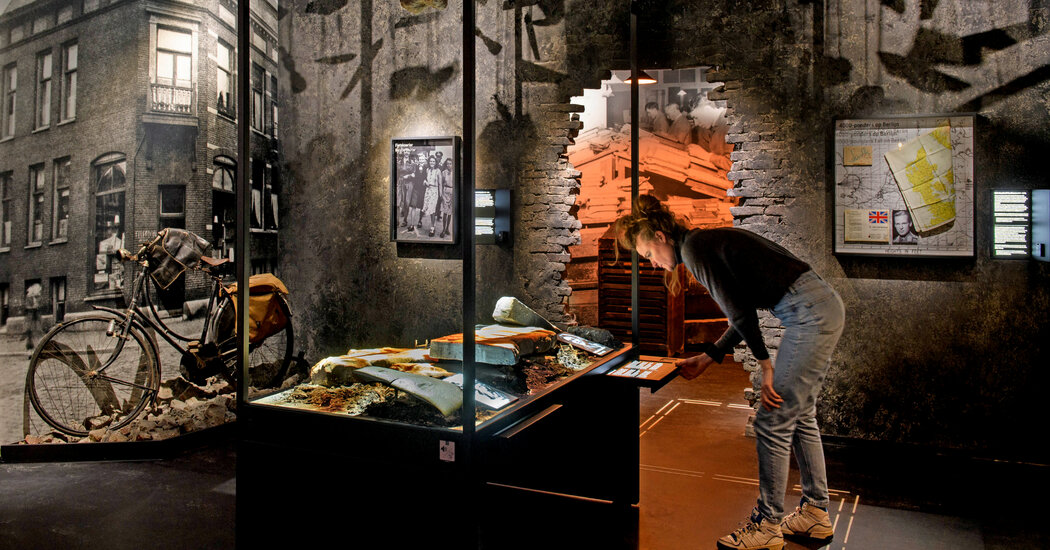
Simeon Hirst looked a bit dazed as he emerged on a recent afternoon from the underground halls of the Museum of Danish Resistance. Mr. Hirst, on a trip to Copenhagen from his home in England, had chosen the museum because of his interest in World War II. But despite his knowledge of the period, he was affected by what he saw. “It really brings it to life,” he said. “The oppression they were under, but also the courage they had to fight back. Too many people today just go with the flow.”
According to curators, Mr. Hirst is not alone in making such comparisons. There are dozens of resistance museums scattered across Europe, and some of them are noticing that their exhibitions about the clandestine networks of ordinary people who fought back against Nazism and Fascism in the 1940s have an increased relevance for visitors today.
Distinct from institutions that emphasize the military and diplomatic history of World War II, resistance museums focus on the home front, and how — by smuggling weapons, printing underground newspapers, ferrying intelligence, conducting sabotage, or sometimes just wearing distinctive hats — regular citizens opposed and undermined the Nazi effort.
At a time of increasing authoritarianism and political instability, curators at some of these museums say it’s not uncommon for visitors to draw connections between the past and present. One group of American tourists recently came to Norway’s Resistance Museum in Oslo wearing the red knit hats that were a symbol of that country’s resistance — and have since been adopted by activists protesting the tactics that ICE used recently in Minnesota.
For those seeking to draw their own connections, or simply to expand their knowledge beyond what they know from the film “Casablanca,” here are some of Europe’s more interesting resistance museums.
Copenhagen
One of the older resistance collections in Europe, Denmark’s museum, which was created by former resistance members, has had its own turbulent history. Its 1957 inauguration, which occurred when divisions between the Danes on the “right” and “wrong” sides of history were still sharp, was accompanied by a bomb threat. More than 50 years later, the building — though not the collection — was destroyed in an arson attack whose perpetrators have never been caught.
Reconstructed in 2020, the museum today showcases some citizens’ courage while acknowledging the relative slowness with which most Danes took up resistance. It also discusses darker moments of opposition, like the violence and humiliation directed against Danish women who dated German soldiers.
It has also become a more immersive experience. Audio sets and videos recreate the stories of five young Danes, four of whom joined the resistance, and one of whom joined the Nazi Waffen-SS on the Eastern Front. Visitors follow Musse Hartig, for example, from the early days of the war when, as an unmarried young woman, she was nearly caught ferrying a handgun in her purse, through her agonizing decision years later to go underground with her husband, even though it meant leaving their two young daughters behind.
Coupled with evocative artifacts, like one of the boats Danish fishermen used to spirit Jews across the sound to Sweden, the immersion is an emotionally powerful experience, and an intellectually provocative one. “The basic thread that runs through the entire museum,” the director, David Hoyer, said, “is the question of choice. Why did some decide to take up arms against the German occupation and some not?”
Oslo
At the Akershus Fortress in central Oslo, this small museum founded by resistance fighters was inaugurated on May 8, 1970, the 25th anniversary of Norway’s liberation. Its first director, Knut Haugland, was a Norwegian commando who parachuted into Telemark to sabotage the heavy water plant there and undermine German efforts to make an atom bomb. His jumpsuit is the first exhibit visitors see when they enter.
The collection remains largely unchanged since its opening, and its permanent exhibition eschews multimedia in favor of dioramas. “Walking into our museum is like a screen detox,” Mats Tangestuen, the director, said.
The museum tells an inspiring story of how resistance was expressed in gestures both grand (teachers who chose Arctic prison camps over adhering to a Nazi curriculum) and small (prohibited from displaying the Norwegian flag, citizens wore paper clips on their lapels to symbolize national unity).
The focus is on resistance and repression rather than personal stories. Omitted as well are less flattering aspects of the resistance’s history, like its failure to help Norway’s small Jewish community and its participation in the “liquidation” of collaborators. In that sense, the museum represents two histories: one, of the events themselves, and another, of how they were remembered in the 1970s.
Founded in 1984, just as many resistance fighters were reaching retirement age, the museum was born from “their need to pass their stories on to the next generation,” Karlien Metz, the director, said.
Highly interactive, the museum’s permanent collection is organized chronologically around six turning points, from the initial occupation of the Netherlands in May 1940, through the Battle of Arnhem in September 1944 and on to liberation the following spring. It includes a children’s museum that follows four children through their wartime experiences and culminates with videos of them as older adults, looking back on their lives.
The collection seeks to represent the variety of positions Dutch citizens adopted during the occupation, from active support for the Germans to armed resistance, and the motivations that drove them. That kind of nuance extends to its representation of Dutch Jews who, contrary to older depictions that portrayed them as victims, are recognized here for their resistance work.
Through stories like the one about a police officer, who first collaborated with German deportations, but eventually joined a resistance group that robbed ration coupons to feed hiding Jews, the museum emphasizes how fluid and complicated wartime identities could be. “We really want to show people how complex it was to live in a period of time when there’s no rule of law, there’s a very harsh dictatorship, there’s no freedom to say what you want, and all those circumstances affect your decisions,” Ms. Metz said.
Champigny-sur-Marne, France
France is home to more than three dozen resistance museums, but for a broad narrative, this museum, about 40 minutes by commuter rail from central Paris, is a good place to start.
Founded in 1965, the museum outgrew its original home as former resistance members donated artifacts, and since 2020, its collection has been housed in a modern building on the Marne river. Today, it works closely with those fighters’ descendants, said Audrey Madec, the head of collections. For them, “donating these materials can mean parting with the last tangible link to a parent,” she said.
Screen projections near the entryway show German troops goose-stepping down the Champs-Élysées, hinting at the visceral shock the French felt in 1940. Organized chronologically, the permanent exhibition mixes displays of its vast array of artifacts — from books hollowed out to conceal weapons to a bakery truck that transported rural resistance fighters — with interactive touch screens and “sound showers.”
French comes in handy; there are no translations for the wall texts nor of some of the most moving objects, like the manuscript of the writer Paul Éluard’s stirring poem “Liberté” and the letter that the 17-year-old activist Guy Môquet wrote before his execution by a German firing squad. But tours in English are available, and many of the items, including the photographer Robert Doisneau’s quintessential images and the actual cell door behind which captured female resistance members were imprisoned, speak eloquently for themselves.
Berlin
Resistance was not confined to occupied countries; it also took place in aggressor nations. Perhaps the most significant collection testifying to that activity is in Berlin, in the former army headquarters that served as the staging ground for an attempted coup against Hitler in 1944.
The collection of the German Resistance Memorial Center, which functions as an archive and research center as well as a museum, focuses on the kinds of opposition possible under the Nazi regime. Consisting primarily of photographs and documents, the exhibition represents the motivations that compelled some Germans, be they Christian, Communist or in the military, to act against their own government.
Although the curation distinguishes between resistance in a dictatorship and opposition in democratic systems, it also acknowledges that the former can hold lessons for the latter.
“When considering how to confront threats to democracy and freedom, engaging with the stories of those who resisted National Socialism is helpful,” the museum’s director, Julia Spohr, said. “They show us that every individual bears a responsibility to actively shape the present.”
Follow New York Times Travel on Instagram and sign up for our Travel Dispatch newsletter to get expert tips on traveling smarter and inspiration for your next vacation. Dreaming up a future getaway or just armchair traveling? Check out our 52 Places to Go in 2026.


