







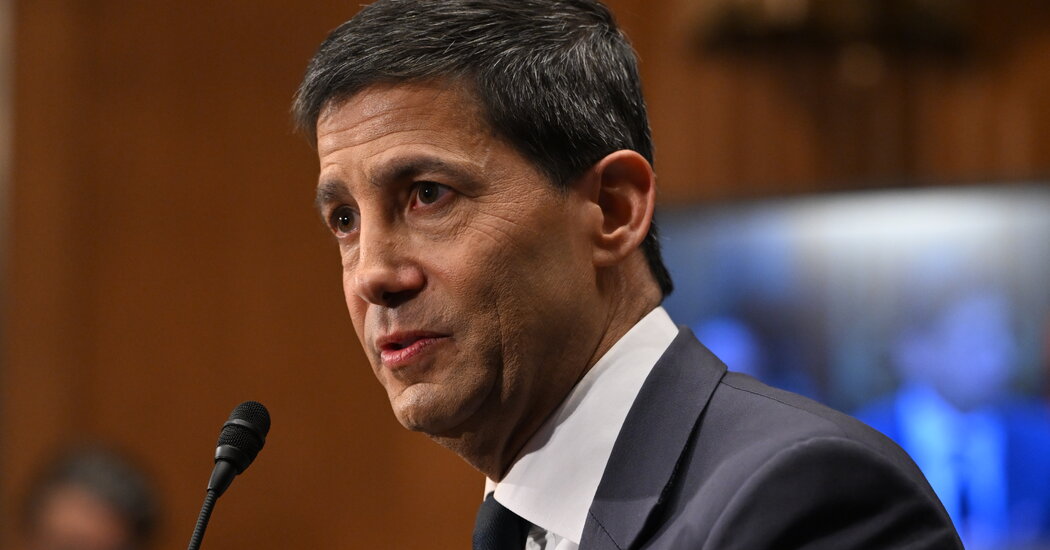
To Kevin M. Warsh, the Federal Reserve’s more than $6 trillion portfolio of government bonds and mortgage-backed securities is emblematic of everything that has gone wrong at the institution he hopes to lead.
The Fed’s decision to expand its portfolio by so much and so quickly since the 2008 global financial crisis has stoked inflation, worsened inequality and distorted the process of how financial assets are priced, according to Mr. Warsh, who is awaiting confirmation to become the next chair. The growing size of the investments on its balance sheet has jeopardized the Fed’s own independence by treading into territory far outside its congressional mandate, he believes. And it has made Wall Street overly reliant on the Fed, creating an unhealthy expectation that the central bank will always be ready to ride to the rescue.
Mr. Warsh’s plan to rectify this appears, on the surface, relatively straightforward. He wants the Fed to have a smaller footprint in financial markets and for there to be closer coordination with the Treasury Department on what the Fed holds in its portfolio and what the government issues in terms of debt to fund itself. Mr. Warsh has argued that reducing the central bank’s holdings will give officials space to lower interest rates, something President Trump has long desired. The rationale is that longer-term rates are likely to rise as the balance sheet shrinks, which then could be offset by lowering short-term rates.
Achieving all of this will be anything but straightforward, however. It will take careful planning and a significant amount of time in order to avoid creating damaging volatility.
There are already jitters about the direction that Mr. Warsh will push the Fed if confirmed by the Senate. Among his first tasks will be to overcome lingering doubts about how susceptible he will be to pressure from the president, who wants more influence over the institution.
But there is a second hitch as well. Fresh in the minds of Fed officials and investors across Wall Street is a 2019 episode in which policymakers reduced the balance sheet by too much, causing short-term interest rates to spike. That episode was a “near heart attack” for markets, said James Clouse, who served as deputy director of the Fed’s division of monetary affairs at that time, leaving a “pretty profound, lasting impact on the way people have thought about the balance sheet.”
That caution remains in force today.
“It’s very clear that the balance sheet cannot be immediately reduced without causing a liquidity crunch that nobody would like,” said Darrell Duffie, a professor of finance at Stanford University’s Graduate School of Business. “Both the plan and the execution are going to make the difference between failure and success.”
What’s on the Fed’s balance sheet?
The Fed’s balance sheet reflects its assets and liabilities.
Its assets include over $4 trillion in Treasury securities and $2 trillion in mortgage-backed securities amassed in past crises as an attempt by the Fed to keep a lid on rates and support the economy.
Its liabilities include extra cash deposits that more than 5,000 banks hold at the central bank, otherwise known as reserves. The amount of reserves fluctuates with the amount of assets the Fed holds. Currency in circulation and the Treasury’s cash coffers represent the central bank’s other major liabilities. At its peak in 2022, its balance sheet totaled nearly $9 trillion.
Since 2008, the Fed has operated an “ample reserves” system to carry out its monetary policy. That entails the Fed supplying more than enough reserves to meet banks’ demands and paying interest on those holdings to create a “floor” for borrowing costs. When the Fed changes the target range of its main policy rate, it either raises or lowers the interest it is paying on those holdings such that rates across the financial system shift accordingly. Before the financial crisis, reserve balances were significantly lower and the Fed was not paying out interest, requiring frequent interventions to ensure supply and demand balanced out.
Last year, reserves dipped below $3 trillion following a three-year period in which the Fed reduced its holdings. Strains soon emerged in short-term markets, where banks and hedge funds borrow cash overnight for trading and to cover daily payments. The Fed reversed course and in December began buying Treasury bills, which mature in one year or less.
Mr. Warsh is cognizant of the potential pitfalls of his balance sheet ambitions, telling lawmakers at his confirmation hearing on Tuesday that there would be an extensive debate before proceeding slowly with advance notice to markets. That echoed Treasury Secretary Scott Bessent, who said it could take up to a year for the Fed to make any balance sheet decisions.
While Mr. Warsh declined to say how much smaller he wanted the overall balance sheet to be, he made clear that the Fed should no longer be holding long-term Treasuries, given his concerns that doing so blurs the line between monetary and fiscal policy by suppressing the government’s borrowing costs.
How to Shrink It
Discussions around reducing the balance sheet have multiplied in anticipation of Mr. Warsh’s ascent to Fed chair. For some, the objective itself is questionable. Those in this camp argue that the current system works well because it is simple, requires minimal intervention and allows for the Fed to maintain a firm grip on rates.
One of the most vocal detractors of a significantly smaller balance sheet has been Christopher J. Waller, a governor who at one point competed with Mr. Warsh for the top job.
“You don’t want banks every night of the day digging around in the couch cushions looking for money,” he said at a conference earlier this year. “This is massively inefficient and stupid.”
What he has conceded, however, is that there is a path to reducing banks’ demand for reserves as a mechanism to shrink the balance sheet that would not jeopardize the Fed’s current system for enacting monetary policy.
A slew of new research points to several ways to achieve that. The most popular path revolves around altering regulations to reduce banks’ need to hold reserves.
Policymakers have zeroed in on the liquidity coverage ratio, which requires banks to maintain sufficient funding to meet their obligations for 30 days, as well as internal liquidity stress tests that assess how much an institution would need to weather a severe shock. There has also been a discussion about allowing banks to count whatever capacity they have to borrow at the Fed’s discount window, a facility that provides short-term loans to banks, toward fulfilling their liquidity requirements.
Already, Michelle W. Bowman, the vice chair for supervision, has hinted at rule changes to reduce “liquidity hoarding.” Regulators will have to be careful not to scale back too aggressively, however, or raise the risk that lenders will not be adequately prepared for a crisis, warned Viral Acharya, a professor of economics at New York University.
Lorie Logan, who oversaw balance sheet operations at the Federal Reserve Bank of New York before becoming a regional president in Dallas, has also proposed making the central bank’s lending facilities more accessible. That would encourage banks to hold fewer reserves while also giving them confidence that they have access to cash if need be. This would require reducing negative connotations that have often plagued these facilities, especially the discount window. The fear for lenders has long been that tapping it sends a signal that they are on shaky footing.
One of the easiest ways to mitigate any potential cash crunch during the transition period would be for the Fed to stand ready to intervene when necessary in the form of so-called temporary open market operations.
“You don’t want to create any environment that would increase liquidity pressure on the system,” said Patricia Zobel, who ran the group that executed monetary policy at the New York Fed before joining Guggenheim Investments.
A more aggressive — and likely contentious — lever to pull is for the Fed to pay banks a lower rate on their reserve balances beyond a certain level. That would sharply reduce the incentive for banks to hold extra cash, but it would likely be difficult to structure and face intense pushback from the industry. It could also potentially undermine the Fed’s ability to control rates.
According to Stephen I. Miran, a Fed governor, enacting a combination of the above changes over several years could allow the Fed to reduce its balance sheet by up to $2 trillion while avoiding any extreme market indigestion. “The most important thing we can do will be to go slowly,” he said in a recent speech.
For Mr. Warsh, closer coordination between the Fed and Treasury would also help. Mr. Warsh has floated a revamp of a 1951 agreement that established the Fed’s monetary policy independence while giving Treasury control of government spending and taxation. What a new “accord,” as Mr. Warsh has called it, is likely to entail at a minimum is an alignment in what securities the Fed is willing to hold on its balance sheet and what Treasury wants to issue in terms of government debt. The department’s preference now appears to be Treasury bills, which Mr. Warsh seems to favor for the Fed as well.
Concerns about how independent the Fed will remain under Mr. Warsh has caused concern, however, that closer coordination between the two institutions will just be a first step toward the Fed becoming more enmeshed in the administration. At worst, economists fear some version of “fiscal dominance,” in which the Fed begins to prioritize the government’s financing needs over controlling inflation.
“It’s potentially a slippery slope,” Mr. Acharya said. “No accord is an accord. It is just the first round of compromise that occurs.”
https://www.nytimes.com/2026/04/24/us/politics/kevin-warsh-fed-rates-balance-sheet.html


