








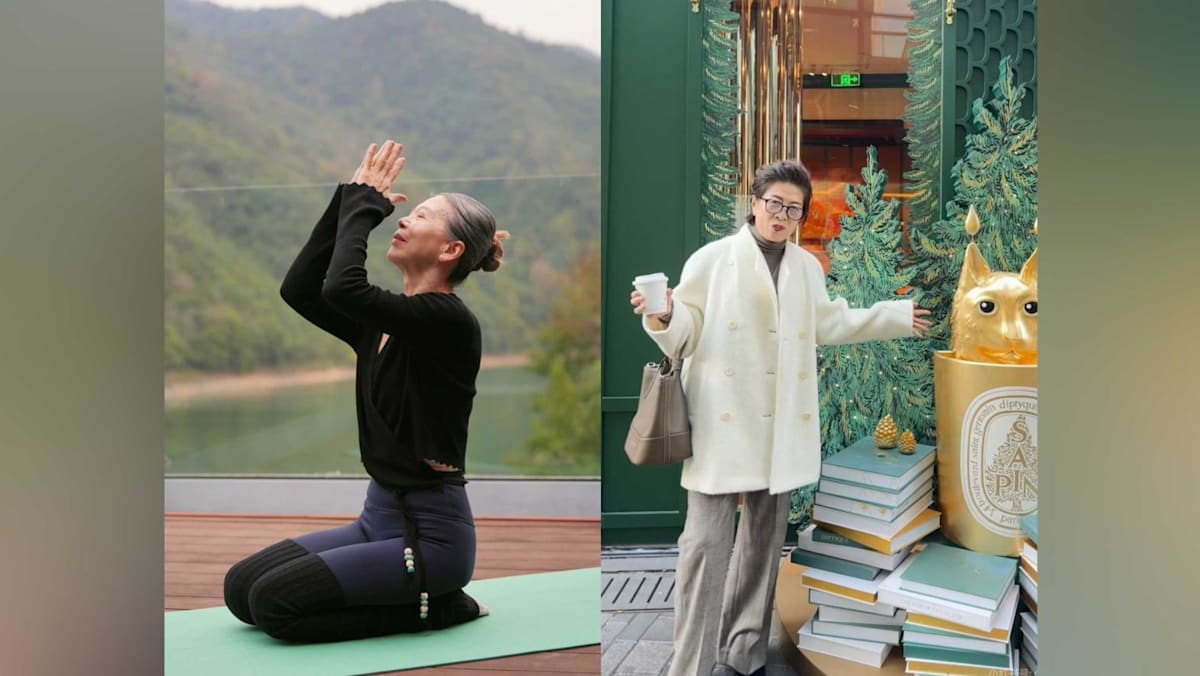
“I hope that when I’m in my 60s, I can be like (Ping Bao) jiejie,” one Xiaohongshu user, Xiao Yu, commented.
“I’m 25 at the moment and I don’t want to get married; I just want to do what I love.”
For vloggers such as Ping and Xixi, encouragement from their own children played a role in their decision to begin posting content online.
DIGITAL EXCLUSION TO ADAPTATION
Analysts said that for many older users, the move into content creation was a natural extension of habits they had already developed online.
Shi from Lingnan University observed that initially, the seniors simply wanted to document their own lives and to find some enjoyment.
“For example, WeChat has a ‘Moments’ function, and I know many elderly people love posting there,” Shi said.
WeChat’s “Moments” operates as a personal social feed, where users can share photos, short videos and daily updates.
“But (WeChat’s) ‘Moments’ function is only visible to (the user’s) friends,” Shi pointed out.
“However, on platforms such as Xiaohongshu or Douyin, you can reach a wider audience. A lot of (older) people started with this mindset of sharing their daily lives, and gradually they find out that many other people actually enjoy watching what they are doing.”
Unlike in past decades, where the vast majority of Chinese seniors were effectively “digitally excluded”, the average older person today has become a “digital migrant”, with smartphone ownership now “near-ubiquitous”, said Shi.
According to a July 2025 report from the China Internet Network Information Center, China has 160 million internet users aged 60 and above, meaning roughly one in two seniors in the country is online.
“WeChat becomes their central hub for socialising, mobile payments, and video calls, while platforms like Douyin and (short-video app) Kuaishou dominate their entertainment.”
This digital shift, Shi said, has granted them “unprecedented” independence, reshaped their consumption patterns and created new social bonds through online communities.
“The barrier to entry isn’t that high anymore, because it’s already woven into (older people’s) daily habits, so accepting it becomes much easier,” Shi said.
Businesses are taking growing notice, said analysts.
“Douyin and Kuaishou are increasingly targeting elderly people through entertaining short videos and grassroots content through ‘silver-haired’ creators,” said Lai from Daxue Consulting.
https://www.channelnewsasia.com/east-asia/china-senior-influencers-silver-haired-bloggers-wechat-xiaohongshu-douyin-5878376


