






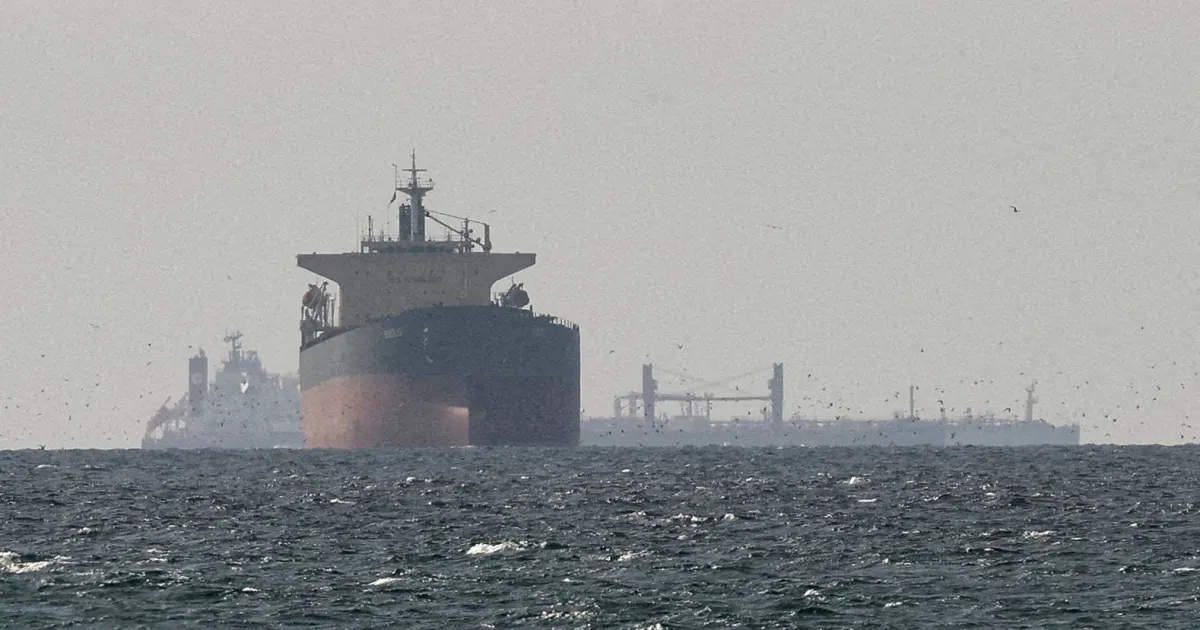
Iran’s Foreign Minister Abbas Araghchi and United States President Donald Trump have said that the Strait of Hormuz is open to commercial vessels.
Araghchi declared on Friday that the strategic waterwat was “completely open” in line with the ceasefire between Israel and Lebanon that took effect the previous day.
Recommended Stories
list of 3 itemsend of list
Trump affirmed on social media that the strait was open, later claiming that Iran had agreed to “never close the Strait of Hormuz again”. However, he also posted that the US naval blockade on Iranian ports would “remain in full force”.
In parallel, France and the United Kingdom hosted a meeting in Paris involving about 40 countries, which agreed to play a role in restoring freedom of navigation in the Strait of Hormuz once the US-Israeli war on Iran stops.
The blocking of tankers from using the strait, through which about 20 percent of the world’s crude flows on a typical day, has led to a global surge in fuel prices.
World leaders have welcomed the news with cautious optimism amid mixed messages from the US and Iran:
United States
“The Strait of Hormuz is completely open and ready for business and full passage, but the naval blockade will remain in full force and effect as it pertains to Iran, only, until such time as our transaction with Iran is 100% complete,” Trump wrote on Truth Social.
Minutes later, he issued another post saying the US Navy’s blockade on Iranian ships and ports “will remain in full force” until Tehran reaches a deal with the US, including on its nuclear programme.
Later, Trump told the news agency AFP that a deal to end the war on Iran was “close”, saying there were “no sticking points” left between Washington and Tehran.
Iran
Foreign Minister Abbas Araghchi posted on X that the strait was “declared completely open” and would remain open for the remaining period of the 10-day Israel-Lebanon ceasefire, which took effect overnight Thursday into Friday.
Some Iranian state media reports later appeared to contradict Araghchi’s announcement, with a senior military official telling state media that only nonmilitary vessels would be allowed to transit with permission from the Iranian Islamic Revolutionary Guard Corps (IRGC) Navy.
The Fars news agency, which is close to the IRGC, noted a “strange silence from the Supreme National Security Council”, the de facto top decision-making body in the country, as the status of the new supreme leader, Mojtaba Khamenei, remains unknown.
United Kingdom
UK Prime Minister Keir Starmer cohosted a summit on a potential military mission to secure the Hormuz Strait with French President Emmanuel Macron in Paris on Friday, with about 30 to 40 countries participating in person or by video conference.
On the sidelines, Starmer cautiously welcomed news of the strait’s reopening but said it must become “both lasting and a workable proposal”.
He said the UK and France would lead a “strictly peaceful and defensive” multinational mission to protect freedom of navigation as soon as conditions allow.
France
Speaking after the gathering, Macron said, “We all demand the full, immediate and unconditional reopening of the Strait of Hormuz by all parties.”
“We all oppose any restrictions or system of agreements that would, in effect, amount to an attempt to privatise the strait – and, of course, any toll system,” he added.
Macron’s office said roles for members of the international coalition working to reopen the strait could include “intelligence, mine-clearing capabilities, military escorts [and] communication procedures with coastal states”.
Germany
Chancellor Friedrich Merz said Germany could contribute mine clearance and intelligence capabilities to the international mission, but would need parliamentary support and a ″secure legal basis″ such as a UN Security Council resolution.
He said he wanted US involvement in the international mission to secure shipping through the Strait of Hormuz. “We believe this would be desirable,″ he said.
Trump later appeared to rebuff his overtures, saying on social media that he had received a call from NATO, but declined its assistance in no uncertain terms.
Finland
Finnish President Alexander Stubb, who participated in the Paris summit, said on X, “We welcome Iran’s announcement on opening the Strait. Lasting solutions require diplomacy,”
United Nations
United Nations Secretary-General Antonio Guterres on Friday welcomed the opening of Strait of Hormuz by Iran and said it was “a step in the right direction”.
International Maritime Organisation
Arsenio Dominguez, secretary-general of the UN shipping agency said, “We are currently verifying the recent announcement related to the reopening of the Strait of Hormuz, in terms of its compliance with freedom of navigation for all merchant vessels and secure passage.”
Shipping companies
The Norwegian Shipowners’ Association said several things had to be clarified before any ships can transit the strait, including the presence of mines, Iranian conditions and practical implementation.
“If this represents a step towards an opening, it is a welcome development,” said Knut Arild Hareide, CEO of the association, which represents 130 companies with some 1,500 vessels.
A spokesperson for Germany’s Hapag-Lloyd Shipping Company said, “We are now beginning to assess the new situation and the risks involved … For the time being, therefore, we are still refraining from passing through the strait.”
In a statement, Denmark’s Maersk said: “We have noted the announcement. The safety of our crew, vessels and customers’ cargo remains our priority. Since the outbreak of the conflict, we have followed the guidance of our security partners in the region, and the recommendation so far has been to avoid transiting the Strait of Hormuz.
“Any decision to transit the strait will be based on risk assessments and close monitoring of the security situation, with the latest developments also included in the ongoing assessments.”
Markets
Oil prices plunged after Iran’s announcement that passage for commercial vessels would remain “completely open” for the duration of a 10-day ceasefire in Lebanon.
“This news is having an immediate impact on markets,” said Kathleen Brooks, research director at XTB. “This is the biggest development so far during the ceasefire, and it gives hope that the war will end soon, and supply chains will return to some normality.”
https://www.aljazeera.com/news/2026/4/17/world-reacts-to-the-opening-of-the-strait-of-hormuz-amid-us-iran-conflict?traffic_source=rss


