






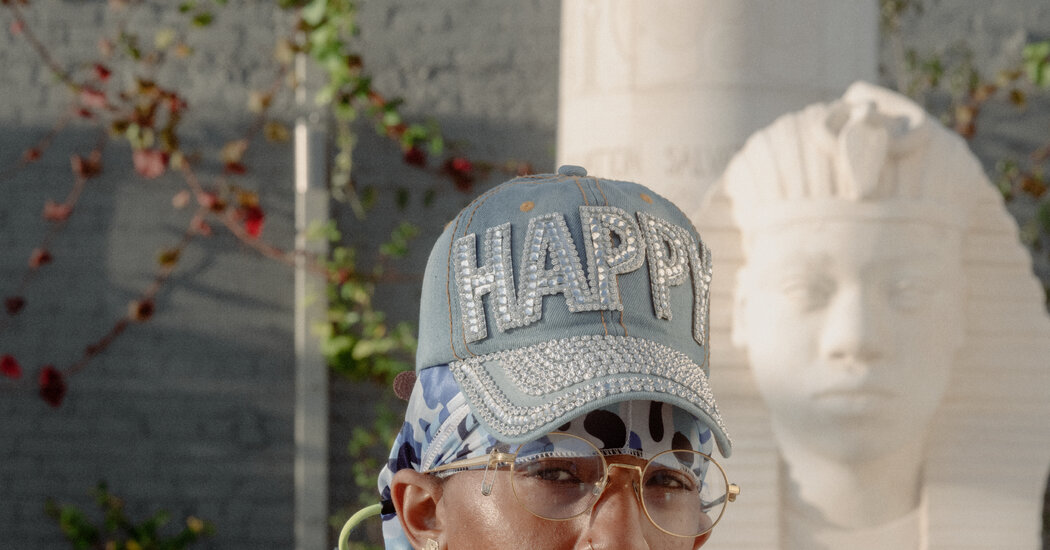
Yolanda Mims Reed came with fellow members of Local 99, the service employees union. Barron Dickerson brought along her aunt Alice. Malik Beyard dropped in by himself.
They were excited to spot people and places from their neighborhood carved into the walls — Deryl with the Curl’s carwash and automotive repair shop, Krst Unity spiritual center, Sika Dwimfo, known as the “Godfather of Leimert Park,” who died in 2024.
They were also simply gratified to see themselves.
“I looked up and I said, ‘Oh my God, that’s our faces,” Reed said. “This is what we needed, this is what our neighborhood needed, this is what our people needed.”
These visitors had come to the corner of Western Avenue and 76th Street in South Central Los Angeles to see the long-awaited sculpture park created by the artist Lauren Halsey, which opened in March and runs through September 2027.
The installation, “sister dreamer: lauren halsey’s architectural ode to tha surge n splurge of south central los angeles,” combines Halsey’s contemporary perspective infused with ancient Egypt and Africa. It features eight columns and eight sphinxes, along with plantings, benches and fountains. A central open air cube is carved with the names, faces and bodies of neighborhood figures; political marches and festive parades; the signage of long-gone local businesses.
“A lot of our history is not told — erasure is real,” said Daquinnise Woodard, a therapist who was visiting the site. “So this is beautiful.”
The columns are topped by the faces of the activist Margaret Prescod, founder of the Black Coalition Fighting Back Serial Murders; Susan Burton, who created a network of safe houses for formerly incarcerated women; and Rosie Lee Hooks, the director of the Watts Towers Art Center, a community arts center and cultural institution in South Central Los Angeles. “It pays homage to the hyperlocal hero,” Halsey said. “It literally monumentalizes them.”
Hooks said in an interview that she was “honored” to see her face “up on a pole.”
“It talks about the power of regular people,” she added. “We’ve forgotten that we have the power to move things.”
On a recent bright morning at the site, which is near where Halsey grew up, the intensely focused artist — dressed in camo pants and her usual baseball cap — seemed newly buoyant and uncharacteristically satisfied. “I’m deeply in context for the first time in my career,” she said. “I couldn’t be more happy. I didn’t even know art could do this.”
With “sister dreamer,” Halsey, 38, has combined two of her passions and priorities: the making of art and a commitment to community. Her center, Summaeverythang, provides free youth programming in arts and education. It served as an important food pantry during the pandemic.
“For me to be able to sleep at night, my artwork needs to be charged with something more,” she said. “This is the first time in my practice where I’ve been able to assert that something more and to be in collaboration with a neighborhood to do it.”
In addition to being formally beautiful in its alabaster-like elegance and openness to the street, “sister dreamer” is meant to be a gathering place of activation, education and celebration.
The park occupies the former site of Gwen’s Ice Cream, a neighborhood staple that closed after a fire in 2014, where Halsey as a child went for Neapolitan sugar cones and chili dogs. For the installation’s March 14 opening, Halsey brought back Gwen’s ice cream and invited all comers to enjoy a block party that also included the band Parliament Funkadelic and skateboarders.
Future programming at the park, which is open from sunrise to sunset, will include poetry readings, yoga workshops, film screenings — even an attempt on Juneteenth to break the Guinness Record for the world’s longest Soul Train line.
The sculpture park’s completion has coincided with the opening of the Los Angeles County Museum of Art’s new David Geffen Galleries, for which Halsey was commissioned to make a large sphinx and a carved wall.
And “sister dreamer” will anchor LACMA’s planned satellite location in South Central. “She’s connected a very intense social practice with really powerfully lasting objects,” said Michael Govan, LACMA’s director. “Some artists say, ‘That’s my social practice, this is my art.’ She seems to have a holism about everything she does.”
The installation echoes — and, in some elements, repurposes — Halsey’s acclaimed installation on the Metropolitan Museum rooftop in 2023.
That commission helped cement Halsey as a star in the art world, having gone from a studio in her grandmother’s garage to a residency at the Studio Museum in Harlem to having her work collected by major museums, including the Met, the Museum of Modern Art and the Brooklyn Museum.
Visitors at the site on a recent day marveled and exclaimed as they walked around. “That’s my corner!” Reed said, pointing to a section of the wall. “They got me on here, y’all!”
Dickerson, another visitor, who works in construction management, had a quieter response. “It just brings calm and tranquillity to the neighborhood,” she said. “It’s like, you hear all the music, the people, the cars, but then when you come in here, you’re at ease, you are at peace.”
Similarly, Beyard, a security guard at the Los Angeles International Airport car rental center, said he liked seeing “Black America with Africa combined” and appreciated Halsey’s celebration of his neighborhood.
“It’s like a great representation of Black L.A.,” he said. “There’s a lot of great things that came out of South L.A., especially the Black Power movement, civil rights and the great migration.”
The sculpture park was organized by the Los Angeles Nomadic Division (LAND), which supports local artists, and curated by LAND’s co-founder Christine Y. Kim. Kim described it as a kind of living memorial that, unlike most monuments, commemorates “someone in the neighborhood who lives right down the street or goes to that temple or that church or that storefront or that barbershop.”
About half of the financial support came from the Andrew W. Mellon Foundation, led by Elizabeth Alexander, who Halsey said was an early believer, given that Halsey has been working toward this for about 17 years. “She would come to my studio,” the artist said, “and just be like, ‘keep on going.’”
Alexander said “sister dreamer” represents the full expression of Halsey’s efforts to convey through her work a message: “This community will be remembered. And these people are worthy of the majestic and monumental.”
The artist Charles Gaines — who taught Halsey at the California Institute of the Arts between 2010 and 2012 — was among several artists who contributed financially to the sculpture park, along with Rashid Johnson, Mickalene Thomas and Julie Mehretu, as well as celebrities like Brad Pitt, LeBron James and Will Ferrell.
Halsey has an upcoming show at her gallery, David Kordansky, next year and plans to take over the Hollywood Bowl with a one-night immersive experience in September that will feature the soul and R&B singer Erykah Badu as well as Flipper’s Roller Boogie Palace. “We’ve never done anything like it at the Hollywood Bowl,” said Johanna Rees, the Bowl’s vice president, programming and creative partnerships.
But going forward, Halsey said, it will be tough to match the uncompromising “sister dreamer” experience.
“I’m scared about what’s coming after this,” she said, “now that I have a taste of freedom.”
https://www.nytimes.com/2026/04/28/arts/design/lauren-halsey-sculpture-park-dreamer-los-angeles.html


