






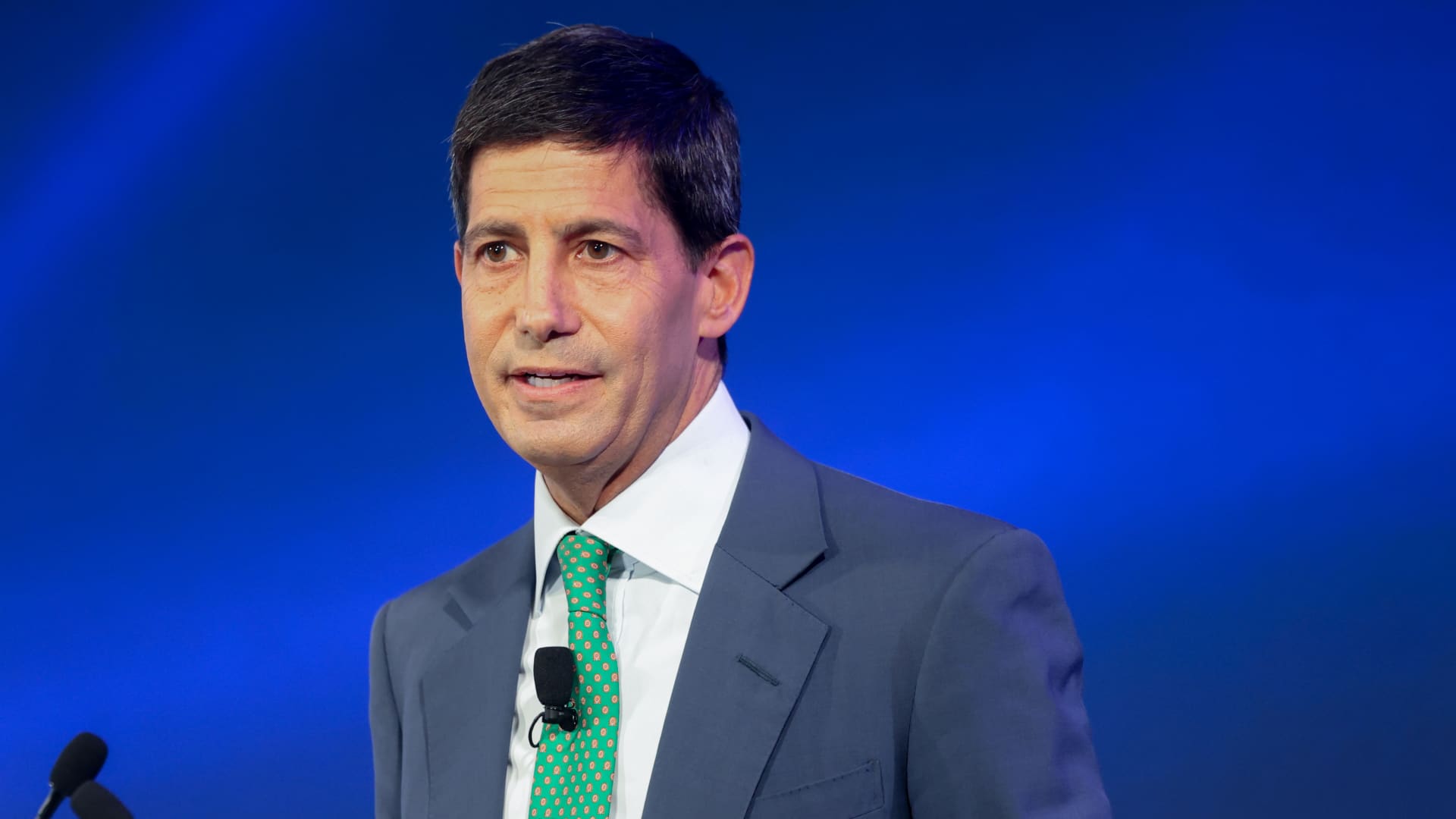


In his first stint at the Federal Reserve, Kevin Warsh came to a central bank that was about to be asked to save the world. He returns now under very different circumstances, asked to serve a notoriously fickle president who will place significant but very different demands on him.
Warsh indeed is a Fed veteran, serving during the critical period of 2006 to 2011 that led up to and ultimately through the global financial crisis and the central bank’s efforts to stabilize the economy. Appointed by President George W. Bush, Warsh was one of the youngest members ever to serve on the board of governors.
While at the Fed, Warsh played an important role in the design and implementation of emergency lending programs aimed at stabilizing credit markets. Warsh also played a key role in helping devise the myriad programs aimed at rescuing the economy. One of those programs, developed separately at the Treasury Department, became known as the Troubled Asset Relief Program, developed by Neel Kashkari, who is now the Minneapolis Fed president.
However, Warsh emerged from the era as a Fed critic.
He warned that large-scale asset purchases and near-zero benchmark interest rates ran the risk of distorting markets and undermining long-term price stability. While supporting the earlier efforts, Warsh voted against the second round of Fed bond buying, a program known as quantitative easing.
Kevin Warsh, former governor of the US Federal Reserve, during the International Monetary Fund (IMF) and World Bank Spring meetings at the IMF headquarters in Washington, DC, US, on Friday, April 25, 2025.
Tierney L. Cross | Bloomberg | Getty Images
‘Central casting’
Warsh has further criticized the post-financial crisis Fed with going too far in monetary policy stimulus, contending that it is helping sow the sees for further crises. In some respects, President Donald Trump is appointing a Fed chair who may be even less inclined to accommodate political pressure than Jerome Powell.
Trump cited Warsh’s extensive background in announcing his appointment to the top Fed post Friday morning. Warsh is currently a distinguished visiting fellow at Stanford University.
“On top of everything else, he is ‘central casting,’ and he will never let you down,” the president posted on Truth Social.
Warsh, is a Stanford University graduate who earned his law degree from Harvard and ultimately married into the Lauder cosmetics family. Before joining the Fed, he worked in investment banking at Morgan Stanley and served in the George W. Bush White House as a special assistant to the president for economic policy.
While positioning himself as a defender of Fed independence, Warsh also has criticized it for mission creep and told CNBC in an interview last year that the central bank needs “regime change.”
Warsh made his misgivings known about the current Fed.
“The credibility deficit lies with the incumbents that are at the Fed, in my view,” he said during that July interview. It’s a position that could put him in an adversarial role at an institution where consensus building is key to policy implementation.
Despite multiple missteps on policymaking, Chair Powell has largely been able to keep the Fed consensus together. However, in recent months that has faltered, with each of the past several meetings featuring at least one and sometimes multiple dissents.
Warsh’s appointment would mark a sharp philosophical shift from Powell’s pragmatic, consensus-driven approach and signal a potential tightening of the Fed’s tolerance for inflation and balance sheet expansion. He would fill the seat currently occupied by Stephen Miran, whose term expires Saturday.
Miran told CNBC on Friday that he supports the pick.
“Chairman-designate Warsh has a long history of being an innovative and original thinker on monetary policy,” Miran said. “He’s got a number of really important insights over the years, and I’m really excited to see all the good work he’s going to do at the Fed.”

Can Warsh sway the Fed committee?
But if Trump thinks Warsh will be able to just push through aggressive rate cuts with ease, he might be in for an unpleasant surprise. Multiple voting members on the Federal Open Market Committee have expressed resistance to cutting further until there’s more evidence that inflation is definitively moving towards the central bank’s 2% inflation goal.
Moreover, the full group of Fed officials in December indicated they see just one more rate cut coming in 2026, then another in 2027. In the aggregate, that’s in line with market expectations, with futures traders pricing in two reductions this year and none next year.
Traditionally, though, the chair has been first among equals when it comes to voting on the FOMC, so Warsh may be able to tilt the group in at least a bit more dovish direction.
“We see Warsh as a pragmatist not an ideological hawk in the tradition of the independent conservative central banker,” Krishna Guha, head of global policy and central bank strategy at Evercore ISI, said in a note. “Because he has a hawkish reputation and is seen as independent, he is better placed to bring the FOMC along with him to deliver at least two and plausibly three cuts this year than some rivals.”
So while Warsh may prove an ideological ally of the administration, how that translates into action will be a key question.
“Analytically, we expect he will be strongly aligned with the Administration’s arguments that booming productivity will allow for neutral or accommodative rates even with robust growth,” wrote Tobin Marcus, head of U.S. policy and politics at Wolfe Research. “But it all depends how the data comes in, as we expect the rest of the FOMC will remain data-dependent and focused on the workhorse Fed models that Warsh has criticized.”
Warsh emerged from a competitive derby that one included 11 candidates, an array of past and present Fed officials, leading economists and a few Wall Street investment professionals including BlackRock fixed income chief Rick Rieder. That field was whittled down to five then four before Warsh emerged as the selection.
Trump made no secret of the most important criteria — a willingness to slash rates lower and keep them low. The president has expressed the importance of lower rates as both a way to help the moribund U.S. housing market and to help lower financing costs for the $37 trillion U.S. debt.
Before all that, he will have to be confirmed by a Senate during a ticklish political situation.
The Trump Justice Department has been investigating the massive renovation project at the Fed’s Washington, D.C., headquarters and has served Powell with a subpoena demanding information. Republican Sen. Thom Tillis of North Carolina has vowed to block any Trump Fed nominees until that situation is resolved.
Once that hurdle is cleared, Warsh would face a full Senate in which Republicans still command a majority.
“The Warsh pick is likely to have broad support – Democrat economist Jason Furman is out early in favor – and he should be relatively easy to confirm in the Senate,” Guha said.
https://www.cnbc.com/2026/01/30/who-is-kevin-warsh-trumps-fed-chair-pick.html


