









Author
Trent Alan
Author


Share



Bitcoin’s new tell isn’t a price candle; it’s a power meter.
As traders chase the next “AI stock” breakout, a strange overlap keeps showing up: when Bitcoin rips, a handful of crypto-linked equities rip too. Especially the miners (and ex-miners) now rebranding themselves as AI/HPC hosting plays. Their pitch is measured less in hash rate and more in megawatts (MW), multi-year contracts, and data-center-style lease language.
The twist: these names can look like AI winners on green days, but when crypto volatility hits, they often snap right back into what the market treats them as first: leveraged Bitcoin proxies with a compute costume.
So, in the next big Bitcoin move (up or down), how can you tell which “AI miners” and crypto stocks will ride it or profit most, and which will lag or get wrecked?
Why Bitcoin, Miners, and “Compute” Can Trade Like One Risk Bucket
In real time, traders don’t always separate business models; they separate exposure. In risk-on windows, capital often rotates into high-beta themes together: Bitcoin, crypto-linked equities, and AI/compute momentum. When volatility spikes or liquidity tightens, the unwind can look synchronized.
The linkage is mostly tape mechanics:
- Risk-on rotation into BTC + miners + growth/AI.
- Risk-off de-risking of the same bundle.
- Basket behavior where “crypto equities” and compute beta get traded as one position.
So a miner touting AI hosting can still behave like a leveraged Bitcoin proxy on a bad crypto day, even if its AI headlines are unchanged.
From Hash Rate to Megawatts: Why the Infrastructure Story Resonates
The AI angle isn’t purely hype. Bitcoin mining forced operators to solve the hard constraints first: power access, cooling, uptime, and facilities that resemble data centers. AI/HPC needs the same foundations (at scale), and power-secured sites are hard to replicate quickly. That’s the “capacity scarcity” pitch: if demand for AI compute keeps rising, the bottleneck isn’t just GPUs; it’s where you can actually run them.
That’s also where NVIDIA (NVDA) enters the frame. NVDA is widely treated as the market’s flagship AI stock because its GPUs are central to modern AI training and inference.
NVIDIA doesn’t move because of Bitcoin, but it often sets the tone for whether investors are paying up for the broader “compute” trade. When that appetite is strong, it can make the AI-hosting angle from miners easier for traders to buy; when it weakens, hybrids can get pulled back into “just a Bitcoin proxy” treatment.
In earlier cycles, investors have argued about hash rate, power costs, and BTC production economics. In the hybrid setup, they add a second yardstick: contracted MW and how long that capacity is spoken for. The catch is that markets may value the “MW math” on good days while still trading the stock mainly on Bitcoin beta in the short term.
Why the AI Angle Shows Up Most When Crypto Isn’t Roaring
The hybrid narrative tends to land best in softer crypto tape. In a range-bound market, pure-play miners can struggle to hold attention as hash-price compresses, network difficulty rises, and investors demand clearer paths to steadier cash flow.
AI hosting offers a second storyline: instead of relying entirely on mining margins, a company can try leasing capacity to AI customers and turn fixed infrastructure into longer-dated revenue. That doesn’t eliminate crypto volatility, but it can keep a miner in the conversation (and sometimes keep capital engaged) between Bitcoin bursts.
A Practical Hybrid Watchlist
The easiest way to follow the theme is to track: (1) liquid Bitcoin-beta equities, and (2) miners with explicit AI/HPC hosting narratives, while keeping NVDA on the screen as the primary “compute sentiment” bellwether.
Bitcoin-beta crypto equities (often move hand-in-hand with BTC sentiment):
- MARA: high-beta BTC proxy, increasingly discussed for data-center/compute optionality.
- RIOT: power strategy and infrastructure reuse are central to the bull case.
- COIN: not an AI play, but often moves with crypto risk appetite.
Hybrids tied to AI/HPC hosting talk (still crypto-sensitive, but pitching MW contracts):
- HUT: reflected an AI infrastructure partnership involving Anthropic and Fluidstack, framed around large-scale MW capacity.
- CIFR: disclosed long-term AI hosting agreements with Fluidstack featuring sizable MW commitments and multi-year value language.
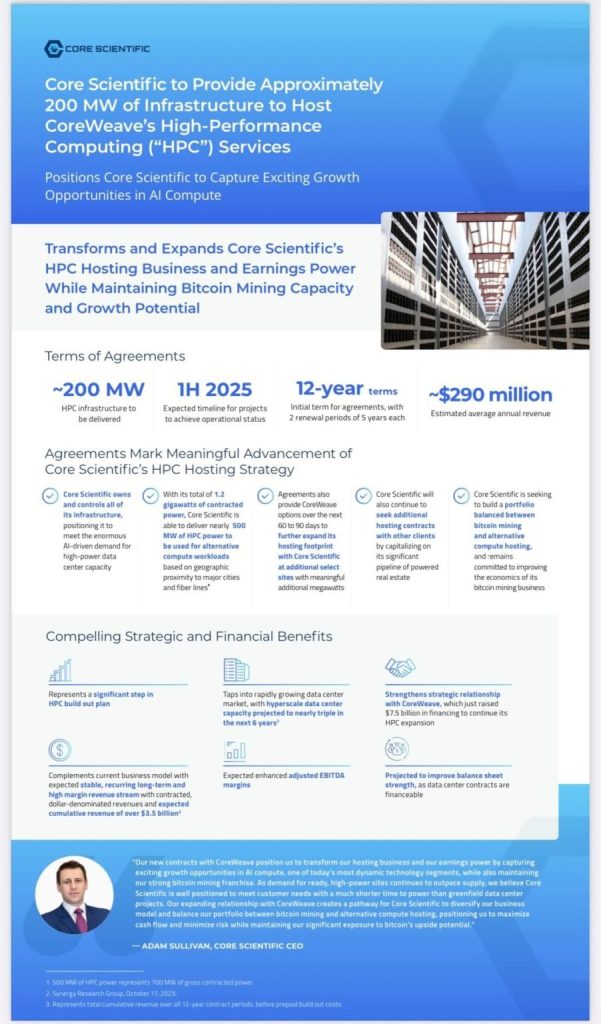
- CORZ: shifted capacity toward hosting CoreWeave’s NVIDIA GPU clusters under long-dated HPC contracts.
- IREN: positions itself as a “Bitcoin + AI data center,” expanding GPU/AI cloud efforts.
Compute backdrop (doesn’t track BTC directly, but often sets the AI tone):
- NVDA: widely viewed as the best single-stock bellwether for AI compute demand and sentiment.
Why Counterparties and Terms Matter More Than the Headline
“Hundreds of MW” is only as good as the contract behind it. For AI-focused investors, three details tend to separate substance from a trading slogan:
- Counterparty clarity: named customers/partners (and their credit) beat vague “AI pivot” claims.
- Deliverability: MW delivered and energized now beats optional expansion later.
- Duration and economics: long-dated hosting terms matter if pricing and timelines are credible.

A Reality Check Before Buying the Narrative
Treat each announcement like a data-center deal. Five questions usually do more than a dozen press-release adjectives:
- What MW is contracted vs. aspirational?
- How long is the term, and how is pricing framed?
- Who is the customer/partner, and how strong is the counterparty?
- How is capex funded—non-dilutive structures or repeated equity issuance?
- What’s the execution plan to deliver GPU-ready capacity (power, cooling, networking) on schedule?
Even if the AI side is real, the crypto side still matters. Hash-price pressure, network difficulty, and spot BTC direction can dominate short windows, and buildouts can stumble if funding tightens or timelines slip. That’s why these stocks can gap down on a Bitcoin drawdown even as they tout multi-year hosting progress.
What Are You Really Buying?
The hybrid trade’s appeal is obvious: miners try to turn mining-era assets into contracted compute capacity, while traders get a story that can participate in both AI enthusiasm and Bitcoin rallies. But the market hasn’t fully decided how to price that bridge.
On some days, it’s MW and multi-year value; on others, it’s pure Bitcoin beta. Watching NVDA alongside the hybrids helps clarify which narrative is in control: compute optimism, or crypto risk.
So the question to sit with is simple: if a stock trades like a Bitcoin proxy today but sells itself as a multi-year megawatt lessor, which story will you trust when the next volatility shock stress-tests both at once?
https://cryptonews.com/news/when-bitcoin-runs-ai-miners-hybrids-often-run-too-today/


