







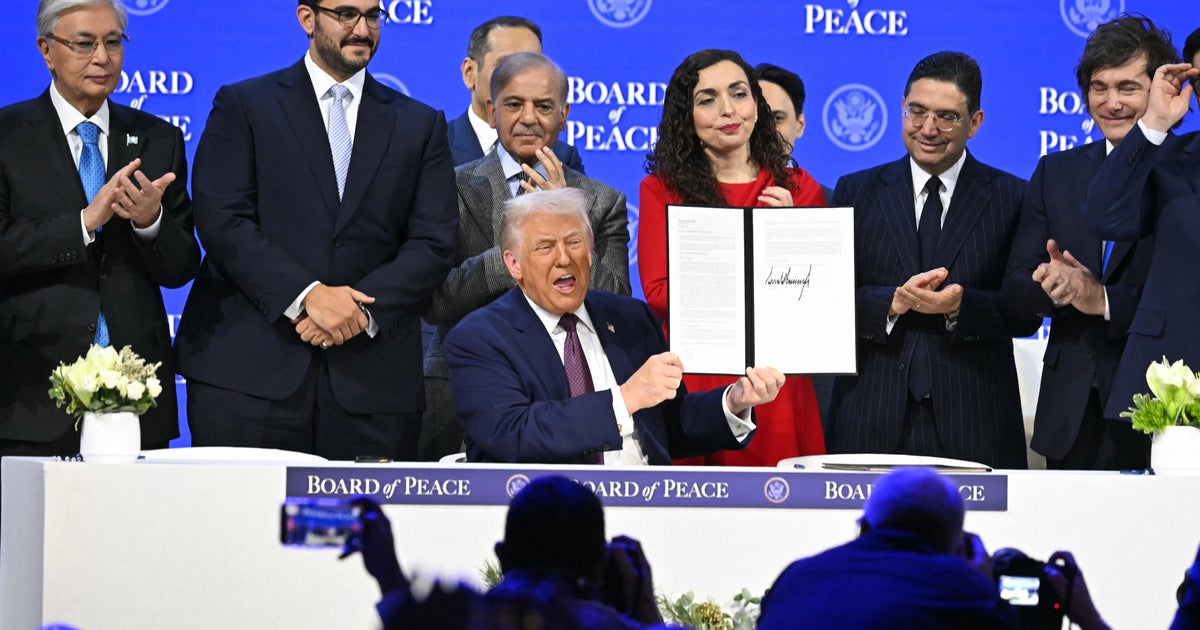
President Trump led a signing ceremony for the founding charter of his “Board of Peace” on Thursday in Davos, Switzerland, as questions lingered over the body’s operations and scope months after it was announced as part of the administration’s peace plan for Gaza.
The president hinted Thursday at wider ambitions for the board, beyond the war-torn Palestinian territory, and said repeatedly that the board would work with the United Nations, though he offered little detail.
“I think we can spread out to other things as we succeed with Gaza,” Mr. Trump said. “Once the board is formed we can do pretty much whatever we want to do … and we’re going to do it in conjunction with the United Nations.”
The board’s formation has faced headwinds from U.S. allies, many of which have yet to commit to participation.
Here’s what to know.
When was the Board of Peace created and why?
The Board of Peace was first announced in September as a key component of the Trump administration’s 20-point plan for long-term peace in Gaza and the broader Middle East. It was described in that plan as “a new international transitional body” that would “set the framework and handle the funding for the redevelopment of Gaza until such time as the Palestinian Authority has completed its reform program … and can securely and effectively take back control of Gaza.”
“This body will call on best international standards to create modern and efficient governance that serves the people of Gaza and is conducive to attracting investment,” it said.
The White House said in a statement last week that the Board of Peace would play an essential role in fulfilling all 20 points of the peace plan, “providing strategic oversight, mobilizing international resources, and ensuring accountability as Gaza transitions from conflict to peace and development.”
Who is leading the Board of Peace and overseeing it?
The Board of Peace is chaired by President Trump, who can hold that position until he resigns from it, according to a U.S. official.
According to the White House, the Board of Peace has an appointed “founding Executive Board” comprised of:
- Secretary of State Marco Rubio
- U.S. special envoy Steve Witkoff
- President Trump’s son-in-law Jared Kushner
- Former U.K. Prime Minister Tony Blair
- Billionaire financier Marc Rowan
- World Bank Group president Ajay Banga
- National security adviser Robert Gabriel
The White House says a separate group called the “Gaza Executive Board” will “help support effective governance and the delivery of best-in-class services that advance peace, stability, and prosperity for the people of Gaza.” That group is comprised of:
- U.S. special envoy Steve Witkoff
- President Trump’s son-in-law Jared Kushner
- Turkish Foreign Affairs Minister Hakan Fidan
- Ali Al-Thawadi, strategic affairs minister in Qatari prime minister’s office
- Egyptian intelligence chief General Hassan Rashad
- Former U.K. Prime Minister Tony Blair
- Billionaire financier Marc Rowan
- UAE Minister of State for International Cooperation Reem Al-Hashimy
- Bulgarian diplomat Nickolay Mladenov
- Israeli businessman Yakir Gabay
- Sigrid Kaag, Dutch former deputy prime minister and ex-UN envoy
Senior advisers to the board who are tasked with leading day-to-day operations are listed as:
- Aryeh Lightstone
- Josh Gruenbaum
Who is invited to the Board of Peace?
CBS News confirmed that more than 50 countries were invited to join as of Jan. 21.
Among them is Russia, despite its continued assault on Ukraine and the Trump administration’s statement that the country poses such a threat to national security that the U.S. must acquire Greenland to counter it.
Mr. Trump said he sent an invitation to Russian President Vladimir Putin, who said his country was still consulting with Russia’s “strategic partners” before making a decision on whether to commit to the peace board, The Associated Press reported Thursday.
Belarus, which has provided material support to Russia during its invasion of Ukraine, was also invited and its president, Aleksandr Lukashenko, accepted.
It isn’t clear what criteria the White House is using to decide which countries are being invited to join.
Who has joined the Board of Peace and who has declined?
The White House shared a list of participants ahead of the charter signing ceremony on Thursday, saying that in addition to the U.S., the following nations were taking part:
- Bahrain
- Morocco
- Argentina
- Armenia
- Azerbaijan
- Belgium
- Bulgaria
- Egypt
- Hungary
- Indonesia
- Jordan
- Kazakhstan
- Kosovo
- Mongolia
- Pakistan
- Paraguay
- Qatar
- Saudi Arabia
- Turkey
- United Arab Emirates
- Uzbekistan
Belgium, however, said Thursday it had not signed the charter.
“This announcement is incorrect,” Maxime Prévot, deputy prime minister and minister of foreign affairs, said. “We wish for a common and coordinated European response. As many European countries, we have reservations to the proposal.”
Israel and Canada were among the nations that previously announced they were accepting Mr. Trump’s invitation to join, although they did not appear on the White House list on Thursday.
None of the U.S.’ European allies had signed onto the board as of Thursday, with many voicing concern over Mr. Trump’s invitations to Putin and Lukashenko.
Britain declined to sign onto the peace board for now, U.K. Foreign Secretary Yvette Cooper said.
“We won’t be one of the signatories today,” Cooper told the BBC Thursday. “Because this is about a legal treaty that raises much broader issues, and we do also have concerns about President Putin being part of something which is talking about peace, when we have still not seen any signs from Putin that there will be a commitment to peace in Ukraine.”
Norway and Sweden said Wednesday they were holding off, at least for now, due to concerns about the terms for joining.
A source familiar with the matter told CBS News earlier this week that France intended to decline due to concerns that the Board of Peace charter goes beyond the framework of Gaza and raises major issues, particularly regarding respect for the principles and structure of the United Nations.
In response, Mr. Trump said Monday night he would impose 200% tariffs on French wine and champagne if they did not join the Board of Peace. The White House has not responded to several inquiries as to whether or not the president was joking.
A French official said they have taken note of Mr. Trump’s statements and called the use of tariff threats to influence France’s foreign policy unacceptable and ineffective.
U.S. Secretary of State Marco Rubio called the board a work in progress, indicating an expectation by the Trump administration that membership would rise.
“Many others who are going to join, you know, others either are not in town today or they have to go through some procedure internally in their own countries, in their own country, because of constitutional limitations, but others will join,” Rubio said in Davos on Thursday.
Is the Board of Peace intended to replace the United Nations?
President Trump said Thursday that the board would be committed to ensuring Gaza’s demilitarization, and hinted at wider ambitions for the group going forward.
He said the board would work “coupled with the United Nations” to create a “safer future for the world, unfolding before your eyes,” adding that the board would help to “end decades of suffering.”
The president also said the board can do “pretty much whatever we want to do” once it is formed, and that “we’re going to do it in conjunction with the United Nations.”
Earlier this week, Mr. Trump said the Board of Peace “might” replace the world’s primary global body.
“I mean, the U.N. just hasn’t been very helpful. I’m a big fan of the U.N. potential. But it has never lived up to its potential,” he said in a more than 90-minute press conference at the White House on Tuesday, Jan. 20.
But he added, “I believe you’ve got to let the U.N. continue because the potential is so great.”
In November, the United Nations passed a Security Council resolution that approved a “Board of Peace,” but with a focus limited only to Gaza.
The resolution welcomed the establishment of a Board of Peace “as a transitional administration with international legal personality” that would set the framework and coordinate funding for the redevelopment of Gaza.
The U.N. resolution more broadly endorsed the Trump administration’s 20-point Gaza peace plan, and authorized countries working with the Board of Peace to establish a stabilization force inside the Palestinian territory.
Is a financial contribution required to join?
A U.S. official confirmed a Bloomberg report that countries can contribute $1 billion to the Board of Peace to become permanent members instead of having a three-year membership. The official also said it isn’t a requirement to contribute to become a member.
The official told CBS News that any contributions will be used to rebuild Gaza and said “virtually every dollar” raised will be spent on the board’s mandate. There will be no “exorbitant salaries” or “administrative bloat,” the official said.
When it comes to financial disbursements and cash management, the board “will implement the highest financial controls and oversight mechanisms,” and funds will sit only in approved accounts at reputable banks, according to a U.S. official.
https://www.cbsnews.com/news/trump-board-of-peace-what-to-know/


