


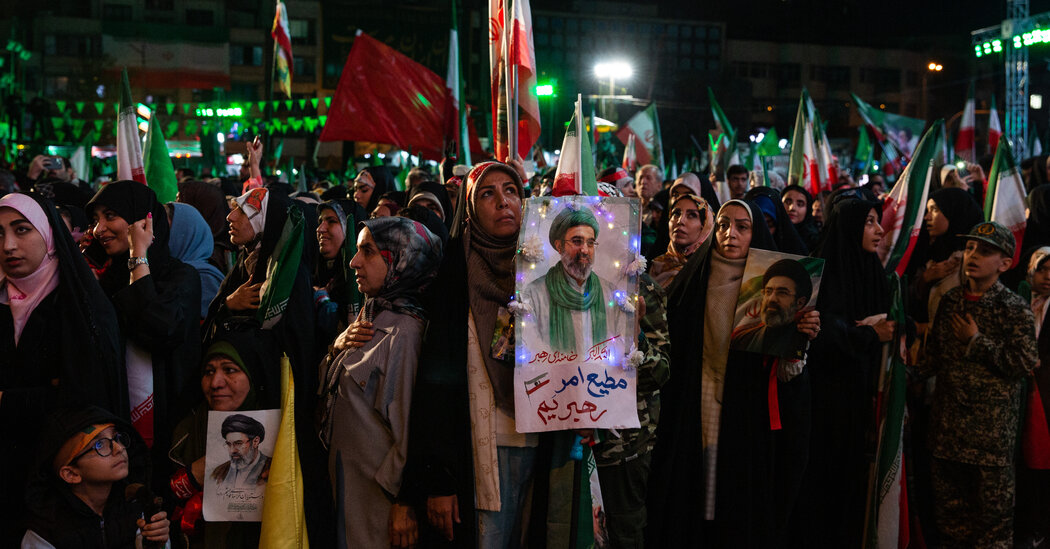
Negotiations to end the war with Iran and reopen the Strait of Hormuz are still at a standoff, after President Trump objected to Tehran’s latest proposal.
“They want to make a deal, but I’m not satisfied with it,” he said on Friday at the White House, without elaborating on what his objections were.
Iran sent the proposal to Pakistani mediators on Thursday evening, according to the Islamic Republic News Agency, which gave no details on its contents.
The two sides remain at an impasse, and Mr. Trump called off talks in Islamabad last weekend. He has repeatedly insisted that Iran cannot have nuclear weapons, while Iran has rejected American proposals that it suspend its nuclear program and hand over its stockpile of highly enriched uranium.
Without a clear way forward, the Strait of Hormuz remains effectively shut. Both the U.S. Navy and Iran’s Islamic Revolutionary Guards Corps have stringently limited which ships can use the waterway, reducing the flow of oil, natural gas and other crucial materials out of the Persian Gulf to a trickle and causing ripple effects for the world economy.
On Saturday, a senior Iranian general said that renewed confrontation between Iran and the United States was possible, according to a report from the Fars news agency.
What’s the latest?
Iran’s new supreme leader, Ayatollah Mojtaba Khamenei, issued a rare statement on Thursday vowing that Iran would manage the Strait of Hormuz under “new legal frameworks” and retain its nuclear capabilities.
“The bright future of the Persian Gulf region will be a future without America,” said Mr. Khamenei, who has been in hiding since the war began.
Shipping companies fear that Iran has mined the main channels in the strait and could attack commercial vessels. That has deterred most of the hundreds of ships in the Persian Gulf from trying to leave.
Earlier in the week, Secretary of State Marco Rubio dismissed the suggestion that Iran could eventually make money from the strait, after Iran included a plan to charge fees to passing tankers in its proposal on Sunday.
“This is not the Suez Canal, this is not the Panama Canal, these are international waters,” said Mr. Rubio, adding that the United States would not tolerate a “system in which the Iranians decide who gets to use an international waterway and how much you have to pay them to use it.”
In an earlier offer, Iran proposed suspending uranium enrichment for five years, followed by five years of very low-grade civilian enrichment. Under that proposal, half of Iran’s 972-pound stockpile of highly enriched uranium would have gone to Russia, an ally, and the other half would have been available to international inspectors.
The United States, which has demanded that Iran suspend all nuclear activity for 20 years and hand over its highly enriched uranium, rejected the offer.
Pakistan has been mediating between the United States and Iran to try to end the war. After a first round of negotiations collapsed, Mr. Trump said last week that he was maintaining the U.S. naval blockade in the Strait of Hormuz and indefinitely extending the cease-fire.
Iran’s nuclear program
Iran insists it has a right to enrich nuclear fuel under the Nuclear Nonproliferation Treaty.
Mr. Trump has repeatedly said that he will not allow Iran to possess a nuclear weapon. But he is also confronting the complicated legacy of his decision, eight years ago, to cancel what he has called “a horrible, one-sided deal” to curtail Iran’s nuclear program.
That Obama-era agreement — formally called the Joint Comprehensive Plan of Action, or J.C.P.O.A. — would have expired after 15 years, leaving Iran free after 2030 to make as much nuclear fuel as it wanted. After Mr. Trump withdrew from the deal in 2018, the Iranians went on an enrichment spree, leaving them closer to producing a bomb than ever before.
Much recent attention has focused on Iran’s half-ton of uranium that has been enriched to a level close to what is typically used in atom bombs. The majority of it is thought to be buried in a tunnel complex that Mr. Trump bombed last June. But those 970 pounds of potential bomb fuel represent only a small fraction of the problem.
Today, international inspectors say, Iran has a total of 11 tons of uranium, at various enrichment levels. With further purification, that is enough to build up to 100 nuclear weapons — more than the estimated size of Israel’s arsenal.
Virtually all of that cache accumulated in the years after Mr. Trump abandoned the Obama-era deal.
A clash of negotiating styles
Mr. Trump views himself as the master of coercive diplomacy, forcing his opponents to capitulate quickly to American demands or face the threat of attack.
In dealing with Iran over the past six weeks, he has discovered that he is up against a nation that prides itself on resilience and delay.
“Trump is impulsive and temperamental; Iran’s leadership is stubborn and tenacious,” said Robert Malley, who negotiated with the Iranians in the lead-up to the 2015 nuclear deal and again in a failed effort by the Biden administration.
Leo SandsFarnaz Fassihi,David E. Sanger and Luke Broadwater contributed reporting.
https://www.nytimes.com/2026/04/26/world/middleeast/us-iran-peace-talks-pakistan.html
