


Four months after mass protests brought down Bulgaria’s government, the country is preparing to vote for new leadership on Sunday, its eighth election in five years.
Bulgaria has seen multiple governments come and go since the fall of communism in 1989, most voted out for failing to deliver. It became a member of the North Atlantic Treaty Organization and the European Union, yet has remained at the bottom of the European family in terms of economic prosperity and endemic corruption.
Public dissatisfaction reached a peak in the last five years over a growing sense that a corrupt elite was ruling with impunity and weak coalition governments were failing to enact promised reforms.
Growing Discontent
The arrest in July of the port city Varna’s mayor — a member of the We Continue the Change party — on charges of embezzlement, which he denied, started rolling demonstrations last year. Then an attempt to force through a budget that raised taxes and lifted the salaries of members of the state security apparatus set off the mass protests in December.
Several videos of altercations between opposition politicians and supporters of the government in Parliament went viral, striking a deep chord with Bulgarians yearning for the kind of prosperous life enjoyed by other Europeans.
Tens of thousands of people filled the streets of the capital, Sofia, on several occasions in organized protests, bringing out a cross section of society, including employers’ associations and trade unions, teachers, students and Bulgaria’s ethnic minorities. The number of protesters surprised even the organizers.
“There is significant disappointment among the people,” Daniel Smilov, a professor of political science and the program director of the Center for Liberal Strategies at the University of Sofia, said of previous short-lived governments. “The last government in particular was composed of political parties that the great majority of people saw as corrupt.”
A caretaker government was put in place in February, and new elections were scheduled for Sunday.
Who’s Running
An alliance of liberal opposition parties called We Continue the Change — Democratic Bulgaria, which spearheaded the protests, hoped to use the momentum of the demonstrations to build electoral gains.
But it was soon overtaken by Bulgaria’s most recent former president, Rumen Radev, who resigned his post and in March joined the race for Parliament, rapidly gathering support behind his new coalition, Progressive Bulgaria.
A former fighter pilot and commander of Bulgaria’s air force, Mr. Radev, 62, was twice elected president and became a popular, well-known figure in the country. The post of president in Bulgaria is largely ceremonial, which allowed him to remain aloof from the political maneuvering, and infighting, of daily governing.
Under Bulgaria’s parliamentary democracy, the party with a majority of seats in Parliament forms a government, with the party leader often but not always assuming the post of prime minister.
Most independent opinion polls show Progressive Bulgaria leading with more than 30 percent support, well ahead of challengers, but not necessarily enough to secure a majority.
Mr. Radev has promised to fight corruption and dismantle the “oligarchy,” a phrase used to describe a powerful and shady elite with outsize influence over Bulgaria’s political and economic life.
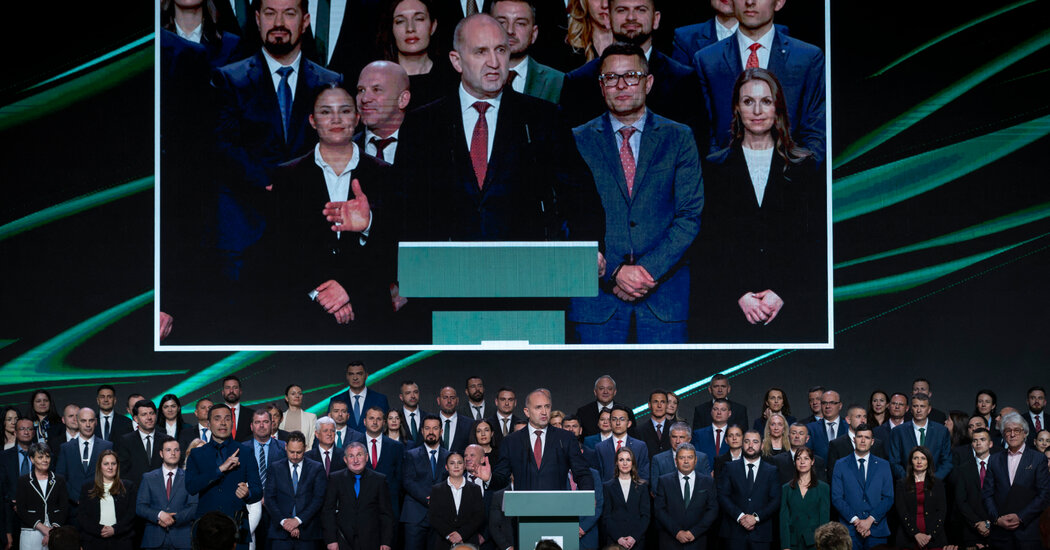
At a glitzy rally on Thursday night of more than 10,000 supporters in Sofia, Mr. Radev said the party was aiming to form a government without needing to enter a coalition with the political parties that have been in power over the past decade.
“Progressive Bulgaria will not go down the path of the previous stitched-together coalitions,” he told an applauding crowd.
“We do not promise miracles, but we promise rules: a law for everybody; peace, because without it everything else loses meaning,” he said.
Mr. Radev’s success in inspiring such a rapid surge of support reflects the disenchantment of many Bulgarians who are fed up with previous leaders.
“The others are trash,” said Simona Georgieva, 22, who attended the rally. Her boyfriend, Kristian Popov, who works in marketing and communications, is running for Parliament as a candidate for Progressive Bulgaria. “We want to make change for our country,” she said.
Mr. Radev has offered a broad platform that can appeal to a wide cross section of society and draw in older generations, conservative, pro-Russian voters and the younger pro-European and business communities.
Ties to Russia
Bulgaria has deep cultural, religious and linguistic ties to Russia, said Parvan Simeonov, the founder of the Myara polling agency, and since the full-scale war in Ukraine began in 2022, politics in Bulgaria has changed from right wing-left wing and conservative versus liberal to an East-versus-West divide.
“The tradition here, the cultural tradition, the religious tradition, is rather linked to Russia,” he said, “and Rumen Radev speaks this language.”
Mr. Radev gained a reputation for being pro-Russian in his comments and positions during his nine years as president. He recently criticized the caretaker government for rushing to sign a security agreement with President Volodymyr Zelensky of Ukraine. He has complained that the previous government’s decision to join the eurozone in January should have been put to a referendum, saying that the timing was not beneficial for Bulgaria.
But he has filled his party list with sports personalities and technocrats who are decidedly pro-European in their outlook and focused on economic development.
“We are very ambitious people, and very pragmatic,” said Alexander Pulev, 45, a former adviser and a candidate for Mr. Radev’s party from the industrial cities of Stara Zagora and Shumen, describing the new party’s members. “We have shared priorities on how to improve the well-being of Bulgarian citizens. That’s the common topic.”
Mr. Radev has been outspoken about his determination to break the stranglehold of organized crime in Bulgaria and, specifically, to dismantle the influence of Delyan Peevski, one of the most powerful politicians in Bulgaria. Mr. Peevski was placed under sanction in 2021 by the U.S. Treasury for engaging in “corruption, using influence peddling and bribes to protect himself from public scrutiny and exert control over key institutions and sectors in Bulgarian society.”
Political parties have made similar promises before, but Mr. Pulev said he believed the team under Mr. Radev was ready for a fight.
Some political analysts said Mr. Radev had been so purposefully vague about his policies that it was far from clear how he would act if he formed a government.
Mr. Radev will most likely want to continue importing Russian oil and gas to Bulgaria and be against the European Union supplying financial and military assistance to Ukraine, said Mr. Smilov, the professor at the University of Sofia.
“I don’t expect any radical moves from Radev, such as withdrawing Bulgaria from NATO or the European Union,” he said. “For the first time, however, there is a possibility of a parliamentary majority that is not strongly committed to the European Union and NATO. It is unlikely to be openly pro-Russian, but it could differ significantly from previous pro-European majorities.”
Boryana Dzhambazova contributed reporting.
