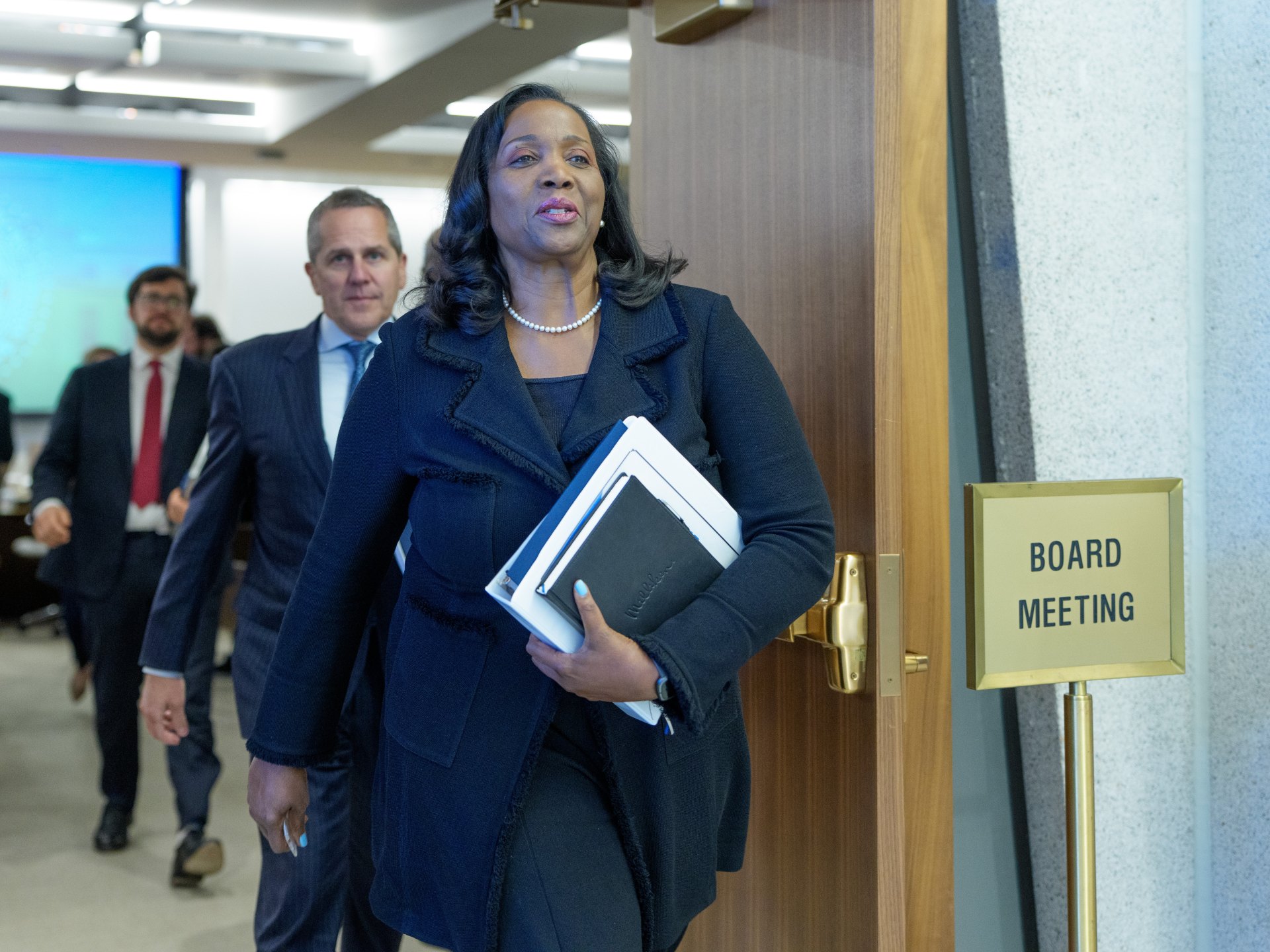
Conservative and liberal United States Supreme Court justices have signalled scepticism towards US President Donald Trump’s bid to fire US Federal Reserve Governor Lisa Cook in a case with the central bank’s independence at stake.
During about two hours of arguments in the case on Wednesday, the justices indicated they were unlikely to grant the Trump administration’s request to lift a judge’s decision barring the Republican president from immediately firing Cook while her legal challenge continues to play out.
Recommended Stories
list of 4 itemsend of list
Some of the justices pressed D John Sauer, the US solicitor general arguing for Trump’s administration, about why Cook was not given a chance to formally respond to the unproven mortgage fraud allegations – which she has denied – that the president cited as justification for ousting Cook.
They also raised concerns about the effect on the economy of such a first-ever presidential firing from the central bank and the implications for the Fed’s cherished independence from political influence.
The case represents the latest dispute to come to the top US judicial body involving Trump’s expansive view of presidential powers since he returned to office 12 months ago.
When the court, which has a 6-3 conservative majority, agreed in October to hear the case, it left Cook in her job for the time being.
“This case is about whether the Federal Reserve will set key interest rates guided by evidence and independent judgment or will succumb to political pressure,” Cook, who attended the arguments, said in a statement afterward.
“For as long as I serve at the Federal Reserve, I will uphold the principle of political independence in service to the American people,” Cook added.
Federal Reserve Chairman Jerome Powell also sat through the nearly two hours of arguments in the packed courtroom.
‘Cause for removal’
Sauer told the justices that the allegations against Cook impugn her “conduct, fitness, ability or competence to serve as a governor of the Federal Reserve”.
“The American people should not have their interest rates determined by someone who was, at best, grossly negligent in obtaining favourable interest rates for herself,” Sauer said.
“Deceit or gross negligence by a financial regulator in financial transactions is cause for removal,” Sauer added, arguing that the allegations require immediate removal.
Cook has called the allegations against her a pretext to fire her over monetary policy differences as Trump heaps pressure on the central bank to cut interest rates and lashes out at Fed Chair Powell for not doing so more quickly.
Conservative Chief Justice John Roberts asked Sauer to explain whether his argument that Cook should be immediately removed applies if the basis of the mortgage allegations – that she cited two different properties as a principal residence – is an “inadvertent mistake contradicted by other documents in the record”.
Sauer responded that, even if Cook made a mistake on mortgage paper, “it is quite a big mistake”.
Roberts seemed sceptical, telling Sauer, “We can debate that.”
Paul Clement, the lawyer arguing for Cook, told the justices that the allegations against her arise from “at most an inadvertent mistake” on a mortgage application concerning a vacation property.
Trump’s move against Cook is seen as the most consequential challenge to the Fed’s independence since it was formed in 1913. Until now, no president had sought to oust a Fed official.
A Supreme Court ruling is expected by the end of June.
Pressure on Fed independence
Conservative Justice Samuel Alito expressed concern that the administration had handled the case “in a very cursory manner”. Though the case involves Trump’s asserted cause to fire Cook, Alito said, “No court has ever explored those facts. Are the mortgage applications even in the record in this case?”
“There’s a million hard questions in this case,” Alito said.
In creating the Fed, Congress passed a law called the Federal Reserve Act that included provisions meant to insulate the central bank from political interference, requiring governors to be removed by a president only “for cause,” though the law does not define the term nor establish procedures for removal.
Clement told the justices that Trump’s position would transform tenure protections for Fed governors into “at-will employment”.
“That makes no sense,” Clement said. “There’s no rational reason to go through all the trouble of creating this unique, quasi-private entity that is exempt from everything from the [congressional] appropriations process to the civil service laws, just to give it a removal restriction that is as toothless as the president imagines.”
Roberts expressed doubts about Sauer’s arguments that the president’s assertion of a cause is not reviewable, or that judges cannot reinstate a fired officer.
Conservative Justice Brett Kavanaugh expressed doubts about the real-world effects of the administration’s arguments.
“Your position,” Kavanaugh told Sauer, “that there’s no judicial review, no process required, no remedy available, very low bar for cause that the president alone determines – I mean, that would weaken, if not shatter, the independence of the Federal Reserve.”
Conservative Justice Amy Coney Barrett also questioned why the Trump administration has denied Cook a hearing to defend herself, saying that it “would not have been that big of a deal” for Trump to sit down with Cook and lay out the alleged evidence against her.
Barrett also asked Sauer about the practical implications of allowing Trump’s firing of a Fed governor.
“We have amicus [friend-of-the-court] briefs from economists who tell us that if Governor Cook is [fired], that would trigger a recession. How should we think about the public interest in a case like this?” Barrett asked, adding: “If there is a risk [at this preliminary stage of the case], doesn’t that counsel caution on our part?”
Sauer said that Cook was notified in August of her termination, and that has not affected the markets. Sauer urged the justices to weigh the predictions of doom for the US economy by economists in briefs submitted in the case supportive of Cook with a “jaundiced eye”.
US District Judge Jia Cobb in September ruled that Trump’s attempt to remove Cook without notice or a hearing likely violated her right to due process under the US Constitution’s Fifth Amendment. Cobb also found that the mortgage fraud allegations likely were not a legally sufficient cause to remove a Fed governor under the law, noting that the alleged conduct occurred before she served in the Fed post.
The US Court of Appeals for the District of Columbia Circuit declined Trump’s request to put Cobb’s order on hold.
‘You’re fired’
Conservative and liberal justices alike posed sharp questions to Sauer on his contention that Cook was not entitled to formal notice and a hearing before removal by the president.
Conservative Justice Neil Gorsuch asked Sauer what such a hearing would look like and whether Cook would have a right to legal counsel.
Sauer responded that the court in the past has been very reluctant to “dictate procedures to the president” and that it would be up to Trump to decide.
“Calling Ms. Cook into the [White House] Roosevelt Room, sitting across a conference table, listening for, I don’t know how long, how much evidence is a lawyer required, and then making a decision? Could that suffice?” Gorsuch asked, adding: “Just a meeting across a conference table finished with, ‘You’re fired’?”
Conservative Justice Clarence Thomas asked Sauer on what basis the justices should conclude that the Fed is “an executive branch agency and hence that the president does have a removal authority”.
“There’s an academic dispute about whether or not the Federal Reserve’s Open Market operations constitute executive power or something else, essentially private conduct. However, Congress has over the years kind of packed on traditional executive powers on the Federal Reserve,” Sauer replied.
As a Fed governor, Cook helps set US monetary policy with the rest of the central bank’s seven-member board and the heads of the 12 regional Fed banks. Her term in the job runs to 2038. Cook was appointed in 2022 by Democratic former US President Joe Biden and is the first Black woman to serve in the post.
Liberal Justice Ketanji Brown Jackson pressed Sauer to reconcile two seemingly conflicting positions: his claim that the president has broad discretion to remove a Fed governor, and his recognition that Congress included tenure protections for Fed governors to shield the Fed’s independence from White House interference.
“How does that further the aims of the statute?” Jackson asked.
Alito voiced scepticism toward Clement’s argument that a Fed governor’s conduct before taking office cannot provide a basis for removal by the president, asking Cook’s attorney to address a series of increasingly egregious hypothetical scenarios.
“How about if, after the person assumes office, videos are disclosed in which the office holder is expressing deep admiration for Hitler or for the Klan?” Alito asked.
The president sought to fire Cook on August 25 by posting a termination letter on social media citing the mortgage fraud allegations disclosed by Federal Housing Finance Agency Director Bill Pulte, a Trump appointee.
The administration this month opened a criminal investigation into Powell over remarks he made to Congress last year about a Fed building project, a move he similarly called a pretext aimed at gaining influence over monetary policy.
https://www.aljazeera.com/economy/2026/1/21/us-supreme-court-appears-reluctant-to-let-trump-fire-feds-lisa-cook?traffic_source=rss