






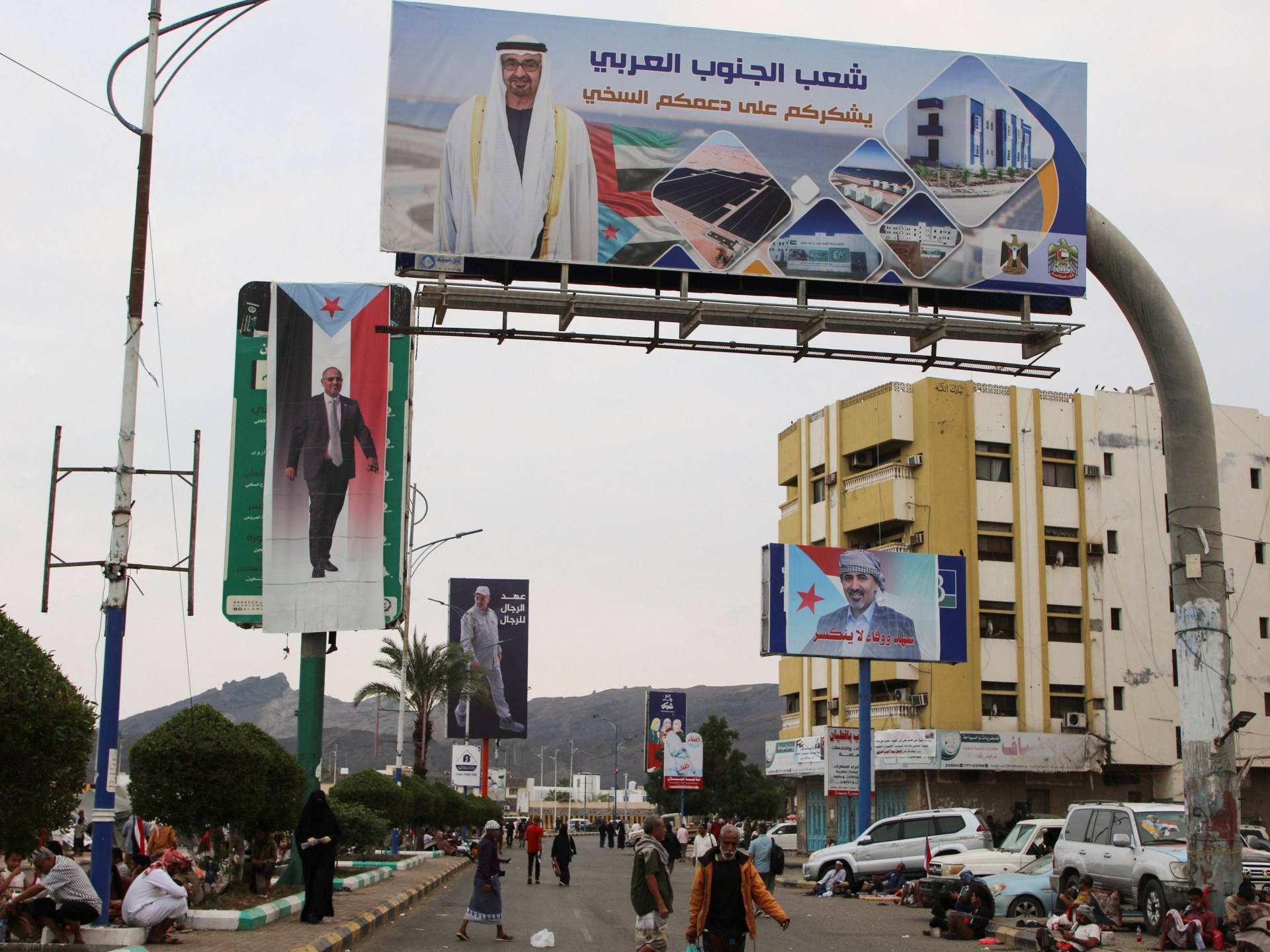
The United Arab Emirates has announced the withdrawal of its forces from Yemen, declaring an end to what it called “counterterrorism” operations there, after Saudi Arabia accused Abu Dhabi of supporting separatists in Yemen.
The announcement on Tuesday came after Yemen’s internationally recognised government demanded the UAE pull its forces from the country within 24 hours, a call backed by Saudi Arabia.
Recommended Stories
list of 4 itemsend of list
Hours earlier, Saudi Arabian-led coalition forces also attacked the southern Yemeni port of Mukalla, targeting what Riyadh said was a UAE-linked weapons shipment destined for the separatist Southern Transition Council (STC) in Yemen.
The STC, which initially supported Yemen’s internationally recognised government against the Houthi rebels, launched an offensive against the Saudi Arabian-backed government troops this month, seeking an independent state in the south.
The advance broke years of deadlock, with the STC seizing control of broad swaths of southern Yemen, including the Hadramout and Mahara provinces, in defiance of warnings from Riyadh. Hadramout borders Saudi Arabia, and Mahara is close to the border.
Saudi Arabia on Tuesday said it was disappointed about “pressure exerted by the UAE” on the STC to conduct military operations in the Hadramout and Mahara provinces. Riyadh said it considered the moves a threat to its national security.
“In this context, the kingdom stresses that any threat to its national security is a red line, and the Kingdom will not hesitate to take all necessary steps and measures to confront and neutralise any such threat,” it said.
Following Tuesday’s rapid-fire events, the UAE’s Ministry of Defence said it carried out a “comprehensive assessment” of its role in Yemen and decided to end its mission there.
“In light of recent developments and their potential implications for the safety and effectiveness of counterterrorism missions, the Ministry of Defence announces the termination of the remaining counterterrorism personnel in Yemen of its own volition, in a manner that ensures the safety of its personnel,” the UAE statement said.
The UAE announcement came amid efforts to tamp down tensions that have erupted in recent days.
Qatar’s Ministry of Foreign Affairs said that it welcomed the Saudi Arabian and UAE statements, which it said reflected a “commitment to prioritising the interests of the region, strengthening the principles of good neighbourliness, and adhering to the foundations and principles upon which the GCC Charter is based.”
The Gulf Cooperation Council consists of Qatar, Saudi Arabia, Bahrain, Kuwait, Oman and the UAE.
Meanwhile, Saudi Minister of Foreign Affairs Prince Faisal bin Farhan Al Saud held telephone conversations with US Secretary of State Marco Rubio and Pakistani Deputy Prime Minister and Foreign Minister Ishaq Dar, discussing “regional developments”.
Tensions over the STC
The Saudi Arabian-led coalition’s strike on Yemen’s Mukalla revealed widening tensions within a coalition built in 2015 to combat the Houthi rebels, who control most of northern Yemen.
Emirati troops first arrived in Yemen as part of the Saudi Arabian-led coalition that year, but the UAE pulled most of its forces out in 2019, leaving only a limited number in the government-run south.
Following the Mukalla strike, which did not cause casualties, Rashad al-Alimi, the head of Yemen’s Saudi Arabian-backed presidential council, dissolved a defence pact with the UAE and gave Emirati forces 24 hours to leave.
In a televised speech, al-Alimi said it had been “definitively confirmed that the UAE pressured and directed the STC to undermine and rebel against the authority of the state through military escalation”, according to the Yemeni state news agency.
Saudi Arabia backed al-Alimi’s call for the UAE to withdraw its forces from Yemeni territory, and asked that it halt “any military or financial support to any party” in the country.
The UAE said it had been surprised by the Saudi air strike, and that the shipments in question did not contain weapons and were destined for the Emirati forces, rather than the STC.
It also said that it was committed to enduring the security of Saudi Arabia and that it was seeking a solution “that prevents escalation, based on reliable facts and existing coordination”.
Yemeni state television showed what it said was black smoke rising from the port in the early morning, with burned vehicles. Al-Alimi declared a no-fly zone, and a sea and ground blockade on all ports and crossings for 72 hours.
However, the STC remained defiant, insisting there was “no thinking about withdrawal” from its newly seized positions.
“It is unreasonable for the landowner to be asked to leave his own land. The situation requires staying and reinforcing,” STC spokesman Anwar al-Tamimi told the AFP news agency.
“We are in a defensive position, and any movement toward our forces will be responded to by our forces,” he added.
https://www.aljazeera.com/news/2025/12/31/uae-to-pull-forces-out-of-yemen-as-tensions-rise-with-saudi-arabia?traffic_source=rss


