






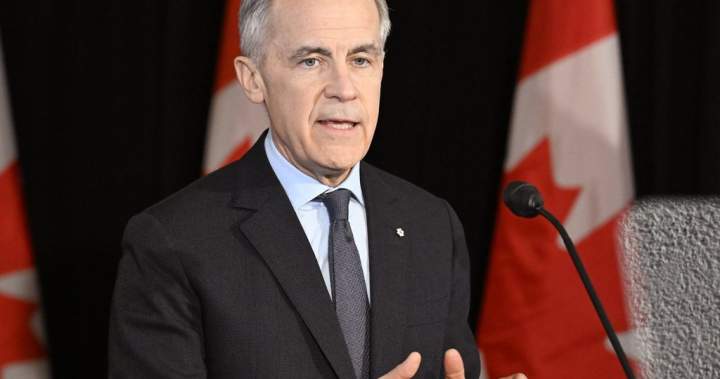
Canadian Prime Minister Mark Carney said Americans will face the brunt of affordability challenges posed by U.S. President Donald Trump’s latest salvo in the trade war between the two countries.


Carney’s comments came a day after Trump threatened 100 per cent tariffs on Canadian goods over its decision to expand economic ties with China.
Asked about the threat, Carney pointed to affordability impacts.
“The impact of American tariffs will be on American affordability, not Canadian affordability,” Carney told reporters in French.
He appeared to be alluding to the fact that duties slapped on Canadian imports by the U.S. would be more felt by American consumers. When American companies bring in tariffed Canadian goods, they’re the ones having to pay the cost and, in most cases, pass that onto the public.
The prime minister outlined measures Ottawa would take to protect affordability in Canada, such as child and dental care, and the national food program for children.
Carney also said there would be “other significant measures” on affordability announced in the coming days.
Trump’s threat came days after Carney negotiated a new “strategic partnership” with China aimed at expanding bilateral trade and investment.


Get breaking National news
For news impacting Canada and around the world, sign up for breaking news alerts delivered directly to you when they happen.
“If Governor Carney thinks he is going to make Canada a ‘Drop Off Port’ for China to send goods and products into the United States, he is sorely mistaken,” Trump wrote on Truth Social. “China will eat Canada alive, completely devour it, including the destruction of their businesses, social fabric, and general way of life.”
Yet despite the partnership, Canada-U.S. Trade and One Canadian Economy Minister Dominic LeBlanc recently said there was no pursuit of a free trade deal with China, calling the recent talks a resolution of specific tariff-related issues.
In his comments Sunday, Carney said Canada respected its current commitments such as the Canada-U.S.-Mexico Agreement (CUSMA).
“We have commitments under CUSMA not to pursue free trade agreements with non-market economies without prior notification,” he stressed. “We have no intention of doing that with China or any other non-market economy. What we’ve done with China is to rectify some issues that developed in the last couple of years.”
The deal signed with Beijing reversed course on 100 per cent tariffs Canada had slapped on Chinese electric vehicles (EVs) in 2024, which aligned with similar U.S. duties. Canada and China also agreed to reduce tariffs on canola and other products.
Trump’s comments Saturday are an about-face from his earlier reaction to the deal reached between Canada and China, who at the time called the agreement a good thing. “That’s what he should be doing. It’s a good thing for him to sign a trade deal. If you can get a deal with China, you should do that,” Trump told reporters.
His cabinet though, had expressed concern.
Canadian MPs are set to return to Parliament on Monday, with budget implementation expected to be at the front of the line.
It’s also where Carney will face off with Conservative Leader Pierre Poilievre. On Saturday, the Opposition Leader called for action by Carney on multiple affordability measures, including making food affordable, and fast-tracking bills that enact trade deals.
Poilievre also wrote in a letter to Carney that Conservative MPs were “Ready” to visit the U.S. and other markets to open up trade, including through bipartisan delegations.
—with files from Global News’ Prisha Dev and Sean Boynton
© 2026 Global News, a division of Corus Entertainment Inc.
U.S. affordability to face brunt of tariffs on Canada, Carney says


