






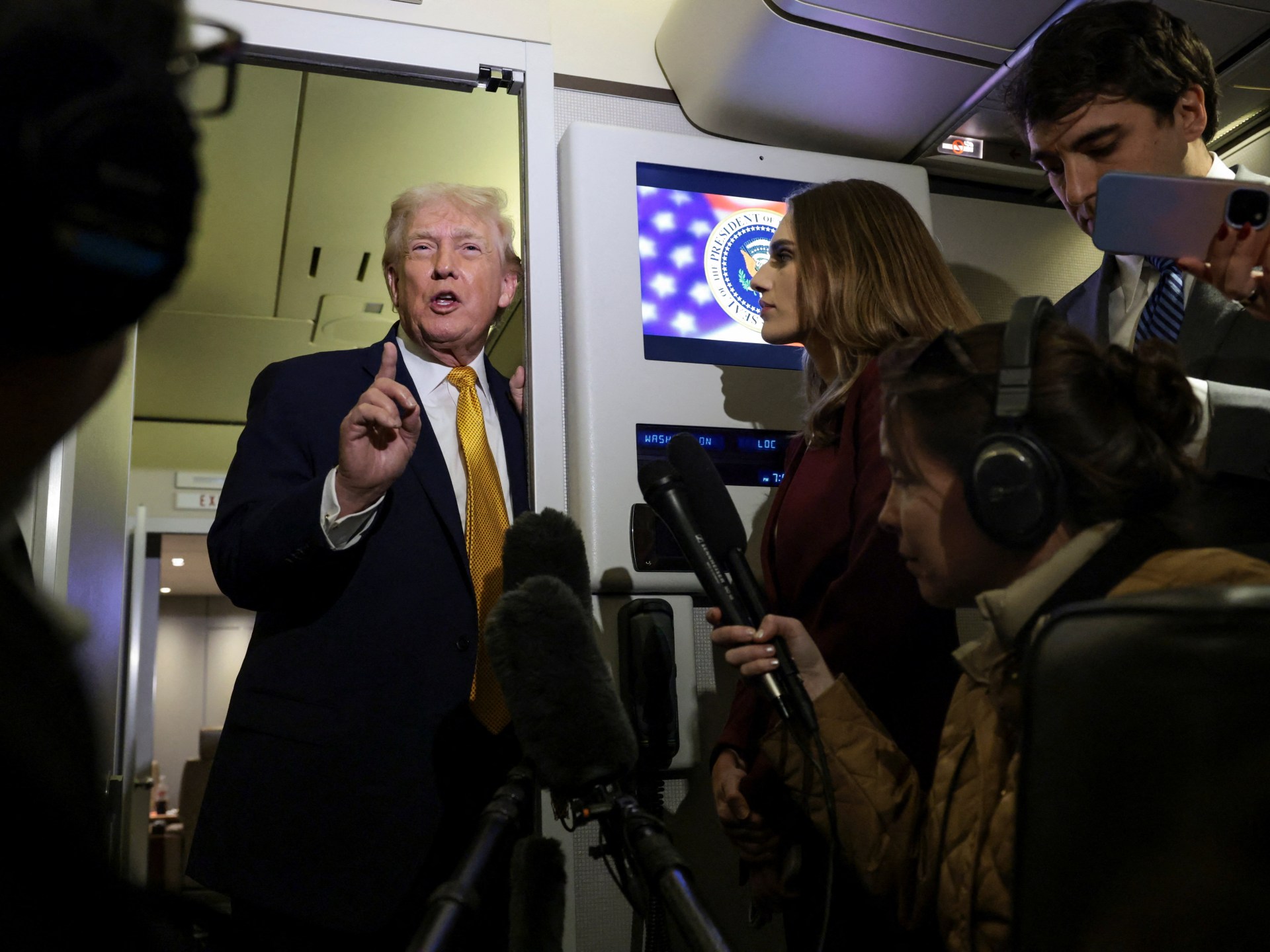
United States President Donald Trump has threatened his Colombian counterpart, Gustavo Petro, following Washington’s abduction of Venezuela’s leader, and said he believed the government in Cuba, too, was likely to fall soon.
Trump’s comments on board Air Force One on Sunday signal the US government is prepared to consider additional military interventions in Latin America, despite the growing regional and global outcry over the brazen abduction of Nicolas Maduro.
Recommended Stories
list of 4 itemsend of list
Trump told reporters that both Colombia and Venezuela were “very sick” and that the government in Bogota was run by “a sick man who likes making cocaine and selling it to the United States”.
“And he’s not going to be doing it very long. Let me tell you,” Trump said, referring to Petro.
When asked if he meant a US operation against Colombia, Trump said, “Sounds good to me.”
The remarks prompted a sharp response from Petro, who called on Latin American countries to unite or risk being “treated as a servant and slave”.
In a lengthy post on X, he noted that “the US is the first country in the world to bomb a South American capital in all of human history” but said revenge was not the answer.
Instead, Latin America must unite, Petro said, and become a region “with the capacity to understand, trade, and join together with the whole world”.
“We do not look only to the north, but in all directions,” he said.
Warnings to Venezuela, Mexico, and Cuba
Trump’s comments came a day after US forces seized Maduro in Caracas in what Washington described as a law enforcement operation to bring him to trial on “narco-terrorism” charges. Maduro denies the allegations and critics of the US claim the Venezuelan leader’s ouster was aimed at taking control of the country’s vast oil reserves.
Speaking to reporters on Air Force One, Trump insisted that the US was “in charge” of Venezuela, even though the country’s Supreme Court has appointed Vice President Delcy Rodriguez as interim leader.
He also reiterated threats to send the US military back to Venezuela if it “doesn’t behave”.
A lot of Cubans were killed in the US raid, he continued, adding that a US military intervention in Cuba was unnecessary because the island appears ready to fall on its own.
“Cuba is ready to fall. Cuba looks like it’s ready to fall,” he said. “Cuba now has no income. They got all of their income from Venezuela, from the Venezuelan oil. They’re not getting any of it. Cuba literally is ready to fall.”
Trump went on to warn neighbouring Mexico, saying the country “has to get their act together because they’re [drugs] pouring through Mexico and we’re going to have to do something”.
He described Mexican President Claudia Sheinbaum as a “terrific person” and said he has offered to send US troops to Mexico every time he spoke to her. The Mexican government is capable of addressing the issue, “but unfortunately the cartels are very strong in Mexico,” he said.
“The cartels are running Mexico whether you like it or not,” he added.
‘Don-roe Doctrine’
Trump has made no secret of his ambitions to expand the US presence in the Western Hemisphere and revive the 19th century Monroe Doctrine, which states that Latin America falls under Washington’s sphere of influence.
Trump has called his 21st century version the “Don-roe Doctrine”.
Al Jazeera’s John Holman, reporting from Cucuta on the Colombia-Venezuela border, said Trump’s remarks come amid a “bigger pattern” of the US leader targeting left-leaning countries in Latin America and trying to assert US dominance in the region.
“He’s saying that Latin America is our area, and we need to be dominant there. And after what’s happened with Nicolas Maduro, those threats and comments are going to be taken a bit more seriously,” Holman said.
The governments of Brazil, Chile, Colombia, Mexico, Uruguay and Spain meanwhile expressed their “profound concern” in a joint statement and said they “firmly reject the military actions undertaken unilaterally in Venezuelan territory”.
“These actions contravene fundamental principles of international law, particularly the prohibition on the use or threat of force. They constitute an extremely dangerous precedent for peace and regional security and endanger the civilian population,” they said.
‘Regime change’ in Latin America
Analysts said it remained unclear whether Trump would act on his threats, or whether he was aiming to coerce them into cooperating with Washington.
“It’s very hard to predict. If you look at the way Trump operates, what he always hopes is other countries will do what he wants them to do without him having to use very much force. These short, spectacular displays of force like the bombing in Iran, this operation in Venezuela scare other countries into doing what Trump wants them to do,” said David Smith, an associate professor of the University of Sydney’s US Studies Centre.
“Maduro seems to have tried to call his bluff in this case, and it turned out it wasn’t a bluff,” Smith told Al Jazeera. “They don’t know whether he’s bluffing now when he makes threats towards other countries, or renewed threats towards Venezuela.”
Trump is “trying to pressure regime change” across Latin America in other ways as well, Smith said, noting that the US president has previously sparred with Petro over deportation flights and sanctioned a Brazilian judge who oversaw the prosecution of former President Jair Bolsonaro – a Trump ally – for an attempted insurrection.
Trump has also backed the right-wing government of Argentina’s Javier Gerardo Milei and pardoned ex-Honduran President Juan Orlando Hernandez of drug trafficking charges.
“We’ve seen in this first year of his administration in general a far more concerted agenda to promote right-wing governments in Latin America and to damage left – wing governments in Latin America,” Smith said.
Matthew Wilson, a political scientist at Southern Methodist University in the US, said Cuba would be the top priority if further action occurred, given longstanding US grievances and the influence of Cuban-American constituencies hostile to Havana’s government.
The US and Cuba have had strained relations since Fidel Castro overthrew a US-backed government in Havana in 1959 and established a socialist state allied with the former Soviet Union.
“I would be more concerned if I were in Cuba than if I were in Colombia… Because there’s a longstanding US grievance against Cuba, and definitely a mobilised constituency of Cuban Americans who are very hostile to the regime there,” Wilson said.
https://www.aljazeera.com/news/2026/1/5/trump-threatens-colombias-petro-says-cuba-looks-like-its-ready-to-fall?traffic_source=rss


