






The proliferation of documentaries on streaming services makes it difficult to choose what to watch. Each month, we select three nonfiction films — classics, overlooked recent docs and more — that will reward your time.
‘Point of Order’ (1964)
Stream it on the Criterion Channel.
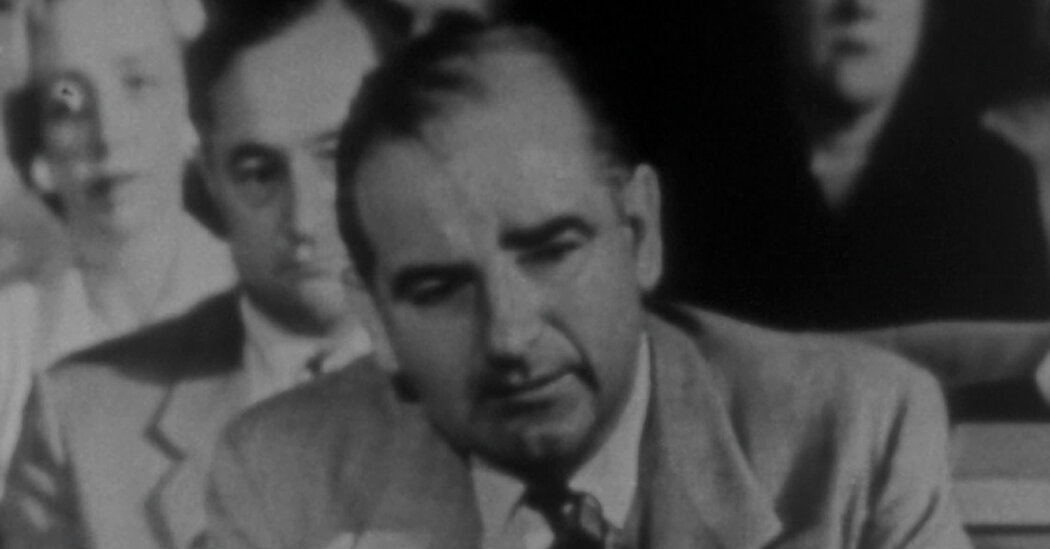
It’s no insult to say that Emile de Antonio’s documentary is a landmark in the history of highlight reels. The film takes the 36 days of TV footage from the Senate’s Army-McCarthy hearings, which began 72 years ago this month, and distills it to its essence. The hearings’ basic subject was whether Senator Joseph R. McCarthy, Republican of Wisconsin, then at the height of his notoriety for making accusations that communists had infiltrated the United States government, had used improper influence to seek special consideration for an Army private, G. David Schine. But the movie’s subject is McCarthy and his methods, as well as those of his aide Roy M. Cohn, the lawyer who had been chief counsel to the subcommittee that McCarthy chaired, and that was now conducting the investigation.
De Antonio condenses the material but in large measure does not embellish it; the film lets McCarthy’s rhetorical strategies speak for themselves. The title — sometimes styled with an exclamation point: “Point of Order!” — refers to one of the senator’s favored methods of interjection. He grandstands, he deflects, he insinuates — sometimes to the clear exasperation of his interrogators.
Much of the sparring takes place between McCarthy and Joseph N. Welch, the special counsel for the Army who five years later would play the judge in Otto Preminger’s “Anatomy of a Murder” (1959). The two men clash over the cropping of a photograph, the source of a copy of a letter purportedly signed by J. Edgar Hoover and, famously, over McCarthy’s public smearing of a young lawyer who worked for Welch’s firm. McCarthy, in a desperate effort to turn the tables on Welch’s questioning, had besmirched the reputation of a bystander. The history books have long recorded Welch’s response (“Have you no sense of decency, sir, at long last? Have you left no sense of decency?”), but watching the exchange in this context is still breathtaking.
This documentary from the director Liza Mandelup is, on the surface, about sight, but its ultimate interest is in something less measurable: self-image. The film follows a Miami man named David Taylor who travels to India to get implants for his irises; the idea is to change the color of his eyes in a lasting, potentially permanent way. This type of implant has not been approved for cosmetic use in the United States, and it’s easy to understand why: The risks of blindness or irreversible vision loss would seem severe enough to make most people stick with contact lenses.
But Mandelup, with a mix of curiosity and compassion, tries to understand why some would make a different choice, and why the prospect of feeling ownership of your eye color can, with a certain mind-set, exert a powerful pull. In her previous “Jawline” (2019), Mandelup delved into the world of teenage live-broadcasting influencers, and “Caterpillar” is, by one light, another look at the hazards of the streaming era. (The implant seekers tend to be lured by online videos.) In David’s case, the reasons for seeking the procedure are complex. He is biracial and feels he experienced racism within his family because he had a darker complexion. Lightening his eyes is one response to that.
“Caterpillar” is also, obliquely, a story of peer pressure. Mandelup films David with his fellow patients, who have likewise traveled from far and wide, in a waiting room in India, as they discuss their desired eye colors. The urge to back out is presumably diminished in a group — even when a doctor tells one patient, during an examination, that he wouldn’t get the implants himself. And while there is nothing particularly comic about this story, suffice it to say that if Mandelup had written the film, she couldn’t have picked a more mortifying way for things to go awry.
The best documentary released last year, “My Undesirable Friends: Part I — Last Air in Moscow” would be unforgettable watched at any time. But this sprawling achievement, the first five and a half hours of a two-part project from the director Julia Loktev, has understandably acquired different resonances since it premiered at the New York Film Festival in fall 2024.
Born in the Soviet Union but raised since childhood in the United States, Loktev (“The Loneliest Planet”) returned to Russia in 2021 to make a film with her friend Anna Nemzer. Nemzer was a host at TV Rain, the country’s last independent news channel. Vladimir Putin’s regime had started designating independent journalists as “foreign agents,” and their broadcasts had to be shown with a disclaimer. Loktev follows Nemzer and a group of other journalists who have been given the label. What she winds up with is a panoramic portrait of life under authoritarianism, and of professionals struggling to hold the line of freedom in a society that cuts them off however it can.
Part of what Loktev captures is the paranoia and borderline surrealism of knowing you’re being watched. The journalist Ksenia Mironova, whose fiancé, a fellow journalist, Ivan Safronov, is being held in prison without charges at the start of the film, talks of the terror of having her home searched. “I’m sure the whole place is still bugged, so yeah, I sometimes talk to them, tell them stuff,” she says, on a lighter note. “I feel for them when I listen to trashy music.” Sonya Groysman, a host of the podcast “Hi, You’re a Foreign Agent,” interviews a sociologist about the cognitive dissonance of living in a Moscow where comforts and authoritarian measures exist side by side. Arrests are carried out; restaurants receive Michelin stars.
What Loktev couldn’t have predicted is that she would be present in Russia at the time Putin began his invasion of Ukraine. The film’s second half unfolds in what feels like a state of free fall, as Loktev’s subject-friends book flights out of Russia or escape by road, even as they agonize about whether to leave at all. Part II will deal with their lives in exile.
https://www.nytimes.com/2026/04/29/movies/three-great-documentaries-to-stream.html


