








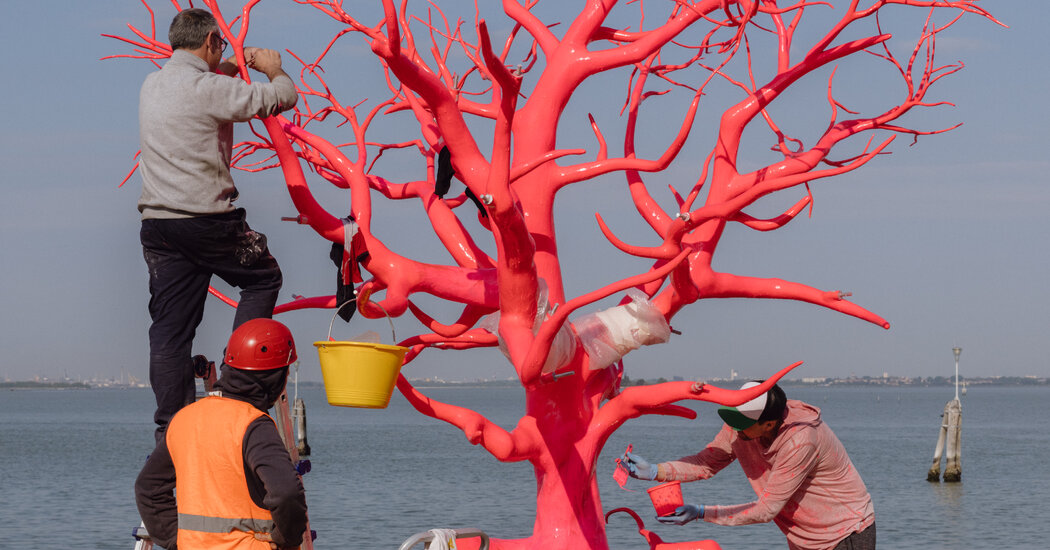
From a distance, across the opalescent waters of the Venetian lagoon, the cluster of low red-brick buildings looks like a factory or a boatyard. It’s only when you get closer and see the huge silver space rocket, the fluorescent pink tree and the neon sign that reads “PATRIARCHY = CO2” that you realize this island is the latest addition to Venice’s ever-expanding array of prestigious contemporary art venues.
The 130,000-square-foot island of San Giacomo in Paludo, 20 minutes by boat from Venice’s historic center, has been transformed into an arts complex by the Italian contemporary art collector Patrizia Sandretto Re Rebaudengo. Venice is the third exhibition hub for her Turin-based foundation, which celebrated its 30th anniversary last year.
The renovated and repurposed island is set to open on May 7, during the preview of the 61st Venice Biennale, with “Fanfare/Lament,” a solo show by the British multimedia artist Matt Copson, and a group exhibition of highlights from the foundation’s collection.
“Venice has always been part of my dreams,” Sandretto Re Rebaudengo said in an interview on the island this week. The first show she ever organized was in the city during the 46th Venice Biennale in 1995, she said. It kept drawing her back, she added, because “Venice is a stage at the center of the international contemporary art scene.”
Stylishly attired in a lilac jumpsuit and turquoise necklace, Sandretto Re Rebaudengo was surrounded by workers busily trying to complete the island’s buildings and installations in time for the opening in less than three weeks. More than 100 of them have been working on the project, she said.
“It will be ready,” she added firmly.
Sandretto Re Rebaudengo and her husband, Agostino Re Rebaudengo, the president of the Asja green energy company, bought San Giacomo in 2018. It was once a prosperous staging post on a pilgrimage route but became a gunpowder store after Napoleon’s army overtook Venice. The island was in military use until 1961 and then lay deserted and derelict for almost six decades.
Sandretto Re Rebaudengo said she said she wanted to give “new life” to San Giacomo, “but in a respectful way” — which meant transforming it into “a very sustainable island.”
Napoleon’s three ruined gunpowder magazines yielded 30,000 bricks that were hand-cleaned and reused for external paving. A dozen buildings have been constructed, including exhibition and performance spaces, a service block, and residential quarters for the collector’s family and guests. There is a vegetable garden and a vineyard. A reactivated well provides fresh water. All of the island’s energy is produced using renewable resources on-site, according to Sandretto Re Rebaudengo.
But, as others point out, environmental sustainability is one thing, and cultural sustainability another, especially at a time when wealthy private collections, rather than public institutions, increasingly shape the way that art is made and viewed. The curator and writer Konstantin Akinsha, who has a home in Venice, said that grandiose private museums in the city like François Pinault’s Palazzo Grassi and Punta della Dogana, filled with works by international stars, felt “less embedded than deposited — installed in Venice, but not of it.”
Akinsha said that in a depopulating city that has become a “spectacular backdrop for the global culture industry,” San Giacomo could make a difference by focusing more on local artists “rather than reproducing the same detached, imported model.” Otherwise, he added, the project will be “just another enclave, and the city will remain a stage set with no audience left to call it home.”
To guard against globalization’s homogenizing effect on the art world, Sandretto Re Rebaudengo founded and leads the 20-member Committee of Contemporary Art Foundations, which aims, according to its website, to enhance and promote “Italy’s artistic and cultural heritage — with particular reference to contemporary art.” Her own foundation’s annual international Young Curators’ Residency Program seeks to “spread the awareness of the Italian artistic scene.”
On San Giacomo, she has set aside 10 rooms for curator and artist residencies. “We want to invite artists who pay attention to the moment in which we live,” she said. “This is how we started 30 years ago.”
Josh Kline, whose much-discussed essay about the affordability crisis for artists in New York was published this year in October magazine, is one of 2,000 artists who have benefited from Sandretto Re Rebaudengo’s patronage. In 2016, her foundation showed Kline’s installation “Unemployment,” which envisions the devastation of the jobs market by artificial intelligence.
“Patrizia’s support before the pandemic made many of my most well-known works possible,” Kline said in an email. “The conditions I describe in my recent essay are shutting down radical, experimental art,” he added. “Patrizia is doing the opposite: backing artists over decades, and funding large-scale ambitious projects. This is what real patronage looks like, and it’s getting rarer.”
San Giacomo will initially be open to the public for about four to five months a year. Access will be free, and visits will be led by trained guides, like in Turin, where 30,000 schoolchildren and students visit the Sandretto Re Rebaudengo foundation each year. Line 12 of Venice’s water bus service will stop at San Giacomo on request to encourage local community engagement.
The project’s island setting, in the shallow waters of Venice’s Northern Lagoon, presents environmental challenges. Although the construction of the city’s flood-defense barrier has stabilized the tides, the average sea level continues to rise. As a precautionary measure, the entire island of San Giacomo has been raised three feet with reused materials from the site.
Sandretto Re Rebaudengo said she wanted the “isolation, slowness, beauty and vulnerability of the lagoon” to be the “defining elements” of her program on the island. She also seems to understand that today’s artists increasingly share that same sense of vulnerability.
https://www.nytimes.com/2026/04/24/arts/san-giacomo-in-paludo-island-venice.html


