The people anxiously sipping hot chocolate in the Canadian Embassy in Washington on a cold night in January almost a year ago couldn’t have predicted the roller-coaster of trade provocations and bilateral blow-ups the next 12 months would bring.


In hindsight, that unusually chilly Washington evening foreshadowed how the Canada-United States relationship would soon freeze over.
U.S. President Donald Trump’s tariff threats and his talk of annexing Canada had already rattled Canadian politics over the preceding weeks. A rushed trip to Mar-a-Lago in early November 2024 failed to mend former prime minister Justin Trudeau’s already rocky relationship with the incoming U.S. president.
On Jan. 20, the day of his second inauguration, Trump returned to the Oval Office to announce his “America First” trade policy. Just weeks later, he announced sweeping tariffs on Canadian imports.
By early February, it was obvious to everyone the relationship Canadians thought they had with their closest neighbour was over.
Former foreign affairs minister Mélanie Joly called on “every single political leader across the board, across the country, to stand united because, now more than ever, we need to make sure that we put country first.”
It was all happening amid a swift domestic political upheaval that saw Trudeau, weakened by poor polling and internal Liberal party dissent, announce on Jan. 6 he would resign as prime minister as soon as a new Liberal leader was chosen.
Mark Carney became party leader in March, and almost immediately launched an election, forming a minority government following a campaign that centred on Trump.
Trump’s tariffs — which don’t apply to goods compliant with the Canada-U.S.-Mexico Agreement on trade, known as CUSMA — hit Canada in March.
They were boosted to 35 per cent in August as Trump complained about Canada’s retaliatory tariffs and supply management in the dairy sector, and claimed Ottawa hadn’t done enough to stop the very modest cross-border flow of fentanyl.
The president’s separate Section 232 tariffs on specific industries, such as steel, aluminum, automobiles, copper and lumber, have also hit Canada hard.


Get breaking National news
For news impacting Canada and around the world, sign up for breaking news alerts delivered directly to you when they happen.
Trump took his trade war global in April with his so-called “reciprocal” tariffs on nearly every nation. World leaders raced to respond. Some signed frameworks of trade agreements that promised massive investments in the United States in exchange for slightly lower tariff rates.
The speed and scale of Trump’s trade war with the world caught everyone off guard, said Fen Osler Hampson, a professor of international affairs at Carleton University in Ottawa and co-chair of the Expert Group on Canada-U.S. Relations.
While the president toned down his annexation talk after Carney’s election, every deadline for a trade deal since then has come and gone, with no clear progress.
Talks remain stalled.
“That’s … I would hasten to add, no fault of (Carney’s),” Hampson said.
Carney suspended Canada’s digital sales tax, tightened border security, dropped most retaliatory tariffs and boosted defence spending in an unsuccessful effort to get Trump to drop his tariffs.
Until recently, however, a swift breakthrough on tariffs seemed possible.
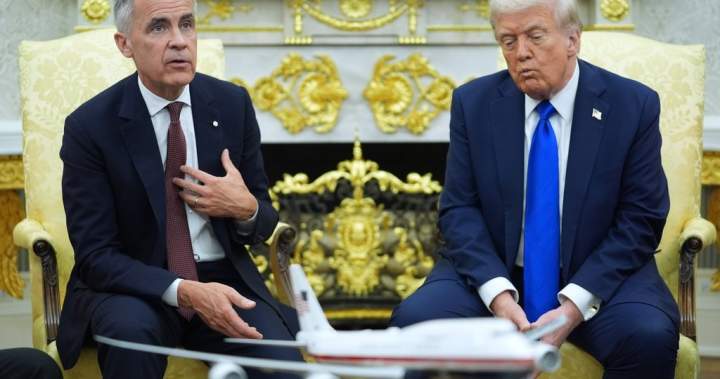
Carney and Trump complemented each other and bantered for the news crews during two cordial meetings at the White House. Media reports suggested in mid-October some sort of framework for a deal easing tariffs was in the works.
It all went sideways in October when Trump, offended by an Ontario-sponsored TV ad quoting former U.S. president Ronald Reagan criticizing tariffs, shut down trade talks.
Canada and the United States have had disagreements throughout their shared history, Hampson said, but in the decades after the introduction of the North American Free Trade Agreement, most observers expected the continent to grow more integrated.
“That’s no longer true,” he said. “We increasingly look like three countries going our own separate ways.”
For many Canadians, the past year has felt like an existential crisis — an extended, numbing assault on this country’s sovereignty and stability. In the United States, the shattered relationship with Canada has had less of an impact.
Americans who support the Trump administration see it doing what they voted for — even if it means Canada getting caught up as collateral damage. For Trump’s opponents, the president’s actions have driven a wave of alarming change they struggle to keep up with — and Canadian concerns aren’t necessarily their priority.
Matthew Lebo, a political-science professor at Western University in London, Ont., said the Trump administration has crossed any number of red lines.
“Democratic decline in many, many directions, the ignoring of constitutional limits on presidential power, the ignoring of Congress’ role in setting policy, especially about tariffs,” he said.
Trump’s administration launched a massive deportation campaign that is filling Americans’ newsfeeds with images of masked and armed ICE officers descending on peaceful neighbourhoods. It has deployed National Guard troops to Washington and other Democratic strongholds despite the objections of governors.
Trump has targeted law firms and universities to bring them in line with his agenda. His administration dismantled the U.S. Agency for International Development and is working to do the same to the Department of Education. Thousands of U.S. government employees have been laid off.
Health Secretary Robert F. Kennedy Jr. has pursued a radical policy on vaccines that has alarmed doctors and researchers.
U.S. foreign policy — on everything from Russia’s war in Ukraine to missile strikes targeting alleged drug boats near Venezuela — seems to change on almost a weekly basis.
The year also saw the longest government shutdown in the United States’ history.
Alasdair Roberts, a professor of public policy at the University of Massachusetts Amherst, described the past year as a “partial revolution.”
“It’s an attempt to change the regime, but it’s limited by the fact that the courts may still check what (Trump’s) doing,” Roberts said. “And he hasn’t got the legislative changes necessary … to kind of entrench the new way of working.”
Despite the rapid collapse of norms in Washington, Roberts said he does not believe American democracy is in crisis. There is dysfunction in the nation’s capital, he said, but that does not mean the entire system is malfunctioning.
Roberts pointed to the November elections, when millions of Americans voted without controversy — and delivered an electoral rebuke to many Republican candidates.
Roberts also pointed out the state of U.S. federal politics has forced Canada to accept an uncomfortable truth: the way the United States perceives its neighbour to the north has shifted fundamentally.
“This is the moment that Canada realized that the game has changed,” he said.
“The game has been changing for a few years, but this is the year that the shoe dropped.”
‘The year that the shoe dropped’: Canada-U.S. relationship in 2025