


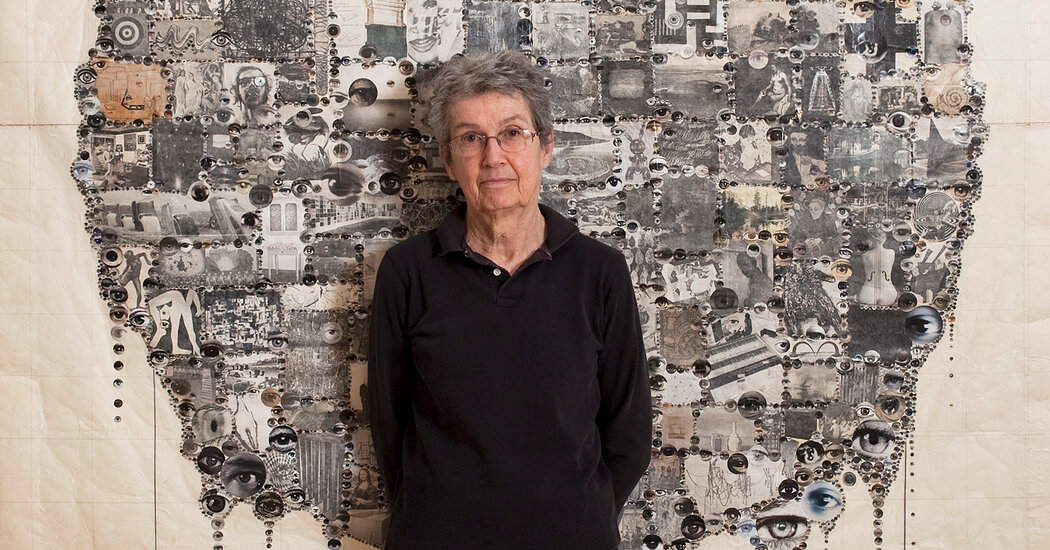
Aldwyth, who died on April 10 at 90, was known for her ravishing collages and intricate assemblages, but her first artworks were paintings that she showed at the Red Piano Art Gallery on Hilton Head Island, in South Carolina.
With typical rigor, she hewed to strict rules. A series of paintings of watermelons set on a horizontal line explored limitless color and pattern combinations. A series of egg paintings on square canvases investigated the possibilities of what might be done within a square.
But canvas, frames and paint are expensive, and Aldwyth needed to economize. In 1989, when Hurricane Hugo ravaged Charleston, she brought water and supplies to artist friends there, and began photographing the wreckage and collecting the debris. With those materials, she started to experiment with assemblages, creating containers and contraptions that were likened to Joseph Cornell’s boxes but that also owed a debt to the work of outsider artists, whose rough, handmade ethos and mysterious narratives she admired.
Always, her themes were historical and revisionist: She queried the history of art, of ideas, of the human species. She wanted to develop her own taxonomies.
She turned to collage after her sister gave her “Zell’s Popular Encyclopedia,” a two-volume reference work from 1871 with all sorts of curious and enticing entries. Aldwyth meticulously cut out the illustrations, which numbered in the thousands, and organized them into categories. Then she began to put together her own history in an enormous collage that she called “The World According to Zell.” Its intricate borders, medallions and central image of what looks like a tree of life recall ancient Persian tapestries.
“To me, if I know what it’s going to look like, I don’t want to do it,” she said in “Aldwyth: Fully Assembled,” a 2022 documentary by the filmmaker Olympia Stone. “I mean, that’s the whole purpose, is to see what it’s going to look like, what’s going to happen.”
One assemblage, “Evolution of a Species,” looks a bit like a hobo’s pack, a collection of boxes strapped together and wrapped up in cloth and string. It opens to reveal more boxes and objects that Aldwyth called “experiments,” representing the various art-making methods — lost-wax bronze casting, fired and unfired clay, photography — that she had experimented with at a residency.
Aldwyth’s final work — “Mr. Varnedoe, Why Abstraction?” — was a kind of argument she undertook with the 2006 book “Pictures of Nothing: Abstract Art Since Pollack,” based on a series of lectures by Kirk Varnedoe, the influential art historian. Because of copyright restrictions, many of the images Mr. Varnedoe discussed were not included in the book, which was published after his death. So Aldwyth set about creating her own book to honor Mr. Varnedoe, reprinting his words verbatim and pasting in images of his original selections side by side with pages torn from the published work.
“It was both her whiskey and her aspirin,” the curator Mark Sloan said of what became a 14-year project. “It was done out of a sense of justice for what she felt was an injustice.”
Aldwyth also painted more than 80 watermelons over a 20-year period. She described each of the oil-on-linen canvases as answers to “a color problem.”
Asked why she painted watermelons, she replied: “Doesn’t everyone paint watermelons at some point?”
All artworks by Aldwyth and photographed by Rick Rhodes, unless otherwise indicated.
https://www.nytimes.com/2026/04/24/arts/design/aldwyth-art-dead.html
