






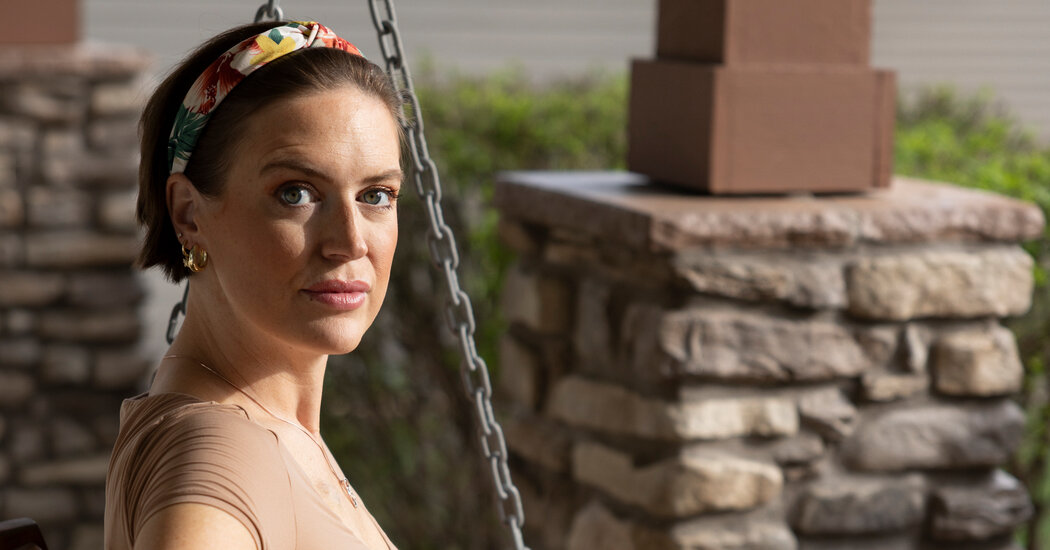
On a sweltering night in August 2024, moments before Robert F. Kennedy Jr. endorsed then-candidate Donald J. Trump at a packed rally in Arizona, a conservative young wellness podcaster named Alex Clark had a fleeting backstage conversation with the once-and-future president.
“I said, ‘Mr. President, please keep talking about food and pharma; this has a massive impact with undecided female voters,’ ” recalled Ms. Clark, now a leading conservative voice in Mr. Kennedy’s “Make America Healthy Again” movement. Witnessing the two men join forces, she said, “was the greatest political moment of my life.”
Not quite two years later, the MAHA movement is still a political force. But MAHA leaders warn that many of those who embrace the cause are dispirited and disillusioned — and that when the November elections come around, some may just stay home.
Six of the movement’s most prominent leaders, who together have millions of social media followers, said in separate interviews that the mostly white, mostly female voters who followed Mr. Kennedy into Mr. Trump’s camp are so disappointed with the president that Republicans risk losing them. But they said Democrats would need to work hard to win their votes.
“Republicans would be stupid, moronic,” Ms. Clark said, “to let these voters just slip through our fingers.”
The MAHA PAC, run by Tony Lyons, a conservative-leaning publisher and close Kennedy ally, launched an ambitious initiative in March to raise $100 million to elect “MAHA-aligned, Trump-endorsed” Republicans — a goal that would far exceed the $1.2 million the group raised through the end of February, according to recent campaign finance filings.
But the MAHA leaders who spoke to The Times said their voters belong to no individual party. They will vote the person, not party.
“The only thing that matters is action,” said Zen Honeycutt, who founded Moms Across America, an advocacy group that threw its weight behind Mr. Kennedy. “Not a political party.”
Leslie Manookian, a former Wall Street executive who became a homeopath and founded the Health Freedom Defense Fund, which fights vaccine and other medical mandates, said this about MAHA: “I don’t think it’s led by anybody. It’s a populist, grass roots movement.”
A Loose Coalition
Long before Mr. Kennedy gave it a Trump-inspired nickname, the MAHA movement was a loose-knit collection of groups.
Vaccine skeptics fought mandates under the “health freedom” banner. Environmental activists fought chemical exposures, allying themselves with fans of organic food and alternative medicine. They are now held together by Mr. Kennedy, and a shared suspicion of government and industry.
Vaccine skeptics complain that the White House seems to be muzzling Mr. Kennedy on what had been his signature issue. Health and wellness activists are thrilled with Mr. Kennedy’s Eat Real Food agenda promoting red meat and rejecting processed foods, but are upset that Dr. Casey Means, a wellness influencer whose emphasis on diet as a way to combat chronic disease make her a MAHA heroine, is struggling to win Senate confirmation as surgeon general.
And both food and environmental activists feel deeply betrayed by Mr. Trump’s recent executive order aimed at ramping up production of glyphosate, the weedkiller marketed as Roundup, which some scientists suspect causes cancer. The president said he issued it on national security grounds to protect the food supply and because its core ingredient is used to make munitions.
“It’s very hard to support a movement that is labeled MAHA when two opposing things are happening at the same time,” said Vani Hari, a wellness personality who markets herself as “The Food Babe.” “It’s like, ‘Yes, we can eat all the real food we want, but it’s covered in Roundup.’ ”
Whether the MAHA moniker — a riff on MAGA, Mr. Trump’s acronym for Make America Great Again — survives is an open question. MAHA leaders say the components of their movement will thrive and grow no matter what it is called. Both Ms. Hari and Ms. Clark worry about getting MAHA voters to the polls.
“They have nowhere to go,” said Ms. Clark, who works for Turning Point U.S.A., the right-wing organization founded by Charlie Kirk. “They feel like their vote is useless. They have lost the energy. They have lost the enthusiasm. They feel like the Democrats don’t care about them. They feel like the Republicans lied to them, and they’re not planning on voting.”
The tension between MAHA voters and the Trump administration will be on full display on Monday outside the Supreme Court. Movement leaders are staging a rally, The People v. Poison, while the justices hear oral arguments in a so-called “failure to warn” case against Monsanto, Roundup’s maker, now owned by Bayer.
The case was brought by a St. Louis man who said Roundup caused his non-Hodgkins lymphoma, which some scientists link to glyphosate. In 2015, the International Agency for Cancer Research deemed glyphosate “probably carcinogenic to humans.” A Missouri jury awarded the patient $1.25 million, saying Bayer had a duty to warn him under state law.
But the Environmental Protection Agency, which says glyphosate is not likely to be a carcinogen, does not require a warning. Bayer says glyphosate is safe, and argues the E.P.A.’s policy pre-empts state lawsuits. The administration is backing Bayer.
Democrats Woo MAHA Voters
Some Democrats sense an opportunity. Senator Cory Booker, Democrat of New Jersey, who disagrees strongly with Mr. Kennedy on vaccines but has long talked about ridding the food supply of pesticides, recently filed a “friend-of-the-court” brief backing the plaintiff in the Bayer case.
While MAHA voters are widely credited with helping elect Mr. Trump, their precise influence is unknown. Polls show that many MAGA voters have embraced MAHA. But Celinda Lake, a Democratic pollster, said that in close races, independent and undecided voters who voted for the president because of Mr. Kennedy are critical.
MAHA voters who are mostly interested in vaccines are unlikely to align themselves with Democrats. But Ms. Lake said voters animated by healthy eating and organic food are a natural fit for her party. Mr. Kennedy calls them “MAHA Moms.” Ms. Lake calls them “Organic Moms.” She faults Democrats for ignoring them, and losing them in 2024.
“There is an incredible opening for Democrats,” Ms. Lake said, “and we should not miss this opportunity.”
Representative Chellie Pingree, Democrat of Maine, who also disagrees with Mr. Kennedy on vaccines, will speak at the rally at the Supreme Court. Ms. Pingree, an organic farmer and longtime foe of the chemical industry, recently co-authored an opinion piece in The Hill with Kelly Ryerson, a MAHA leader who goes by “The Glyphosate Girl” online. They called for tougher action to get chemicals out of foods.
“I spend an increasing amount of my time talking to my colleagues, saying ‘You’re missing a big opportunity if you’re not talking about these issues,’” Ms. Pingree said, referring to pesticides and healthy food. “The reason Donald Trump ran on them, the reason he put R.F.K. in office, is because people care about them. We should be all over this.”
The White House, worried about losing the MAHA vote, recently invited MAHA influencers including Ms. Clark and Ms. Ryerson to meet with Mr. Trump. The women spent 20 minutes with the president in the Oval Office, and also met with White House chief of staff, Susie Wiles, the deputy chief of staff, and Stephen Miller, who solicited their ideas on messaging.
Dr. Means was present as well. Ms. Clark said she told the White House team that getting Dr. Means confirmed was essential. “She is trustworthy to the MAHA base,” Ms. Clark said.
But Dr. Means’s fate is uncertain. Three prominent Republicans on the Senate health committee, Senators Susan Collins of Maine and Lisa Murkowski of Alaska, and Senator Bill Cassidy, its chairman, have yet to say they support her.
Mr. Cassidy declined to comment Wednesday when asked when he would schedule a vote. He has little incentive to do so. The MAHA PAC is backing his primary challenger, and will face its first test when Louisiana voters go to the polls next month.
‘I Thought He Was Speaking to People Like Me’
Tricia Busch, a former elementary schoolteacher in a suburb of Des Moines, Iowa, is among the MAHA voters who say they will vote for the person, not the party. Ms. Busch, 35, has three young children and is a two-time cancer survivor. She is now in remission from non-Hodgkins lymphoma, the same blood cancer at issue in the Supreme Court case. She blames exposure to glyphosate in Iowa, a farming state.
Then a registered Democrat, Ms. Busch met Mr. Kennedy when he campaigned in Iowa in 2024. She was in a wheelchair, she said, still taking morphine and temporarily paralyzed from the waist down after a stem cell transplant that saved her life.
“I really had faith in him and this whole MAHA,” she said. “I thought he was speaking to people like me, who feel like we’re slowly being poisoned, and we’re waking up to what the big companies are doing to us.”
Mr. Trump’s glyphosate order changed her mind. Mr. Kennedy, who as a plaintiff’s lawyer helped win a major judgment against Monsanto in 2018, has recently said he was “not happy” about the order. But at first, he defended it, writing on social media that while herbicides and pesticides were “toxic by design,” the food supply depended on them and it would take time to develop nontoxic alternatives.
“I’ve never felt so betrayed,” Ms. Busch said.
Kennedy defenders say he is in a tough spot, working for a president with whom he does not always agree. Del Bigtree, Mr. Kennedy’s former communications director, and a prominent vaccine activist, said Mr. Kennedy is doing “the best he can under difficult circumstances.”
But while the MAHA voters are frustrated, Mr. Bigtree said, “if the Democrats don’t make an effort to re-engage with the organic crunchy granola moms and the issues they care about, I highly doubt they will see these votes return.”
That appears to be the case for Ms. Busch in Iowa. Instead of trying to make change in Washington, she is pouring her energy into the governor’s race, working to elect a Republican, Zach Lahn, a farmer who is endorsed by the MAHA PAC, Mr. Lyons’s organization. But she said she is “a political orphan,” not aligned with any party.
MAHA voters like Ms. Busch, who were once Democrats, grew disenchanted with the party under President Barack Obama. As a candidate, he promised to label genetically modified foods. But he did not fulfill that promise until the end of his eight years in office, by signing an industry-backed bill that food safety advocates derided as the “DARK Act,” for “Denying Americans the Right to Know.”
Ms. Hari, who attended the 2012 Democratic National Convention as a delegate for Mr. Obama, said she would “forever be thankful” to Mr. Trump for his choice of health secretary, whom she still supports. “But to be indebted in servitude to him because of that, is a false reality,” she said.
She said the constellation of MAHA-themed groups, including Mr. Lyons’s PAC, that have organized to support Mr. Kennedy are in “a complicated position” because “they have to be careful not to criticize the administration.”
The political action committee became an issue when Mr. Kennedy testified on Capitol Hill this week. Senator Chris Murphy, Democrat of Connecticut, called it “a moral and ethical mess” and complained to Mr. Kennedy that some of its donors had business before his department.
Mr. Kennedy responded that he did not know who gave money to the group, which he said had done nothing “that is against my values.”
Mr. Lyons defended the committee’s determination to elect Republicans. His company, Skyhorse Publishing, has published books by Melania Trump, the first lady; Mr. Kennedy; one of Mr. Kennedy’s sons; and Mr. Kennedy’s wife, the actress Cheryl Hines; Senator Rand Paul of Kentucky; Rudolph W. Guiliani; and other leading Republicans.
“MAHA is open to working with anyone,” Mr. Lyons said in a text, “but we also have to face facts. Democrats haven’t been willing to cross party lines.”
Ms. Pingree and Mr. Booker said that is untrue. Ms. Pingree said she recently talked to Mr. Kennedy’s office about a “food-is-medicine” initiative. Mr. Booker said he and Mr. Kennedy met in person and talked about “things that we thought we could champion together,” such as pesticides, when Mr. Kennedy was seeking Senate confirmation.
But Mr. Booker voted against confirmation. He said they never met again.
https://www.nytimes.com/2026/04/23/us/politics/maha-voters-midterms.html


