






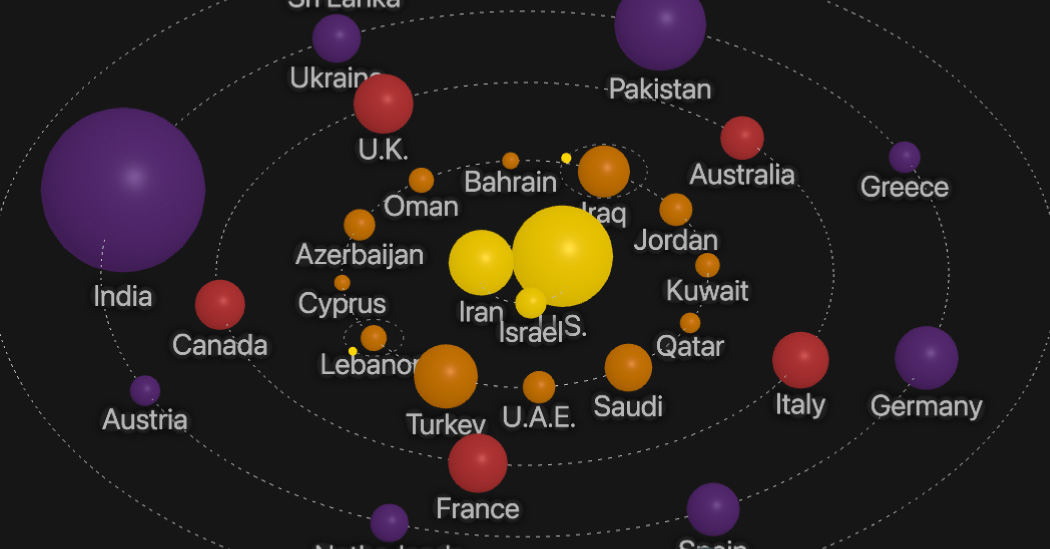
Many forces have pulled reluctant nations into war throughout history.
Countries may feel they must act to protect vital economic interests, like access to basic resources and shipping routes. Others may be provoked more directly, like when a missile enters their airspace. Mutual defense pacts can act as tripwires that entangle allies, and larger powers can press proxies to step in.
Raising the stakes of the war to impose costs on more and more countries is part of Iran’s strategy. Faced with an overwhelming aerial bombardment that has killed many of its leaders, Tehran views the moment as existential.
“From the Iranian perspective, they were going to go big, and this is going to be the final war,” said Mona Yacoubian, director of the Middle East Program at the Center for Strategic and International Studies. The Iranian government decided it would “either emerge standing with a place in the region, or they’re going to go down fighting,” she said.
With its military depleted and overmatched, Iran is trying to make the conflict too politically combustible — and too expensive — for Washington to sustain.
To that end, the Iranians have been striking data centers and oil facilities in U.S.-friendly Gulf nations. They have also paralyzed ship traffic in the Strait of Hormuz, sending crude oil soaring beyond $100 a barrel and setting off fears of crippling global inflation.
Even with their bases in the Gulf hit and NATO airspace breached, European leaders are trying to stay out of the conflict. But brutal economic realities may change their calculus, analysts say. A severe disruption to the global energy supply is “the most likely issue to draw in other powers,” said Robert Johnson, the director of the Changing Character of War Center at Oxford University
With so many actors already involved, the war could quickly unfold in other directions. “Tehran does not have control over the escalation dynamics — no one has control,” Ms. Yacoubian said.
It has already spawned a parallel front in Lebanon, where a fragile cease-fire between Israel and Hezbollah, the Iranian-backed militia, has been shattered. And analysts warn that another Iranian ally, the Houthi militia in Yemen, might also join the conflict. If it does, it could create a second global trade chokepoint by stepping up its threats to shipping through the Red Sea.
As the conflict expands the prospect of a negotiated settlement remains remote.
“It’s very hard to see where the space for creative diplomatic off-ramps is,” Ms. Yacoubian said. “I fear this has to get worse before it can get better.”
https://www.nytimes.com/interactive/2026/03/21/world/middleeast/iran-war-gravity.html


