






For two months now, the Iran war has dominated headlines. But now that there’s a cease-fire, the focus has shifted from the battlefield to the negotiating table.
It turns out Trump-style diplomacy is a lot like Trump-style war. It involves a lot of gut instinct and mixed messages, often delivered in ALL CAPS. It also involves a lot of U-turns — like this weekend, when Steve Witkoff and Jared Kushner were going to Pakistan, up until the moment that they weren’t.
It’s not always easy to follow the various plot twists. But there’s one useful benchmark to evaluate whether this war ultimately produces a good result for the United States: Whatever agreement Trump reaches with Iran, will it improve on the nuclear deal he walked away from in 2018? Today I’m writing on why that may be difficult.
The challenges of reaching a ‘FAR BETTER’ deal with Iran
The last time the United States successfully reached an agreement with Iran, it took almost two years, scores of meetings and an army of diplomats, nuclear experts and C.I.A. agents, both at the negotiating table and at home.
That was 11 years ago, when President Obama signed the Joint Comprehensive Plan of Action, or J.C.P.O.A. It ran 160 pages long, included five technical annexes detailing the limits on Iran’s nuclear program and largely delivered on what it promised.
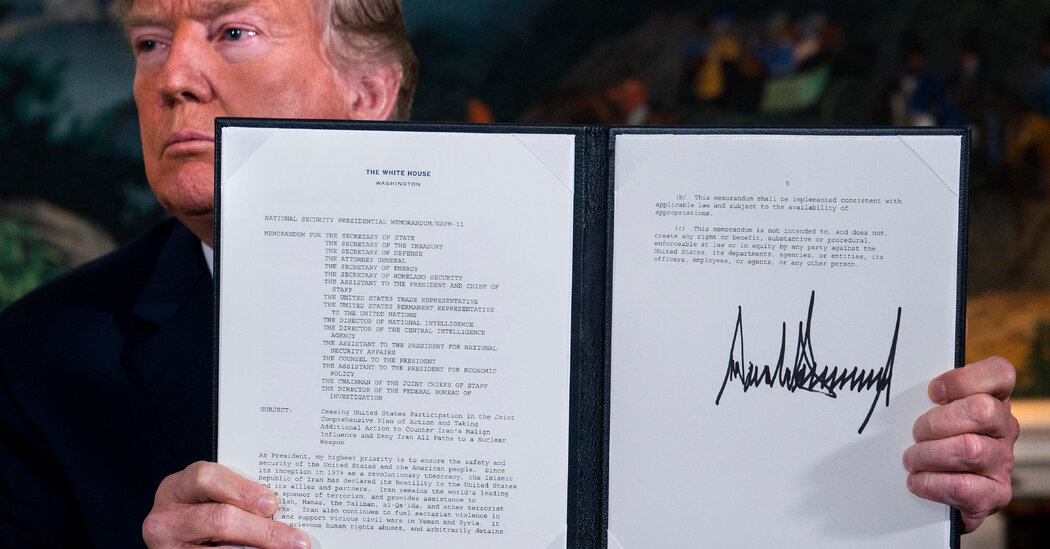
This is the deal Trump ripped up in 2018. He’s now promising something “FAR BETTER.” But he’s doing so with negotiators much less steeped in the subject matter, at a time when Iran has discovered a powerful new source of leverage in the Strait of Hormuz and Trump himself is under time pressure to end the war and its disastrous effects on gas prices before midterm elections in the fall.
The decision to scrap Obama’s nuclear deal prompted Iran to enrich at much higher levels, arguably setting the world on a path toward the current war. Trump knows the results of that war will be judged by whatever agreement comes next. But improving on the Obama agreement at this point is a daunting task.
That may be one reason negotiations have stalled before they’ve even really begun.
The devil is in the details
I spoke to David Sanger, our White House and national security correspondent who covered the J.C.P.O.A. negotiations. That agreement had one main objective: keep Iran at least one year from being able to build a nuclear bomb.
To this end, it obliged Iran to agree to three main conditions in return for sanctions relief:
-
Ship 97 percent of its nuclear material out of the country, leaving it with less than what was needed to make a bomb.
-
Limit any ongoing enrichment of uranium to 3.67 percent, which is reactor fuel level — well below bomb-grade.
-
Adhere to an intrusive inspection regimen conducted by the International Atomic Energy Agency.
The test now is whether Trump can do better than that in very different circumstances and with a very different negotiating team.
Obama’s chief negotiator always came to the table with a large posse of experts. The C.I.A.’s top Iran expert was often in the room. So was the energy secretary, an expert in nuclear weapons design.
Trump’s team does not have an entourage of experts. The main people involved in the limited negotiations so far have been Vice President JD Vance; Trump’s son-in-law, Jared Kushner; and his special envoy, Steve Witkoff. The latter two learned their deal-making skills in New York real estate.
The man who is currently Iran’s foreign minister, Abbas Araghchi, was deputy negotiator at the time of the J.C.P.O.A. negotiations. David recalled how intimately familiar he was with Iran’s nuclear program.
“He knew every inch of it,” David told me. “Witkoff and Kushner are smart people and quick learners, but they’re relatively new to this. The Iranian team has a depth of expertise.”
Iran also holds better cards now than it did at the time. Its control over the Strait of Hormuz means it will resist giving up more than it might have before the war, Erika Solomon, our Iran bureau chief, told me.
The Iranians have already rejected the two central U.S. demands that would have been improvements on the previous deal: They’ve refused to hand over their nuclear stockpile and suspend enrichment indefinitely.
For now, following two rounds of aborted talks, the big question is whether and when the two sides will meet again.
100 nuclear weapons
The J.C.P.O.A. did fall short: It failed to put a limit on Iran’s missile capability. It did not stop Iran from funding its proxies. It also would have expired in 2030.
It was these shortfalls that Trump latched onto when he pulled the U.S. out, calling it a “guaranteed Road to a Nuclear Weapon.”
But it was after the U.S. left that deal that Iran ramped up its enrichment levels. At the time the U.S. pulled out, Iran’s weapon designers had too little nuclear fuel to build a single bomb — they’d shipped almost all of it to Russia, in accordance with the deal’s requirements.
Today, according to international inspectors, Iran not only has half a ton of near-bomb-grade uranium buried under the rubble of last year’s U.S. strikes. It also has a total of 11 tons of uranium, at various enrichment levels. With further purification, David writes, “that is enough to build up to 100 nuclear weapons.”
Iran enriched virtually all that uranium in the years after Trump abandoned Obama’s deal.
Other developments in the war:
MORE TOP NEWS
Attempted assassination charges
A California man who authorities say ran through a security perimeter and fired a gun at a dinner in Washington for White House correspondents on Saturday was charged with attempting to assassinate Trump.
Cole Tomas Allen, 31, was also charged with two gun crimes and faces up to life in prison if convicted, the judge told him during a brief court appearance yesterday.
Allen, who did not enter a plea, came to Washington with a pump-action shotgun, a handgun and three knives with the intent to carry out a political assassination, a prosecutor told the judge.
For more:
OTHER NEWS
-
Raghu Rai, a photojournalist who captured many of India’s political milestones and major tragedies, died at the age of 83.
-
Oprah Winfrey reached a licensing deal with Amazon to produce video podcasts and specials.
-
A big-game hunter from California was killed by an elephant after his hunting party stumbled across a herd in the forests of Gabon.
TOP OF THE WORLD
The most clicked link in your newsletter yesterday was our quiz on aging well.
SPORTS
Football: Here’s what to know about Gianluca Rocchi’s refereeing scandal, which has rocked Italian football.
Tennis: When it comes to electronic line calling on clay courts, some top players can’t believe their own eyes.
Scientists have finally identified a strange, shiny blob that had perplexed researchers since it was retrieved from the sea near Alaska in 2023. Was it coral? A sea sponge? An alien? No. It’s part of a deep-sea anemone, a species with long tentacles, generally purple, pinkish or red, that’s found at the bottom of oceans around the world.
MORNING READ
Elie Saab says he’ll never leave Lebanon. Since founding his fashion house in Beirut in 1982, he has been making his dresses under extraordinary circumstances. He started his label during the Lebanese civil war, which lasted from 1975 to 1990.
Now, amid the war between Israel and Hezbollah, Saab continues to make couture even as the bombs fall. Saab and his son, who also serves as the label’s chief executive, spoke to Vanessa Friedman, our chief fashion critic. “For me, fashion was always the means to transform what is going badly into something beautiful,” the designer said. Read the Q&A.
AROUND THE WORLD
Super shoes, ideal conditions and a marathon for the ages
Sabastian Sawe of Kenya broke the two-hour mark to win the London Marathon on Sunday, followed closely by Yomif Kejelcha of Ethiopia. Two 1:59 marathons at once: What’s going on?
A few things have happened at once. The mild weather conditions were crucial, as were the pack-running strategies. And then there were those super shoes, chunky yet lightweight sneakers embedded with a carbon plate, which have revolutionized the sport.
All these elements came together for the greatest day in marathon history. On their own, each part might account for tens of seconds in a race. But combined, the impact was record-breaking. “It’s something not to be forgotten,” Sawe said, “it will remain in my mind forever.” Get the full story.
RECOMMENDATIONS
Visit: This Regency-era parsonage in Somerset, England, reopened as a luxury vacation rental.
Follow: How will BTS endure a grueling world tour? We asked the band’s ex-trainer.
Browse: Here are 11 standout moments from Milan’s annual design fair, including midcentury homes not typically open to the public.
Read: Do we really need another book about the Lewis and Clark expedition? After reading “This Vast Enterprise,” our critic says yes.
RECIPE
A tuna salad and potato chip sandwich may not be the classic pairing of peanut butter and jelly, but it’s no less delicious. Beyond crunch, chips also add stability to the sandwich, holding the tuna salad in place as you eat.
https://www.nytimes.com/2026/04/27/world/nuclear-deal-iran-trump-assasination-charges.html


