






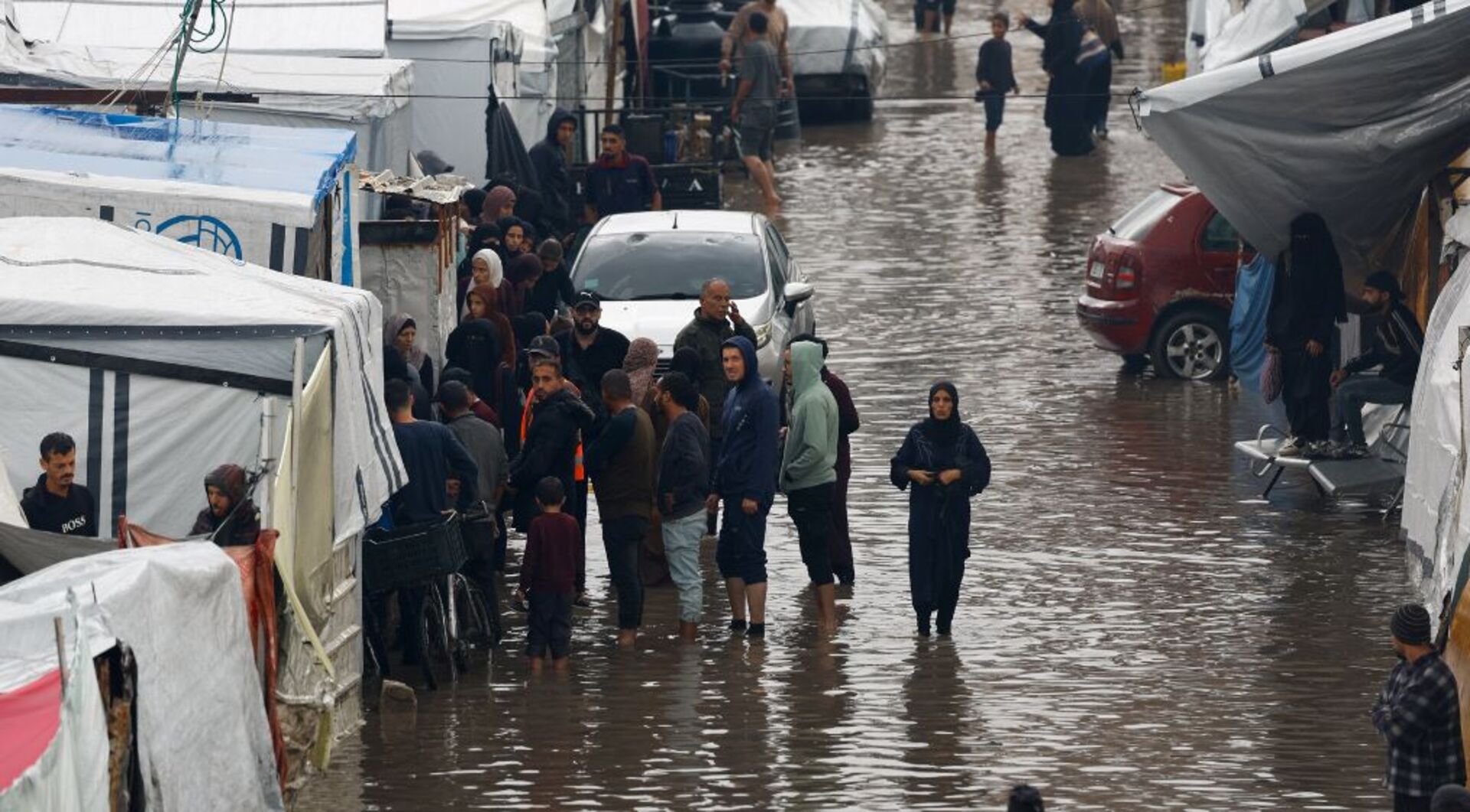
Storm Byron is threatening to heap new miseries on Palestinians in Gaza, with families making distress calls from flooded tents and hundreds of others fleeing their shelters in search of dry ground as the fierce winter storm lashes heavy rains on the besieged territory.
Officials warned Wednesday that the storm was forecast to bring flash floods, strong winds and hail until Friday, conditions expected to wreak havoc in a territory in the grip of a humanitarian crisis, where hundreds of thousands of displaced people live in tents, temporary structures, or damaged buildings after two years of Israel’s genocidal war against the Palestinian people in Gaza.
Recommended Stories
list of 4 itemsend of list
Humanitarian workers said Israeli restrictions on the entry of tents, tools to repair water and sewage systems have left Gaza poorly equipped to respond to the storm, and called on the international community to pressure the Netanyahu government to urgently allow in supplies.
In the southern city of Rafah, the Palestinian Civil Defence said its teams had already received distress calls from displacement camps, with families reporting “flooded tents and families trapped inside by heavy rains”.
“Despite limited resources and a lack of necessary equipment, our teams are working tirelessly to reach those in need and provide assistance,” the rescue agency said on Telegram.
Footage posted on social media and verified by Al Jazeera showed Palestinians shovelling a ditch around tents in a desperate attempt to create barriers that would prevent them from flooding.
Displacement camps at risk
Nearly 850,000 people sheltering in 761 displacement sites face the highest risk of flooding, according to the UN Office for the Coordination of Humanitarian Affairs (OCHA).
Flooding has previously been recorded at more than 200 of the highest-risk sites, affecting more than 140,000 people, the office said.
Previous storms had contaminated displacement sites with sewage and solid waste, swept away families’ tents and driven them out of makeshift shelters.
Reporting from Gaza City, Al Jazeera’s Tareq Abu Azzoum said that UN agencies and local authorities were warning that any significant rainfall could have devastating consequences for Gaza’s population, with the displacement camps built on barren, open terrain that would be highly susceptible to flooding.
The tents available to people were typically flimsy, unreinforced and often torn, he said, offering negligible protection from heavy rains, which were likely to seriously damage whatever possessions families had left.
Risk of water contamination, disease
Amjad Shawa, director of the Palestinian NGOs network, said Israeli restrictions on the entry of aid and equipment had left Gaza ill-equipped to deal with the storm.
He said only 40,000 tents, out of a needed 300,000, had been allowed in, while tools that would likely be needed to repair sewage systems and water networks were also restricted.
Flooding would bring a serious risk of sewage and solid waste contaminating drinking water or food supplies, raising the risk of diseases in the densely populated Strip, where 2.2 million people are crammed into just 43 percent of the territory, while the remaining 57 percent remains under Israeli military control.
“If Israel were to allow the entrance of supplies, things would be different. But for now, it has done all it can to make life more complicated for Palestinians,” Shawa said.
Oxfam humanitarian response adviser Chris McIntosh agreed, telling Al Jazeera that the people of Gaza were bracing for a “very tragic situation”.
“Persistent bureaucracy prevented us from bringing in adequate dwellings for people in Gaza,” McIntosh said. “The Israelis have not permitted tents to enter Gaza for many months. The only thing they’re allowing at this point is some tarpaulin, which isn’t going to do much for people who need proper shelter.”
He said Palestinians were being forced to live in “deplorable conditions”, with well more than 50 percent of the population living in tents.
He anticipated many would attempt to find dry ground inside bombed-out buildings that were at heightened risk of collapse amid the forecast heavy rains and winds.
Families flee flooding risk
Farhan Haq, a spokesperson for UN Secretary-General Antonio Guterres, warned that vulnerable groups, including newborn children, are at particular risk from the incoming winter storm.
About 200 families were expected to arrive at a new displacement site in eastern Khan Younis in the south of the Strip, fleeing a heightened risk of flooding in their present location, he said.
“These households made the decision to move given the impact of the frequent rains and the risk of flooding,” he said.
Ismail al-Thawabta, director of Gaza’s Government Media Office, told Al Jazeera that about 288,000 Palestinian families were without shelter as Storm Byron bore down on the enclave, and issued a call to the international community to pressure Israel to allow in supplies to help respond to the storm.
“We are issuing an urgent appeal to the world, [United States] President Trump and the [United Nations] Security Council to pressure the Israeli occupation,” he said.
Francesca Albanese, the UN special rapporteur on human rights in the occupied Palestinian territory, condemned global inaction as families in Gaza braced for the storm.
“Palestinians in Gaza are literally left alone, freezing and starving in the winter storm,” she posted on X.
“I keep asking how we became such monsters, [i]ncapable of stopping this nightmare.”
https://www.aljazeera.com/news/2025/12/10/tents-flood-families-seek-shelter-as-storm-byron-bears-down-on-gaza?traffic_source=rss