


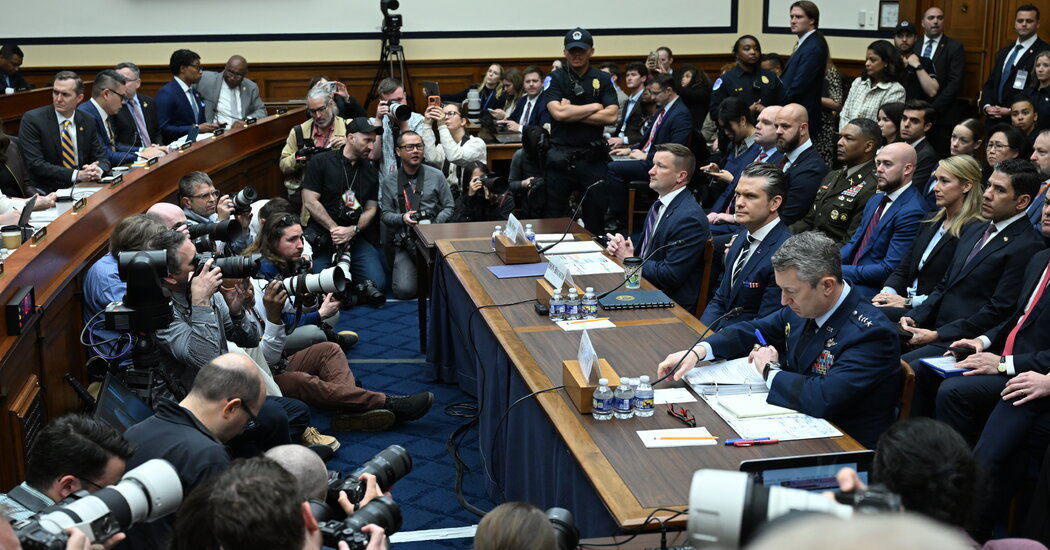
In his first major public appearance before Congress since the beginning of the Iran war, Defense Secretary Pete Hegseth said on Wednesday that the biggest adversary the United States faced was not Iran’s military, but the “feckless and defeatist words” of Democrats and some Republican lawmakers.
It was a preview of what turned out to be a contentious debate over the Iran war.
The Defense Department’s nearly $1.45 trillion budget request was ostensibly the reason for the House Armed Services Committee hearing, but lawmakers made little mention of it during several hours of questioning.
Mr. Hegseth offered a full-throated defense of “Operation Epic Fury,” which began on Feb. 28. Sitting next to Gen. Dan Caine, the chairman of the Joint Chiefs of Staff, and Jay Hurst, the Pentagon comptroller, Mr. Hegseth repeatedly stressed that the war was necessary because Iran posed an “existential threat” to the United States.
The defense secretary grew testy during the hearing and mocked the questions of Democratic lawmakers, prompting a rare admonition from the committee chairman.
Here are the main takeaways from the hearing.
The Iran war has cost $25 billion so far, according to the Pentagon.
Mr. Hurst said that figure is mostly representative of the tens of thousands of bombs and missiles used in the conflict. It was the first time the Defense Department has publicly provided a cost estimate for the war.
The war has consumed a large percentage of the Pentagon’s longest-range conventional munitions, such as air-launched stealth cruise missiles and ground-launched Precision Strike Missiles.
A 14th service member has died during the war.
General Caine mentioned that 14 U.S. military service members have died as part of Operation Epic Fury, although the Pentagon’s casualty analysis system online showed 13 U.S. deaths as of Wednesday morning.
The 14th service member was Maj. Sorffly Davius of the Army National Guard, who according to ABC News died on March 6 after a medical emergency in Kuwait. Two Pentagon representatives, speaking on the condition of anonymity because they were not authorized to discuss the matter publicly, confirmed the death.
Hegseth made a false claim about U.S. support to Ukraine.
The defense secretary said the Biden administration provided Ukraine with “hundreds of billions of dollars’ worth of munitions” after Russia invaded in 2022. However, the true tally is far smaller.
According to a New York Times analysis of Pentagon records and statements, the Biden administration sent Ukraine $33.8 billion in weapons from Defense Department stockpiles under a program called the Presidential Drawdown Authority. The Biden administration also gave Ukraine $33.2 billion in cash to purchase weapons directly from U.S. defense companies under the Ukraine Security Assistance Initiative. That totals about $67 billion in military support since the war began.
Following the last disbursement of weapons from the Pentagon’s stockpile on Jan. 9, 2025, about $3.8 billion in congressionally authorized funds remains unspent for drawdowns of existing arms for Ukraine.
He attacked critics of the Iran War.
Mr. Hegseth, who served in Iraq and Afghanistan as a junior officer in the Army National Guard, took exception to members of Congress who have characterized the Iran War as “a quagmire.”
“It’s been two months,” Mr. Hegseth retorted. “You want to talk about a forever war?”
“I know the American people support that mission, despite your loose talk and words like ‘quagmire,’” Mr. Hegseth said. Recent polls, however, show a minority of Americans approve of the U.S. military action in Iran.
Mr. Hegseth also dismissed queries from Democrats about higher gas and food prices as a result of the war as “gotcha” questions. “What would you pay to ensure that Iran doesn’t get a nuclear bomb?” the defense secretary said.
And he defended actions that legal experts have called war crimes.
Asked if he stood by his statement that American troops would allow “no quarter, no mercy for our enemies,” Mr. Hegseth said the military under his leadership “fights to win.”
A “no quarter” order is one to kill all enemy combatants, even those who are badly injured or have surrendered.
“We ensure that our war fighters have the rules of engagement necessary to be as effective as humanly possible,” the secretary added, after Representative Seth Moulton, Democrat of Massachusetts, pointed out that at such an order was a war crime under the military’s Uniform Code of Military Justice and international law.
Eric Schmitt and Helene Cooper contributed reporting.
https://www.nytimes.com/2026/04/29/us/politics/hegseth-congress-hearing-takeaways.html
