








The House voted on Wednesday to extend a high-profile warrantless surveillance law for three years, but its fate remained uncertain ahead of a midnight expiration on Thursday after the Senate said it would not move ahead with the measure.
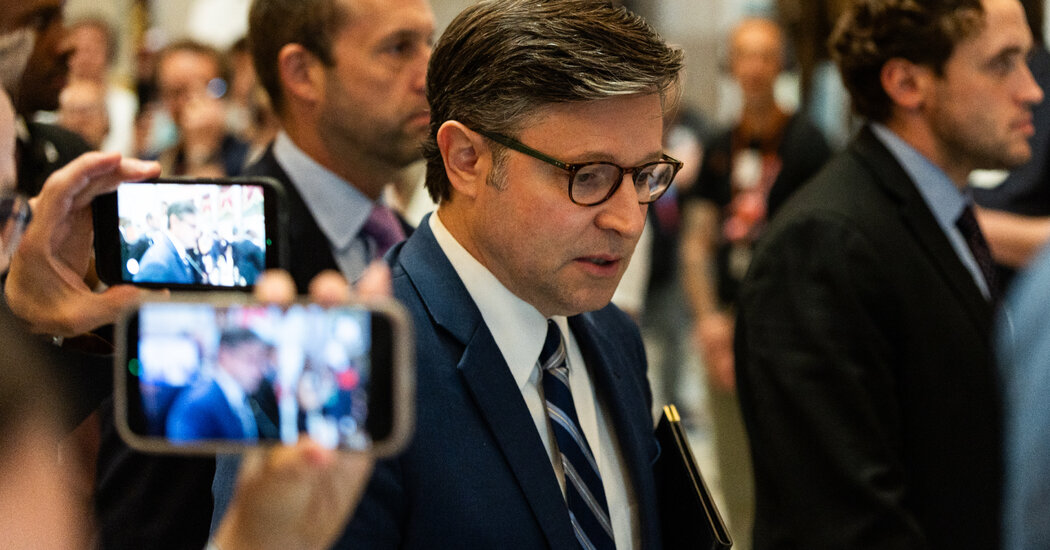
Bipartisan approval in the House capped a chaotic struggle in that chamber, where Speaker Mike Johnson just barely overcame a rebellion by a libertarian-leaning faction of Republicans who had blocked the legislation as they demanded a chance to add privacy protections.
But just hours later, Senator John Thune, Republican of South Dakota and the majority leader, said his chamber would instead attempt to push through a 45-day extension, punting a debate on renewing a key section of the Foreign Intelligence Surveillance Act, or FISA, until mid-June.
Mr. Thune’s plan was a bow to the clock and to political reality. The surveillance law, known as 702, is set to lapse after midnight on Thursday, and members of the Senate in both parties want to make changes to the extension the House passed, which included a ban on the establishment of a federal cryptocurrency.
It was the latest twist in Congress’s turbulent attempts to deal with the surveillance law. Should the Senate approve a short-term extension, right-wing Republicans would be likely to balk, forcing Mr. Johnson to turn to Democrats to help fast-track it back through the House.
After trying and failing to bring up the measure earlier this month and then again on Tuesday, the speaker had struggled for more than two hours on Wednesday to round up the votes to advance the surveillance bill, threatening and cajoling holdout Republicans before they ultimately caved and allowed it to move ahead.
The vote was 235 to 191 to pass the bill, with 42 Democrats crossing party lines to support it and 22 Republicans opposing it.
In the Senate, any bill to extend Section 702 would need 60 votes to overcome a filibuster. A bipartisan group of privacy-minded lawmakers — including Senators Ron Wyden, Democrat of Oregon, and Mike Lee, Republican of Utah — wants to add new limits to government wiretapping and data collection.
Further complicating matters, as part of his effort to persuade libertarian-minded Republicans to stop blockading the bill in the House, Mr. Johnson bundled the FISA bill with unrelated legislation they favor that would bar the Federal Reserve from issuing digital currency. Mr. Thune, Republican of South Dakota, said that measure was a dead letter in his chamber.
Proponents of quickly extending the law without major changes have warned that any lapse in Section 702 would cause the government to “go dark,” gravely threatening national security. Similar arguments played out in April 2024, when the law was last about to expire and reached the Senate with little time to spare.
Those warnings are misleading. Section 702 has a built-in safety net for a temporary lapse that allows the surveillance program to keep operating until annual certifications issued by the nation’s intelligence court expire. The court recertified the program last month, meaning the National Security Agency could legally continue to operate the program through March 2027 even if the statute were to expire.
Still, current and former national security officials caution that a lapse in the statute could lead some technology companies to stop cooperating with the program, raising the possibility of short-term gaps in data collection.
Section 702 permits the government to collect — from U.S. companies like Google and AT&T, and without a warrant — the private messages of foreigners abroad, even when the targets are communicating with Americans. Congress enacted it in 2008, legalizing a form of a once-secret warrantless wiretapping program created by the Bush administration after the Sept. 11, 2001, attacks. But it added a “sunset” provision that ensures the law periodically comes up for review and potential modification.
The House-passed bill would extend the statute by three years while making minor tweaks to it. Among them, it would make it a crime to intentionally search the repository of collected messages for an American’s information without a proper purpose. Only F.B.I. lawyers could preapprove queries for Americans’ information, and the measure would add another layer of after-the-fact review of such queries.
Privacy advocates have long wanted to require the government to obtain a warrant from a judge before it can deliberately access information from or about an American in the repository of messages collected under the program. That debate scrambles the usual polarized partisan lines, with civil liberties-minded lawmakers in both parties squaring off against centrists and security hawks in both parties, who oppose the idea.
President Trump has urged Republicans to extend Section 702 without new limits for 18 months. That effort ran aground in the House two weeks ago.
Given the G.O.P.’s slim House majority that leaves little room for defections, the struggle to pass the FISA measure played out entirely among Republicans. Libertarian-minded Republicans associated with the Freedom Caucus defied Mr. Johnson on April 17 and blocked the bill in an overnight session.
Still short of an agreement, Mr. Johnson scrapped a planned vote on Tuesday, and on Wednesday, it appeared opponents would block the measure from the House floor once again, leading to hours of furious negotiation before the holdouts acquiesced.
According to lawmakers familiar with the talks, Mr. Johnson’s haggling included unrelated deals to change a pending farm bill, which itself remained stalled on Wednesday night after those agreements prompted intense infighting among Republicans.
https://www.nytimes.com/2026/04/29/us/politics/congress-house-fisa-surveillance-law.html


