








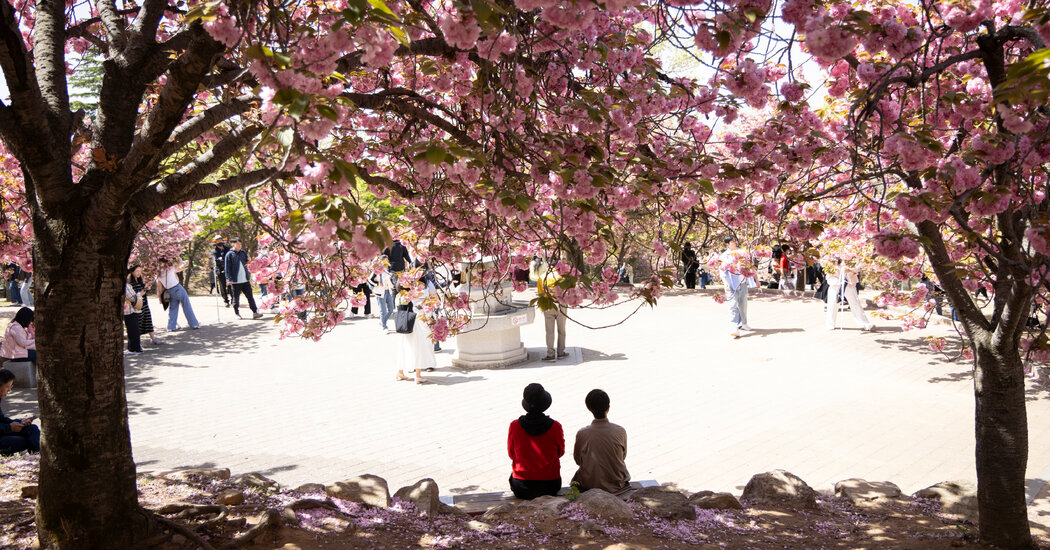
On a recent spring day in Gyeongju, a South Korean city that was the seat of an ancient kingdom, cherry blossoms were in full bloom, frosting tree tops with the color of strawberry-flavored cotton candy.
They had drawn many visitors, but the city and some businesses were trying to appeal to a particular kind of tourist.
One cafe blasted the song “Lady” by the Japanese musician Kenshi Yonezu. Informational videos for tourists about the city’s rich history were playing in Japanese. Some restaurant names were rendered in Japanese along with Korean.
The number of Japanese visitors to South Korea has soared this year, government data shows. Some of them are coming to see cherry blossoms, even though Japan’s spring blooms are world famous and draw millions of tourists.
“I wanted to see Korea’s cherry blossoms before they disappeared,” said Taki Sugimoto, 33, a native of Tokyo who was visiting Gyeongju. “Social media posts said they were on par with the Japanese sakura,” he added, using the Japanese word for cherry blossom, “and I wanted to see it for myself.”
There is one key difference in how South Koreans and Japanese enjoy the flowers.
“Korean ‘Hanami’ is different from the Japanese style,” said Yohei Nakano, a branch manager at Venus Travel, a Japanese travel agency, using a Japanese word for viewing cherry blossoms. “In Japan, people reserve spots to have parties under the trees. In Korea, the popular style is to walk along the paths and simply take in the view.”
Referring to the trees, he said, “The scale is just breathtaking.”
Venus Travel and Kochi Shimbun Kanko, another travel agency in Japan, said that they had organized tours to South Korea specifically for cherry blossoms in Gyeongju, Jeju Island and Jinhae. Some of the cherry trees in Gyeongju date back to the early 20th century.
In the first three months of the year, nearly one million Japanese tourists visited South Korea, a 20 percent year-over-year increase, according to data released by the South Korean Ministry of Culture, Sports and Tourism. This spring, flight bookings from Japan to South Korea doubled from a year ago, according to Trip.com.
But the majority of Japanese travelers are not coming to see cherry blossoms in South Korea, said Kwon Sun Ho, the chief executive of Korea Time Tour, a travel agency based in Seoul. Most visit Seoul or the port city of Busan to shop and eat Korean food, he said, adding, “I wish more people would venture out to places like Jeonju Hanok Village or Seoraksan National Park.”
Daiju Matsuo, 48, from Chiba, Japan, who works in real estate, was in South Korea for a business trip with about 20 co-workers. For a group excursion, they went to Gyeongju.
“Cherry blossoms in Japan are a given, but I was surprised at how beautiful they are in Korea,” Mr. Matsuo said.
Other recent Japanese visitors to Gyeongju included Mai Suzuki and her mother, who live in Kanagawa. Ms. Suzuki said they had planned a trip to South Korea because they were fans of K-pop and K-dramas and were in Gyeongju because it was the backdrop for many historical shows.
“We didn’t know that there were cherry blossoms in Gyeongju,” Ms. Suzuki said.
At the Bulguksa Buddhist temple in Gyeongju, a UNESCO World heritage site, tourists from Vietnam, Germany and Spain were among thousands of people trying to capture the end of the cherry blossom season. Several said they had known that the temple was home to a field of cherry blossom trees. Others said they were pleasantly surprised as they had come to the temple on a historical excursion.
Mr. Sugimoto, the traveler from Tokyo, said that he was looking forward to eating Korean food like tteokgalbi, or marinated beef patties, and jeon, or savory pancakes, and trekking up Gwanaksan, a mountain in Seoul.
As for the cherry blossoms, he said, they were worth the trip.
“They’re not like the ones back home,” he said, “but they’re still a spectacular sight.”
Kiuko Notoya contributed reporting from Tokyo.
https://www.nytimes.com/2026/05/02/world/asia/south-koreas-cherry-blossoms-attract-a-connoisseur-the-japanese.html


