


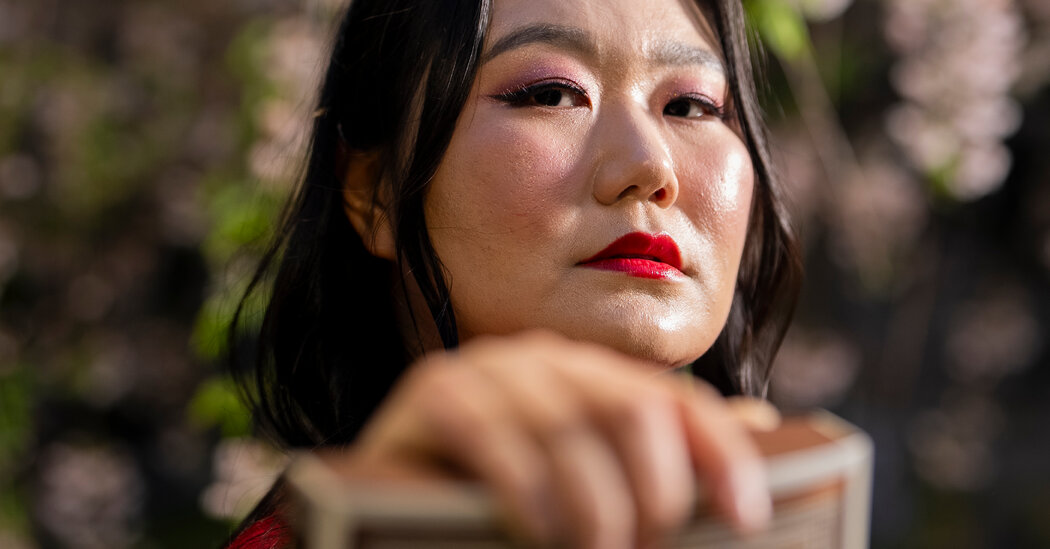
“This is my new baby,” DoYeon Kim said and beamed as she unzipped one of several tall, thin instrument cases leaning against the wall of the practice room in her South Brooklyn duplex. She drew out a gorgeous 12-string gayageum, the traditional Korean zither that has been a part of the country’s musical history since the sixth century.
Sitting on a pillow on the floor, she rested the instrument, longer than its player is tall, across a bright pink Minnie Mouse blanket on her lap and struck a single resonant note. “In Western music, it’s when you hit the note, that boom, that’s important,” she explained. Another strike of the silk string, this time bent through wavering, serpentine permutations as she pressed down on the strings with her left hand, a manipulation Kim refers to as “cooking” the note — a loose translation of the Korean word “sigimsae.”
“In Korean music,” she continued, “the notes start from my right hand and end with my left hand. The after is more important.”
Since moving to New York in 2022, Kim, 34, has quickly become an in-demand collaborator for some of the most inventive artists in jazz and improvised music, despite the unfamiliarity of her instrument to both audiences and to many of her fellow musicians. At the time of our interview in early April, she’d just returned from a tour of Europe with the pianist Kris Davis and had recently recorded with the composer, saxophonist and flutist Anna Webber and the saxophonist Ingrid Laubrock. She’s worked with the post-bop saxophonist Jim Snidero, the avant-garde bassist Nick Dunston and the free jazz legend William Parker, among others.
For the drummer Tomas Fujiwara, who has performed with Kim in a number of improvised duos, her singular voice quickly outshone the novelty of the gayageum. “There’s the initial curiosity to play with an instrument that you don’t usually engage with,” he said. “But as with any musician that I enjoy playing with, it’s more about what the artist brings to it. DoYeon has a personal approach along with a strong character and personality that’s really captivating.”
Following a series of duo recordings with both peers and mentors, Kim is releasing her debut as a bandleader, “Wellspring,” on Friday via the Tao Forms label. The striking album premieres a venturesome quartet with the drummer Tyshawn Sorey, the violist Mat Maneri and the bassist Henry Fraser, a band equally adept at exploring stark beauty, corrosive textures and enchanting lyricism.
Imagery from dreams and nature are woven throughout the titles of Kim’s compositions, ideas reflected in the often surreal narrative flow and lush poetics of her music. On the album’s opening track, “The Beats of Distant Thunder,” several minutes of pointillist cross talk and sweeping drones suddenly erupt into a brisk rhythmic unity. “Walking in the Dream” begins with an intimate whisper before rising in tension to the strident incantation of a lullaby over an agitated cacophony. The 15-minute group improvisation “Linear System” builds with a glacial entropy from shimmering aurora to violent clamor.
Little of the dramatic intensity that Kim projects on record and onstage is evident in her personal demeanor. She exudes a bubbly enthusiasm, continually interrupted with demure apologies for the garrulous flow of her conversation. Yet this sunny charm barely conceals the fierce determination and fearlessness that characterize her story.
“It takes courage to be that totally different,” said the pianist and instrument builder Cooper-Moore, who has become an advocate for Kim since first performing with her.
“I remember the way that I felt when I was 12 years old and I heard Charlie Mingus,” he said. “I’d never heard music like that before.”
“A few years later, I heard Ornette for the first time,” he added, referring to Coleman. “I never got that feeling again until nine or 10 years ago when I met André 3000 and he pulled out his phone and played me what he was working on. Then I didn’t feel it again until I heard DoYeon’s recording.”
Kim never set out to meld tradition and innovation. She came to the States on more of a cultural mission, determined to remedy what she saw as a blind spot in Western cultural awareness.
She’d found comfort in the study of the gayageum after being forced by her parents to give up her dreams of becoming a professional dancer. (Kim has revived her love of dance in recent years, studying ballet at the Mark Morris Dance Center.) Amid a stormy adolescence, she enrolled in a two-month study abroad program on Vancouver Island in Canada. Despite the prevalence of fellow Koreans among the student body, Kim was distressed to find a lack of representation in the school’s cultural festivities, to the point that she called her ambassador to complain.
Kim emerged from the experience determined to enter the diplomatic field, but eventually decided that she could effect change through music. She also recognized that her personality, which had made her a misfit throughout her upbringing in Seoul, might find a better fit in another culture. “In Korea, people always told me I’m too much,” she said. “My character is a little bit dramatic. I’m a little weird. It felt like I wasn’t part of the society. But when I was in Canada I felt normal.”
She contacted every major music school in the United States, most of which encouraged her to follow an ethnomusicology path. Only the New England Conservatory in Boston accepted her as a performer, suggesting a Contemporary Improvisation major. Kim became the first student admitted to the school playing a traditional Korean instrument; she later achieved the same feat at the Berklee Global Jazz Institute.
“DoYeon is a virtuoso classical musician,” said the guitarist and bassist Joe Morris, who became a key mentor during her tenure at the New England Conservatory. “I’m never trying to change anybody, so I asked her a few times if she was cool with improvising. She told me, ‘I love doing this. It’s opened up the whole universe for me.’”
Steeped in traditional Korean and Western classical music to the exclusion of nearly all else — even the ubiquitous K-pop failed to break into her consciousness — Kim found her sudden immersion into improvised music a drastic shift. “People were screaming and making all this noise,” she recalled. “I wondered, ‘Why are they so mad at the world? Is this because of all the plastic and concrete?’ I couldn’t understand where this grief and madness was coming from.”
After a year, “I realized they are just honest about their feelings,” she said. “I’m the one who was afraid to talk about myself. I’m the one who was wearing a mask.”
As seems to be her habit, Kim once again dived into the deep end of a new pursuit, discovering kindred spirits in the audacious sounds of masters like Cecil Taylor, Anthony Braxton and Iannis Xenakis and becoming a prolific performer and collaborator on the Boston scene. She also poured a confessional spirit into this new form of expression, finding an outlet for a deep reservoir of long-repressed emotions.
Many of these stem from her upbringing as an only child, when she felt rejected by her father’s family, who would have preferred a boy. In the final moments of “Linear System,” she pleads in Korean: “To all of you gathered here today, please listen to this girl’s story. This girl has something to say.”
At the same time as she began to find her voice as an artist, Korean cultural exports like “Squid Game,” “Parasite” and BTS were dominating global markets. “When I moved to the U.S. in 2014, there was no K-beauty at Sephora; all the models were white women,” she said. “Then suddenly people on the street were speaking Korean to me and there are restaurants everywhere.”
As personal as the lyrics on “Wellspring” are, the album is another turning point in Kim’s evolution, as she searches for more universal subjects for her music, feeling she’d indulged too deeply in personal confession.
“I felt tired of talking about me, me, me all the time,” she said. “The audience doesn’t come to listen to my diary. Everyone has their own hurt and their own story. I need to figure out why I was born in this time, in this place, and why I chose music. There must be a reason and a way I can use it to serve the world.”
https://www.nytimes.com/2026/04/28/arts/music/doyeon-kim-wellspring-gayageum.html
