






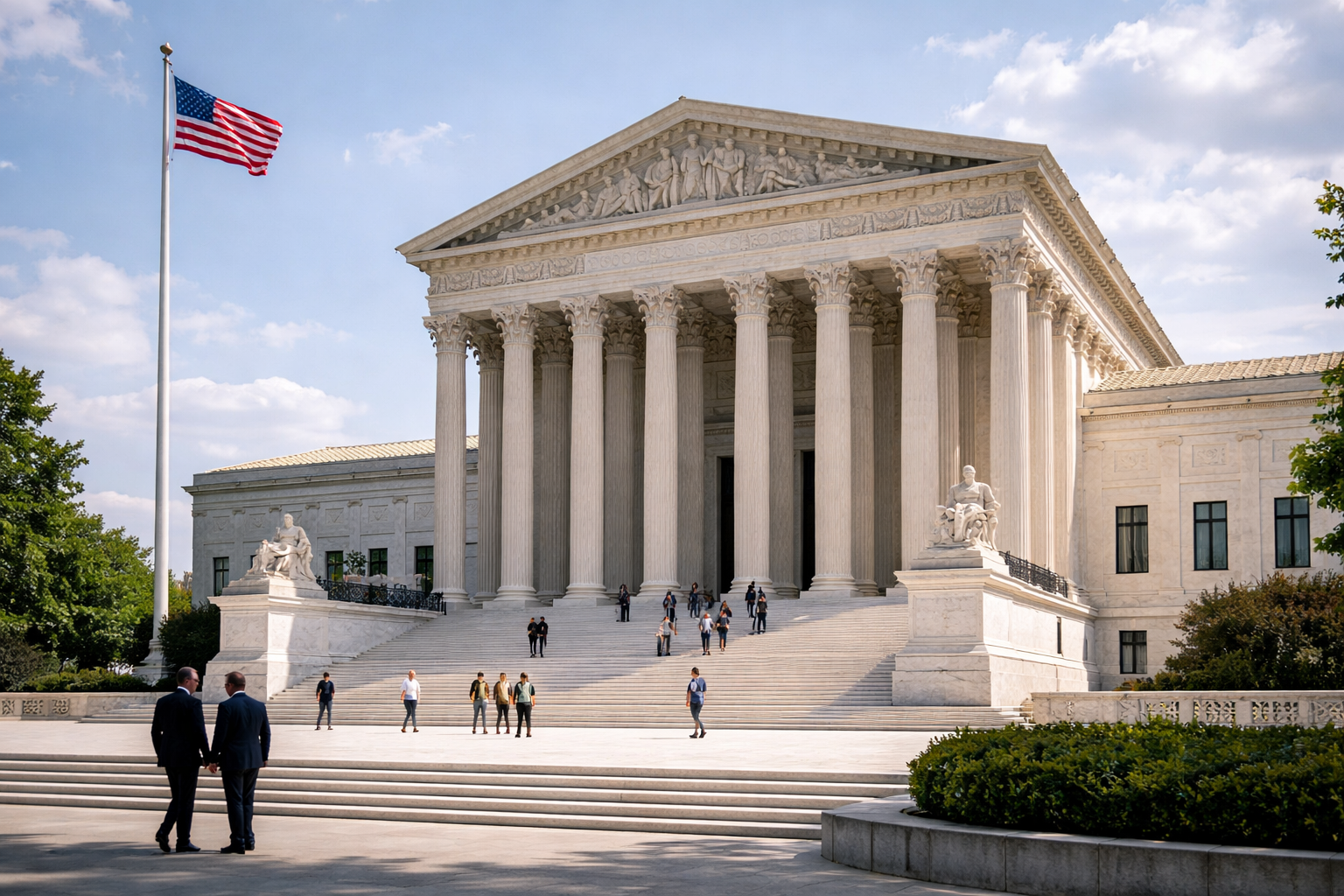

The US Supreme Court’s decision to strike down President Donald Trump’s use of emergency powers to impose sweeping tariffs has delivered a jolt to global markets, even as it opens a new chapter of uncertainty over trade policy, federal finances and the limits of presidential authority.
In a closely watched ruling, the court invalidated tariffs imposed under the International Emergency Economic Powers Act, or IEEPA, a 1970s statute the administration invoked to justify what Trump had branded “Liberation Day” duties beginning April 2, 2025.
Stocks climbed in the immediate aftermath, with investors betting that the removal of the emergency tariffs could ease cost pressures on businesses and consumers.
Yet beneath the initial optimism lies a tangle of unresolved questions: whether importers will receive refunds, how large the fiscal hit could be, and whether the administration will reimpose tariffs under different legal authorities.
Dissent warns of short-term chaos
The 6-3 ruling drew a forceful dissent from Justice Brett M. Kavanaugh, joined by Justices Clarence Thomas and Samuel A. Alito Jr., who argued that the majority had overstepped by limiting the president’s ability to wield tariffs as a tool of foreign policy.
In a 63-page dissent, Justice Kavanaugh warned that the decision could unleash short-term turmoil as importers seek refunds for duties already paid.
“The United States may be required to refund billions of dollars to importers who paid the IEEPA tariffs, even though some importers may have already passed on costs to consumers or others,” Justice Kavanaugh wrote.
He noted that during oral arguments, justices acknowledged that any refund process could be a “mess.”
The scale of potential repayments is significant.
Reuters previously reported that more than $175 billion in collections could be at risk, citing estimates from the Penn-Wharton Budget Model.
Fiscal impact and budget pressures
Beyond the seeming cheer, the ruling has direct implications for the federal budget.
Tariffs, long criticized by many economists for distorting trade flows, had nonetheless become a substantial source of revenue.
Tariff revenue had also buttressed the federal budget.
The US Treasury has collected roughly $240 billion in tariff revenue since April 2025.
Research firm Capital Economics estimates that if courts order refunds, the cost could reach about $120 billion, equivalent to 0.5 percent of gross domestic product.
However, the Budget Lab at Yale estimates that while tariffs imposed as of February 2026 could raise about $1.2 trillion over the 2026–35 period, slower economic growth trims the net dynamic revenue to about $1 trillion.
With IEEPA, these figures would be more than twice as large, it said.
It projects that real GDP would remain roughly 0.1 percent smaller in the long run, equivalent to about $30 billion annually in 2025 dollars.
With IEEPA tariffs, these economic costs would have been somewhat larger, it said.
The Cato Institute, however, says even with tariff revenues at a century high, deficits are projected to continue to increase.
According to data cited by the Cato Institute, the federal government collected $264 billion in tariff revenue in calendar year 2025, more than triple the $85.6 billion collected in 2021 and far exceeding comparable figures from Trump’s first term.
Not all of that revenue stemmed from IEEPA authorities.
US Customs and Border Protection data show that IEEPA tariffs accounted for about 60% of duties collected in fiscal 2025, with the remainder arising from other statutes unaffected by the ruling.
The Tax Policy Center estimates that IEEPA tariffs alone were projected to raise more than $2 trillion over the next decade, reducing cumulative deficits by roughly 7%.
Without that revenue, deficits would average less than half a percentage point of GDP larger, though the broader trajectory of widening deficits would remain intact.
The Cato Institute argues that additional revenue cannot offset structural spending pressures.
“The United States’ budget is on an unsustainable path, driven by automatic spending that’s projected to increase faster than the economy, inflation, and the population. As spending rises and revenues remain flat, the deficit increases,” said the Cato Institute.
“The Treasury estimates that more than 95% of the government’s long-term funding shortfall is driven by growth in just two programs: Medicare and Social Security. Additional revenue, from any source, cannot fix these spending-based drivers of the long-term fiscal imbalance,” they added.
Implications for trade
Justice Kavanaugh’s dissent also underscored the diplomatic dimension.
He wrote that the administration had used tariffs as leverage to secure trade deals with countries including China, the United Kingdom and Japan, suggesting that the ruling could inject uncertainty into those arrangements.
Trading partners reacted cautiously.
William Bain, head of trade policy at the British Chamber of Commerce, said the decision clarified the limits of executive power but did little to reduce business uncertainty.
“While this decision gives clarity on the president’s executive powers to raise tariffs, it does little to clear the murky waters for business.”
“Different legislation has been used for other US tariffs, such as for steel and aluminium, and the president also has other options at his disposal to retain his current regime … For the UK, the priority remains bringing tariffs down wherever possible,” Bain added.
Mexico’s president, Claudia Sheinbaum, said her government was reviewing the ruling, emphasizing the deep trade ties between the two countries.
India was subject to some of the highest reciprocal tariffs under the IEEPA framework, reaching 50% at their peak before a bilateral trade agreement (BTA) was reached just two weeks ago.
Under that deal, India had committed to a massive purchase of $500 billion in American goods over five years—effectively doubling its imports of US energy, aircraft, and technology.
Now, with the legal basis for the original tariffs thrown out, experts suggest the leverage used to extract those concessions has vanished.
Ajay Srivastava, an Indian former trade official and head of the Global Trade Research Initiative (GTRI) in New Delhi, wrote that the ruling should prompt India to re-examine its trade deal.
ING economists Carsten Brzeski and Julian Geib cautioned that Europe should not interpret the Supreme Court’s ruling as a turning point for global trade.
“This ruling will not bring relief,” they said, warning that investigations under Sections 301 and 232 could target specific industries more precisely than the emergency powers previously used.
Pharmaceuticals, chemicals and automotive components are among the sectors that could face renewed scrutiny.
“The legal authority may be different, but the economic impact could be identical or worse,” they noted.
They stressed that the court’s decision addressed constitutional limits rather than the substance of trade policy.
In their view, President Trump’s broader tariff agenda remains intact, albeit on a new legal footing and with a potentially turbulent transition.
Companies now face prolonged uncertainty over refunds that may never fully materialise, the likelihood of replacement tariffs restoring previous rates, and the risk of fresh sector-specific measures.
“The scaffolding has come down, but the building remains under construction,” they said, adding that regardless of the ruling’s wording, “tariffs are here to stay.”
Alternative legal pathways
The central question now is whether the administration will pivot to other legal authorities.
Justice Kavanaugh himself suggested that the ruling may not substantially constrain a president’s ability to impose tariffs, arguing that the majority concluded only that the “wrong statutory box” had been checked.
He cited several possible avenues, including provisions of the Trade Expansion Act of 1962, the Trade Act of 1974 and the Tariff Act of 1930.
Section 232 of the 1962 act allows tariffs on national security grounds, while Section 301 of the 1974 act addresses unfair trade practices.
Trump used Section 301 against China during his first term.
Other options include Section 122, permitting temporary tariffs tied to balance-of-payments concerns, and Section 338, which addresses discriminatory practices by foreign governments.
Trade experts say these routes may require additional procedural steps, but they offer a viable framework for reinstating much of the existing tariff regime.
Lale Akoner of eToro said tariffs are likely to be recalibrated rather than eliminated.
The ruling removes one legal channel, she said, but does not signal the end of the broader tariff agenda.
Markets, she added, had already begun pricing in a restructuring rather than a dismantling of US trade policy.
Markets cheer but brace for volatility
Financial markets reacted swiftly, but analysts cautioned that clarity remains elusive.
Chris Beauchamp, chief market analyst at IG Group in London, said the ruling contains both positive and negative elements.
“It has good elements to it and slightly less good elements, because it will increase this legendary uncertainty that markets, of course, always fear.”
While the potential unwinding of tariffs could relieve industrial and consumer discretionary companies reliant on imports, he warned that heightened legal and policy uncertainty may fuel volatility in the coming days, he said.
Eric Merlis, co-head of global markets at Citizens in Boston, noted that the court stopped short of clarifying who qualifies for refunds.
Markets must now weigh the prospect of easing inflation against the possible loss of hundreds of billions of dollars in tariff revenue.
“While the initial reaction is up, the confusion it’s going to lead to is probably going to keep this market going back and forth over the next couple of days,” Rick Meckler, partner, Cherry Lane Investments, New Jersey, said.
https://invezz.com/news/2026/02/20/sc-tariff-ruling-fiscal-fallout-trade-pacts-and-trumps-next-legal-options/


