






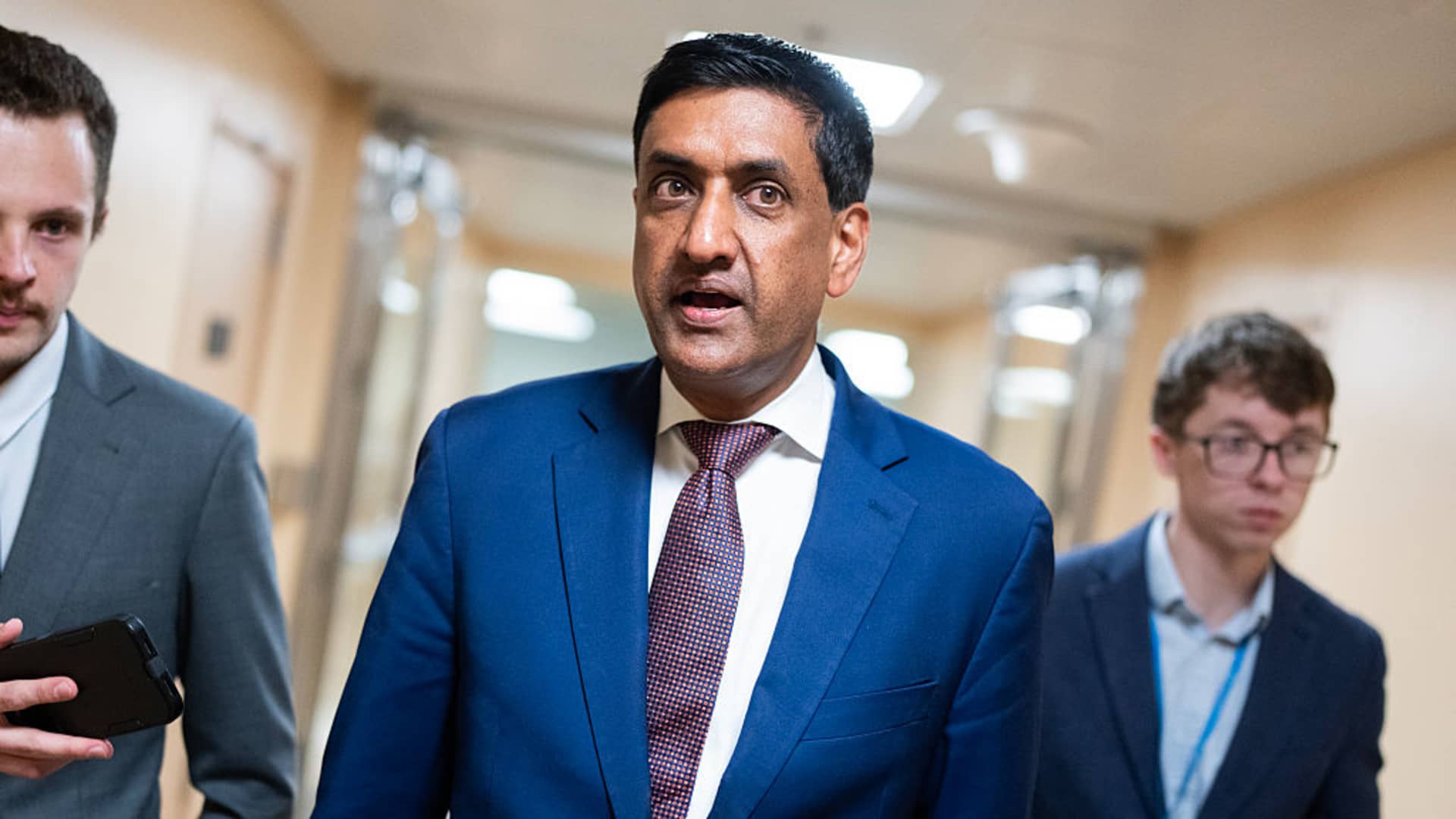


California Democrat Rep. Ro Khanna says he has a solution for Silicon Valley elites angered by his embrace of a wealth tax: Tackling fraud.
Over the weekend, Khanna came under fire from some donors and allies in the tech industry after he endorsed a wealth tax. Labor groups in California are trying to add a proposal for a statewide tax on billionaires to the November ballot, prompting some wealthy Californians to warn they will leave the state if it passes and support a primary challenger to Khanna in next year’s elections.
In an interview with CNBC, Khanna, who represents Silicon Valley, said he’s launching a bipartisan effort from his post on the House Oversight and Government Reform Committee to root out state-level fraud to ensure the new tax windfall doesn’t go to waste. The effort, he said, will make sure that funds go toward health care and other essential services.
“If you want, as I do, to advocate for Medicare for all, to advocate for higher taxes, you have to have the public trust,” Khanna said. “People need to have a receipt for what their money is going toward. You can’t have corruption in the government and waste in the government and then expect people to support the progressive ideals that I have.”
Khanna said he will find someone on the other side of the aisle to work with on the issue, similar to his recent partnership with Rep. Thomas Massie, R-Ky., that compelled the release of files relating to notorious sex offender Jeffrey Epstein. Khanna said he hopes to commission a bipartisan Government Accountability Office report on state-level fraud and hold hearings on the issue.
U.S. Representative Thomas Massie (R-KY), accompanied by U.S. Representatives Marjorie Taylor Greene (R-GA) and Ro Khanna (D-CA), speaks during a press conference on the Epstein Files Transparency Act ahead of a House vote on the release of files related to the late convicted sex offender Jeffrey Epstein, on Capitol Hill in Washington, D.C., U.S., November 18, 2025.
Annabelle Gordon | Reuters
Khanna’s pitch comes after the California State Auditor released new reports that identified potential fraud in the state. Meanwhile, alleged fraud cases in Minnesota, some leading to indictments first handed down in 2022, have also seen renewed national attention from Republican lawmakers and the Trump administration.
Many who criticized Khanna’s endorsement of a wealth tax cited those instances of fraud as a reason that the tax won’t work.
“If, after audits and zero based budgets, there are revenue gaps, I’d support a wealth tax,” said Chamath Palihapitiya, a prominent tech investor and Trump supporter, in a post to X. “Until then, you and your ilk are just getting more incentives for fraud, voter manipulation and larceny.”
Khanna noted that his new oversight effort is in response to “feedback from constituents in my district and leaders” over his embrace of a wealth tax.
He added that the investigation will cover more than just the fraud uncovered in California and Minnesota, and that finding a Republican partner will prevent the investigation from becoming a partisan affair.
“It’s not going to be a blue state or a red state thing,” Khanna said. “Obviously, there have been the reports in Minnesota and California, but it’s beyond that. We need to look at state government and making not just an issue against blue states, but to expose where this fraud is happening and what we can do about it.”
California and Minnesota are both run by Democratic governors. Minnesota Gov. Tim Walz, the former Democratic vice presidential candidate, is up for reelection in 2026. House Oversight Committee Chair James Comer, R-Ky., has called on Minnesota officials to testify before his committee.
The California wealth tax proposal, known as the 2026 Billionaire Tax Act, would levy a one-time 5% tax on the assets of the state’s billionaires to shore up an expected shortfall in the state’s health-care budget. The Service Employees International Union-United Healthcare Workers West labor union is pushing the measure.
The measure still needs to garner enough signatures to qualify for the ballot. If it does, it would be up to California voters to decide on installing the new tax.
Tech leaders opposing the proposal are concerned the tax would apply to unrealized gains, meaning startup founders with a net worth of more than $1 billion based on the paper value of their private stock would be on the hook despite their wealth being illiquid.
Khanna acknowledged those concerns in the interview, saying he supports a wealth tax to pay for health care in California and federally, but with the caveat that there are “workarounds for stock that is restricted with illiquid founders who have companies that are not profitable.”
“You can do it in a way that doesn’t hurt the startup paper billionaires with restricted stock,” he said.
https://www.cnbc.com/2025/12/30/ro-khanna-calls-for-fraud-probe-after-california-wealth-tax-firestorm.html


