







It’s not often a suburban art show sees visitors waiting out front of the gallery before opening each morning.
But when art lovers lined up early every day of the inaugural Melbourne Art Print Fair last February, organisers realised they were onto something.
“We absolutely did it on the smell of an oily rag but people love it when something new and worthwhile happens and they’re willing to come and support it,” says former NGV curator Kirsty Grant.
The success of the inaugural fair has led to an aptly-titled second edition this summer, showcasing the work of nine print studios from across Australia including new participants BSG Editions, Viridian Press and Troppo Print Studio.
There’s also a print prize and workshops including a large format letterpress class by Firestation Print Studio, while an exhibition of etchings by Fred Williams will be installed in an upstairs gallery.
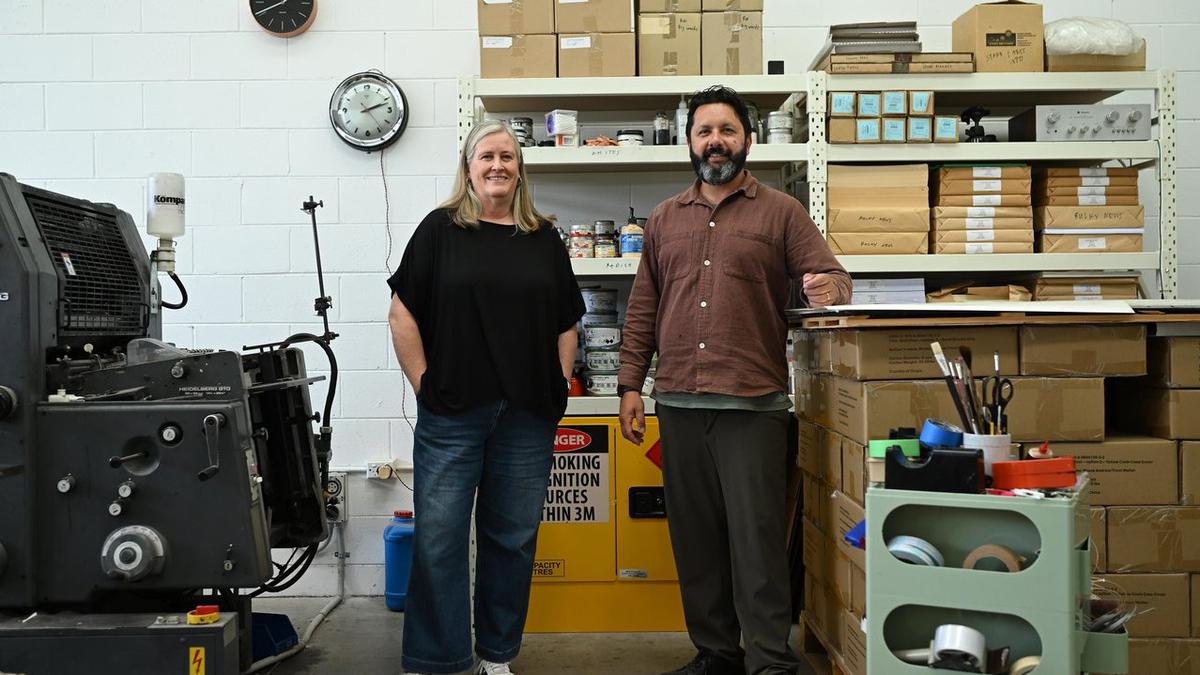
One of the fair’s founders is artist and printmaker Trent Walter, who runs Negative Press from an industrial warehouse in the Melbourne suburb of Brunswick.
Inside, there’s a screen printing table and etching and offset lithography presses, which he uses while working alongside artists to produce limited edition prints and books.
They include Kamilaroi artist Reko Rennie, who is producing a diamond shaped two-colour screen print that reads “Remember Me” at Negative Press.
The studio space can also be used as a gallery, with the three main presses recently crammed to the rear of the building to make way for an exhibition of selected prints by artists Janet Burchill and Jennifer McCamley.
But the art print fair is not so much about selling existing artworks such as these or the secondary market generally: the aim is to promote new art by living Australian artists, Walter says.
Fine art printmaking boomed in Australia in the 1960s with the founding of the Australian Print Council and in the following decades but public interest in the medium has subsided in more recent times, he explains.
But artists from other disciplines like painting are still keen to work with specialist printmakers and buyers remain interested in purchasing art prints.
Another of the fair’s backers is Kirsty Grant, a director of Kaleidoscope Editions alongside another former NGV curator Kelly Gellatly and former Melbourne Art Fair chief Bronwyn Johnson.
Grant believes major galleries have moved away from more modest disciplines such as printmaking and towards attention-grabbing work that brings in big audiences like large-scale installations.
“We wish them the best in that but we see a gap where we need to try and give space again for this collection and appreciation of printmaking that’s being produced by living artists in Australia,” she says.
Also in play in the market more broadly is a persistent conflation of industrial printing, which involves thousands of reproductions.
Then there’s fine art printmaking, in which a small number of impressions are produced directly from an original artist-made image, known as a matrix.
Those who feel unfamiliar with the latter might not realise some of the most iconic (and ironically, widely reproduced) artistic images are actually prints.
Andy Warhol’s famous soup cans are screenprints, while one version of Edvard Munch’s The Scream is a lithograph, and Katsushika Hokusai’s The Great Wave is a woodblock print.
Negative Press can facilitate these printing methods and more through Walter’s technical skills and decades of experience.
Yet he’s wary about the title of master printmaker and says mastery is a notion that depends very much on the environment.
On a recent trip to remote South Australia, Walter worked with the Mimili community on the Anangu Pitjantjatjara Yankunytjatjara (APY) Lands, where artists required some extra creativity to make prints by repurposing the equipment on hand.
Screenprint designs were created with a high pressure hose and woodblock matrixes shaped using an angle grinder.
And instead of using a traditional printing press, the Mimili Maku men’s group carefully drove a Toyota Landcruiser over their carvings, the tyres making large scale print impressions on paper.
It’s been dubbed the Troopie Press and the local arts centre says it’s “Printmaking Mimili Way. No presses, no fancy studios, no worries”.
Lithography presses or Landcruiser tyres, there’s certainly innovation at play in Australian printmaking and fair organisers hope to see lines outside the gallery once again.
“We’re trying to encourage people to learn and understand what original prints are and help develop a culture of collecting prints,” Grant says.
“In other countries people collect prints as really valued, treasured works of art, and there are some in Australia who do too but we’d like to encourage that and develop it.”
MAPF Edition2 runs February 6-8 at Linden New Art in Melbourne.
https://thewest.com.au/entertainment/print-scene-makes-an-impression-with-return-of-art-fair-c-21405598


