






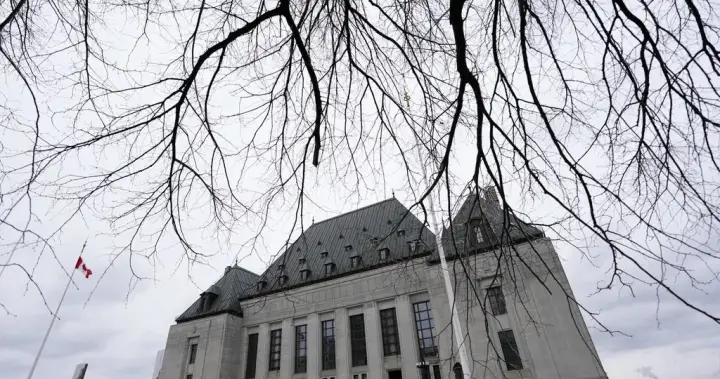
The federal government is appealing to the Supreme Court a lower court decision that found its use of the Emergencies Act four years ago during “Freedom Convoy” protests was unreasonable and led to the infringement of constitutional rights.


The government invoked the act to quell protests in the national capital and at key border points.
“Canada has sought leave to appeal to the Supreme Court of Canada to review of the use of the Emergencies Act during the convoy protests and blockades that caused serious disruptions across the country,” said Justice Minister Sean Fraser’s spokesperson Lola Dandybaeva.
“Our government remains committed to ensuring it has the tools needed to protect the safety and security of Canadians in the face of threats to public order and national security.”
Dandybaeva said it would not be appropriate to comment further because the matter is before the courts.
In 2024, a federal court ruling rejected the use of the emergencies law and found its use of the act breached Charter rights.
A January ruling from the Federal Court of Appeal affirmed that decision.


Get breaking National news
Get breaking Canada news delivered to your inbox as it happens so you won’t miss a trending story.
The court said the government lacked a basis to declare that the events across Canada posed a threat to national security or amounted to a national emergency — requirements that must be satisfied to invoke the Emergencies Act.
For about three weeks in January and February 2022, downtown Ottawa was filled with protesters, including many in large trucks that blocked streets around Parliament Hill.
The influx of people, including some with roots in the far-right movement, prompted many businesses to temporarily shut down and aggravated residents with noise, pollution and harassing behaviour.
While many people demonstrated against COVID-19 health restrictions, the protest attracted some with a variety of grievances against then-prime minister Justin Trudeau and his government.
Trucks also jammed key border crossings to the United States, including routes at Windsor, Ont., and Coutts, Alta.
On Feb. 14, 2022, the government invoked the Emergencies Act, which allowed for temporary measures, including regulation and prohibition of public assemblies, the designation of secure places, direction to banks to freeze assets, and a ban on support for protest participants.
It was the first time the law had been used since it replaced the War Measures Act in 1988.
The Emergencies Act defines a national emergency as an urgent and critical situation of a temporary nature that seriously endangers the lives, health or safety of Canadians, exceeds the capacity or authority of a province to deal with it and cannot be effectively dealt with under any other law of Canada.
The Court of Appeal concluded the government “did not have reasonable grounds to believe that a national emergency existed,” taking into account the wording of the act, its constitutional underpinning and the record that was before it at the time the decision was made.
The judges said the failure to meet the requirements to declare a public order emergency led them to conclude the federal proclamation “was unreasonable” and exceeded the bounds of legal authority.
The government had contended the steps taken to deal with the pan-Canadian turmoil were targeted, proportional, time-limited and compliant with the Charter of Rights and Freedoms.
—With files from Jim Bronskill
© 2026 The Canadian Press
Ottawa appeals Emergencies Act use during ‘Freedom Convoy’ to Supreme Court


