






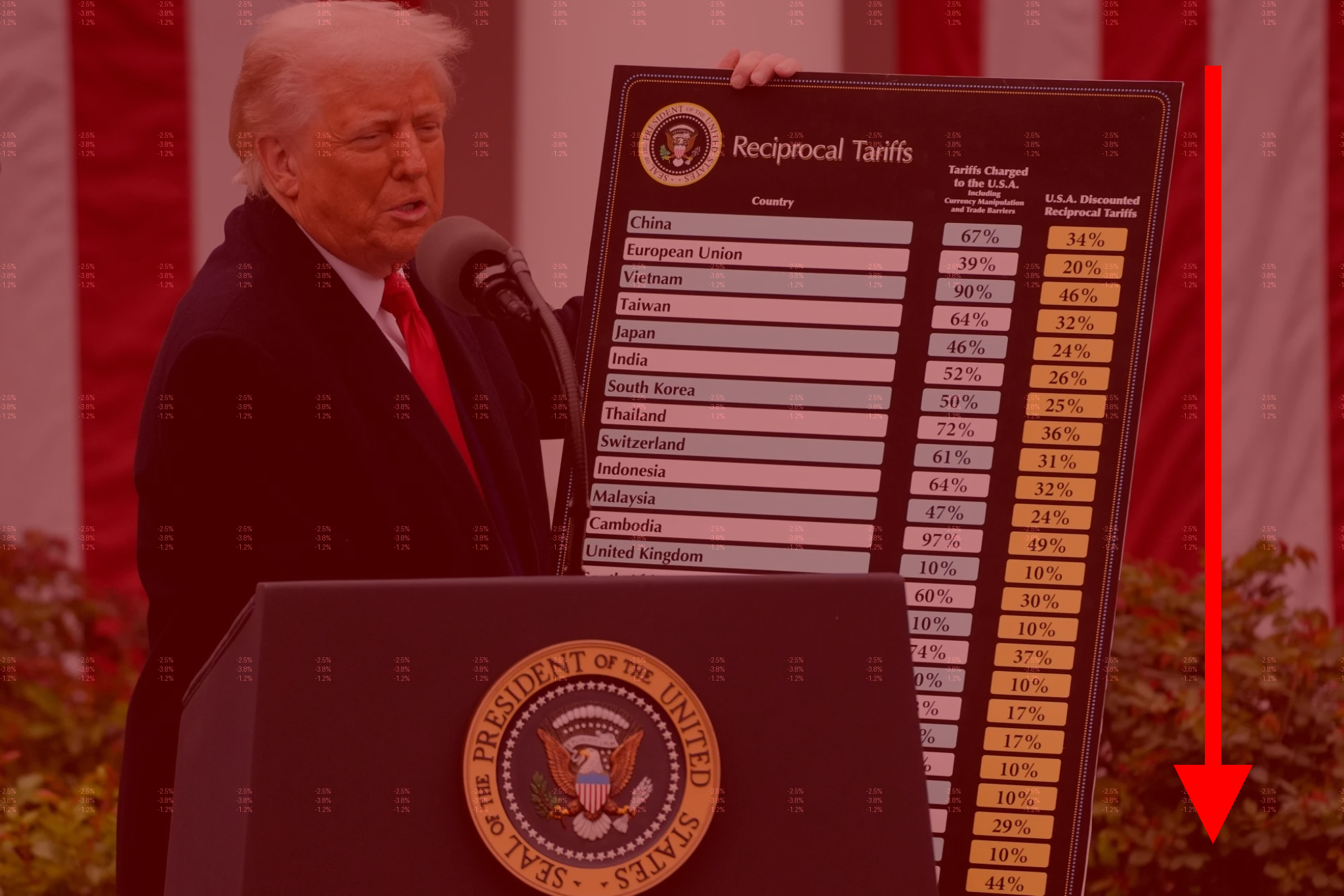
Just over a year ago, on April 2, 2025, US President Donald Trump walked into the White House Rose Garden holding a large placard and signed what he called a declaration of economic independence.
He called it Liberation Day.
The US President promised it would make America wealthy, bring factories roaring back, and force the rest of the world to pay its fair share.
12 months later, the Supreme Court has struck most of it down, $166 billion must be refunded, the trade deficit is larger than when he started, and Americans have already made up their mind.
This is what actually happened.
The promise vs. the reality
Trump framed the tariffs as simple and fair. America would charge trading partners the same rates they charged America.
But the actual formula told a different story.
The US Trade Representative’s office calculated rates by converting each country’s bilateral goods trade deficit into a synthetic tariff number, with a 10% floor.
Trade economists immediately noted that a trade deficit is not a trade barrier. Countries with zero tariffs on American goods still received punishing rates. The “reciprocal” label was rejected by virtually every independent trade analyst who examined the methodology.
50 changes in 12 months
What followed the April 2 announcement was not a stable new trade regime. It was a policy whipsaw unlike anything in modern trade history.
Tariff rates changed more than 50 times in the following year, spanning increases, cuts, new exemptions, new inclusions, pauses, and reimpositions.
The effective tariff rate peaked at 21.5% in April 2025, the highest since 1911. China briefly faced a 145% rate. By year’s end, after a cascade of exemptions, the rate had fallen back to 13.6%. Today it sits at 11%, roughly four times the pre-Trump level, on uncertain legal footing.


Economists describe it as the “uncertainty tax.” Businesses cannot invest, hire, or plan around a policy that changes once a week on average.
Who has been paying the bill so far?
The administration insisted foreign countries would absorb the costs, though Federal Reserve data and independent research disagree.
By August 2025, Federal Reserve economists found Americans bore 94% of the tariff cost.
By year’s end, foreign exporters had absorbed roughly 14%, a modest improvement reflecting some success by importers in pressuring suppliers. The remaining 86% stayed on the American side of the ledger.
The Harvard Pricing Lab estimated tariffs added a cumulative 0.76 percentage points to Consumer Price Index inflation through October 2025.
Fed Chair Jerome Powell stated plainly in March 2026 that tariff effects accounted for between half and three-quarters of a percentage point of remaining inflation.
Food prices are up 2.9% year-on-year. A typical US household faces roughly $1,500 more in annual food costs, according to the Yale Budget Lab.
The worst is not yet over. Economists estimate a 12 to 18-month lag between tariff imposition and peak consumer impact. That window closes in the coming months.
The investment boom that did not arrive
Trump claimed Liberation Day would attract $6 trillion in investment, a number he later revised to $18 trillion. But the actual figure for foreign direct investment in 2025 was $288 billion.
That is not just short of $6 trillion. It is below the prior 10-year average of $320 billion, and lower than every year from 2021 through 2024.
Manufacturing employment fell in all but one of the 10 months following Liberation Day. American factories employed 89,000 fewer workers in February 2026 than they did in April 2025. Construction spending on manufacturing fell from $230.9 billion to $196.2 billion over the same period.
A September 2025 KPMG survey of 300 senior US executives found only 10% were actually taking reshoring action, despite 63% saying they were thinking about it.
The trade deficit got worse
The singular stated goal of Liberation Day was to shrink the US trade deficit. But the deficit grew instead.
American imports in 2025 totaled $3.4 trillion, up 4% from 2024. The total goods trade deficit rose approximately 2% to $1.24 trillion.
The primary target, China, recorded a record trade surplus of $1.2 trillion for the full year, its highest ever. American agricultural exports to China collapsed by 54% in the first half of 2025.
Brazil now supplies over 90% of China’s soybean imports. That market redirection may be permanent regardless of what happens to US tariff policy.
The court stepped in
On February 20, 2026, the Supreme Court ruled 6 to 3 that the International Emergency Economic Powers Act does not authorise tariffs.
Chief Justice Roberts wrote the majority opinion, joined by Gorsuch, Barrett, and the three liberal justices.
The ruling was constitutionally precise. The power to tax belongs to Congress, and the president cannot use emergency trade law as a substitute for legislative authority.
The administration has responded by pivoting to alternative legal tools, including a 10% tariff under Section 122 of the 1974 Trade Act, itself already under legal challenge, and 76 new Section 301 investigations launched in rapid succession.
Critics argue these investigations, designed for targeted responses to specific unfair trade practices, are being deployed as a blunt reconstruction of the tariff wall the Court dismantled.
Has the American public made up its mind?
TAs of March 2026, Trump’s economic approval rating stands at 31% in the latest CNN polling, a career low, down from 44% one year ago.
Among Republicans under 45, the decline was 23%. 65% of Americans say Trump’s policies have worsened economic conditions, a higher reading than any recorded for Biden at any point during his presidency.
One year after Liberation Day, the effective tariff rate is four times higher than when Trump took office, but half what it was at the peak, on questionable legal authority, with $166 billion in refunds pending, 17 trade deals concluded but none ratified by Congress, and the lagged inflation impact still arriving at grocery stores and gas pumps.
The promise was liberation.
The outcome, measured against the administration’s own stated goals, is a policy that raised prices, reduced investment, increased the trade deficit, and was ultimately struck down as unconstitutional.
The underlying changes it set in motion, particularly in global agricultural trade, are likely to outlast the tariffs themselves.
https://invezz.com/news/2026/04/04/one-year-on-did-trumps-liberation-day-tariffs-make-america-wealthier/


