








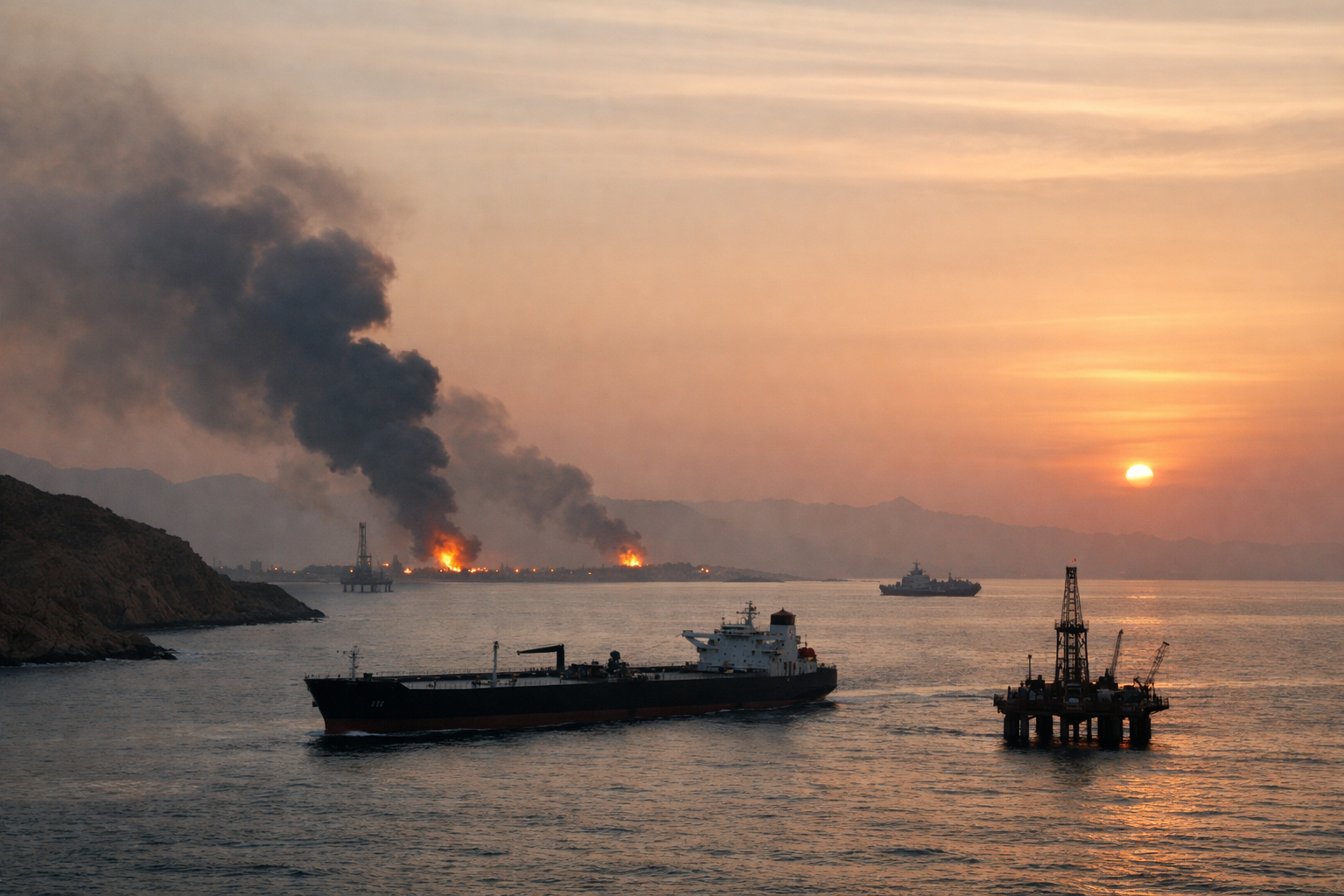
If supplies from the Persian Gulf remain blocked, oil prices are expected to rise again.
Experts also believe that prices are unlikely to decline much further than what they experienced this week.
Oil prices had experienced their sharpest decline since 2020 earlier this week in response to the two-week ceasefire agreement between the US and Iran.
“If the strait reopens, a price decline would be expected. However, prices are unlikely to fall significantly below this week’s low,” Carsten Fritsch, commodity analyst at Commerzbank AG, said.
Transit risks and new fees impede strait reopening
Experts said that prices have a risk premium because of the uncertainty about the safety of vessels that would transit the Strait of Hormuz even if it reopens fully.
Iran is implementing new regulations, such as requiring permission for ships to transit the strait. Furthermore, there is discussion of imposing a transit fee, which could be as high as $2 million per tanker.
Analysts at Rystad Energy said that the transit fee would have a “diplomatic wrapper” around it even if insurers and ship owners require proof of safety for their vessels.
“Even within this two-week window, the expectation is that activity will restart in a measured manner rather than all at once,” Rystad analysts said in an emailed commentary.
Focus would be on the traffic through the Strait of Hormuz in the coming days as the risks of drone attacks by the Revolutionary Guards remained high.
The significant level of Chinese crude oil imports following the March closure of the Strait of Hormuz, especially when contrasted with crude oil processing volumes, is a point of particular interest.
The pervasive mistrust surrounding the ceasefire agreement is evident, as only a small number of ships have reportedly proceeded since the precarious truce began on Wednesday night, despite the fact that it has already been breached numerous times.
Shipping companies cautious
Western shipping lines and tanker companies are demanding safety guarantees and have been reserved in their public statements.
Meanwhile, Maersk, the world’s second-largest container shipping operator, said earlier this week that it would need more clarity and does not yet have full maritime certainty to transit the waterway.
German shipping line Hapag-Lloyd’s CEO, Rolf Habben-Jansen, told clients on Wednesday that it is too soon to assess how much traffic can use the key waterway. He cautioned that fully restoring the network would take at least six weeks, even if some vessels exit the Gulf soon.
The above scenario, naturally, presupposes that hostilities won’t resume once the ceasefire concludes.


Meanwhile, data from Kpler, a firm specialising in monitoring vessel traffic, indicated that 187 loaded oil tankers were “stuck” in the Gulf just before the ceasefire came into effect.
The volume of crude oil and oil products being carried is 172 million barrels. This amount is roughly equal to the typical 8-9 days of transit volume through the strait before the blockade, according to Commerzbank’s calculations.
Additionally, the International Maritime Organisation (IMO) has warned that a transit toll by Iran would set a dangerous precedent, while US President Donald Trump has also opposed such a fee.
It is likely to take some time before the Strait of Hormuz is safe to navigate again. This points to higher oil prices.
Discrepancy between futures and physical markets
If and when the Strait reopens, the phased manner of the process would have a significant impact on the oil markets as it would create a discrepancy between the futures and physical market.
For example, after the announcement of the two-week ceasefire, the futures market priced in the relief almost instantaneously, but physical indicators still reflected caution, according to Rystad.
While the flat price for Brent crude has dropped, key market indicators suggest persistent tightness. Immediate physical price differences (differentials) are expected to remain firm, tanker transportation costs (rates) are elevated, and buyers of sour crude are still paying a premium.
This premium is due to the scarcity of global supply outside of the Gulf region, which provides a sense of supply security.
This disparity highlights that a decline in perceived geopolitical risk does not necessarily translate to a swift reduction in operational risks in the oil market, according to the Norway-based energy intelligence company.
Futures contracts would experience the swiftest and most extreme reaction in a scenario of escalation, primarily because their pricing reflects probability, optionality, and fear, according to Rystad Energy.
The steepest premium is typically observed at the front of the futures curve. This is where traders price in risks such as immediate supply disruption, interference with tankers, delays through the Strait of Hormuz, and the potential for a wider regional military conflict, Rystad analysts said.
That is why the four-month and six-month war scenarios had gained and remained strong relative to the pre-war line and the ceasefire case.
These trajectories represent more than just lost barrels; they signal the market’s valuation of time, unpredictability, and the increasing likelihood that the disruption will expand beyond a brief, isolated incident.
https://invezz.com/news/2026/04/11/oil-price-drop-wont-last-spot-markets-hint-at-spike-despite-iran-ceasefire/


