




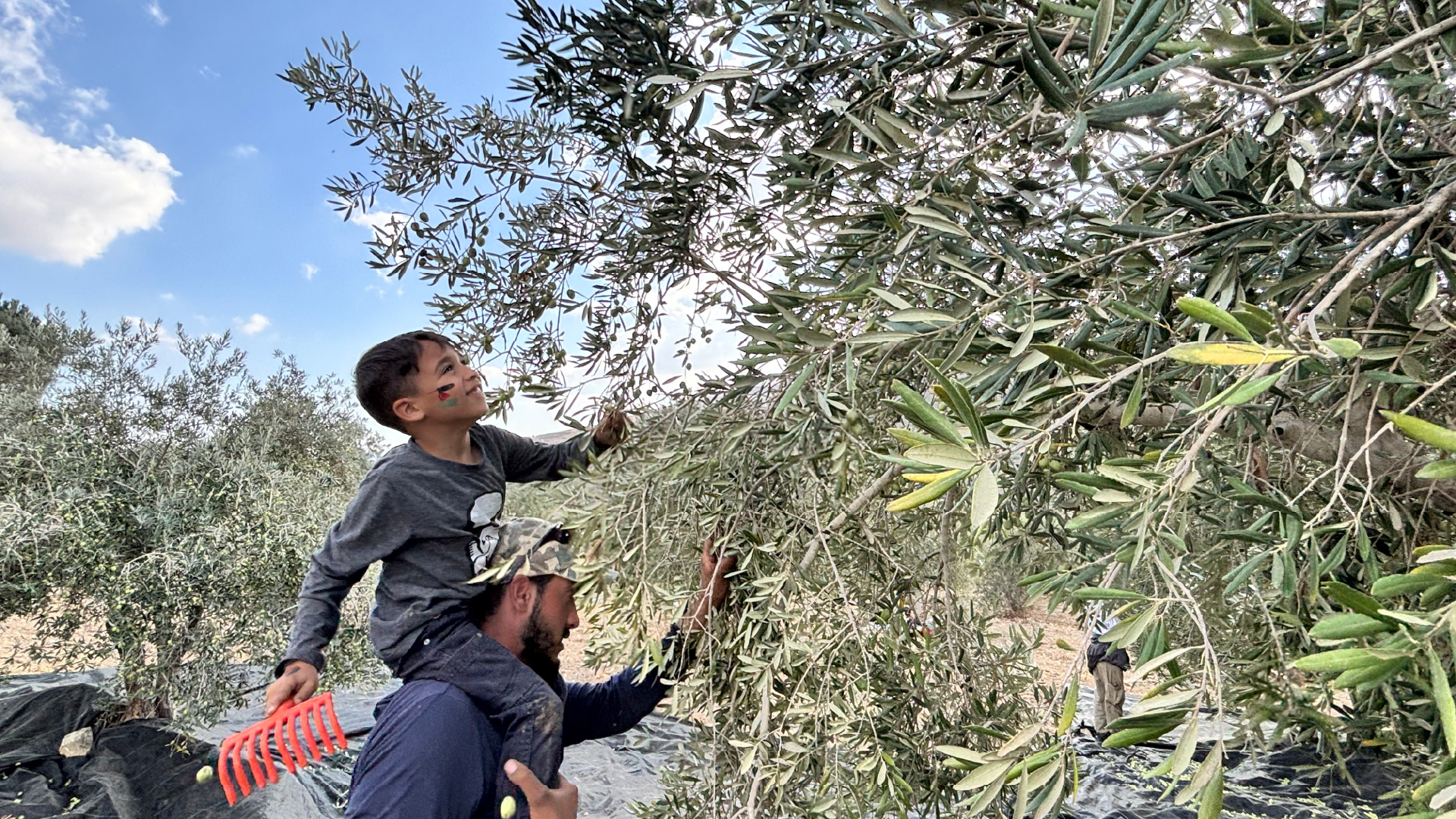
Between October 1 and November 10, the United Nations Office for the Coordination of Humanitarian Affairs documented 167 olive harvest-related settler attacks resulting in casualties or property damage, which locals note is likely a significant undercount.
OCHA also notes the number of affected communities, 87, has doubled since 2023, mostly due to the expansion of settler outposts and infrastructure into new areas of the occupied West Bank.


Moustafa Badaha, 48, owns a small house among these olive groves on the other side of Deir Ammar from the Othmans.
In July, yet another settler outpost was erected just south of Moustafa’s property. Moustafa has since filmed settlers breaking his fence, damaging property, and stealing farm equipment.
Settlers from this outpost also started attacking Ein Ayyoub, a Bedouin community of 130 people south of the village, forcing them out, eventually by military orders, which made the area a “closed military zone”.
According to Deir Ammar’s mayor, Ali Abu al-Kaak Badaha, 65, settlers have been attacking villagers trying to reach their farms in eastern and southern Deir Ammar for years.
This year, he added, the villagers have been completely cut off, and now the settlers, supported by Israeli soldiers, have started attacking villagers on the western side of the village, where Moustafa’s property is.
Having scared the Deir Ammar villagers off, settlers from this outpost make a point of releasing their cows to feed on the village groves west of the village.
The Israeli settlers also steal from the farms, said the mayor, taking olives, tarps and plastic sheeting used in the harvest.
“This year, everywhere you go for the olive harvest, the settlers find you,” Izzat said. “And they attack you.”
There’s a pattern to how the settlers stop the harvest, according to Kai Jack, a field coordinator for the Rabbis for Human Rights (RHR) organisation, which accompanies Palestinian farmers as a protective presence.


“Very often, we’re first spotted by settlers, who then can be seen on their phones, and within a few minutes, the army shows up,” said Jack.
“It’s just obvious that they’re working together.”
Jack, along with about 50 other solidarity activists from RHR and Standing Together, had accompanied some Deir Ammar villagers on October 16 to pick olives on the west side, near Moustafa’s property.
Within five minutes of arriving and starting to pick, two female Israeli soldiers arrived, telling the group the area was a closed military zone and they had to leave.
The soldiers did not have official orders, so the olive picking continued.
Fifteen minutes later, more Israelis arrived – some were in military uniforms, some were masked, and others were in partial military fatigues, with “no clear separation between the settlers and the soldiers”, Jack said.
A closed military zone order was soon delivered, and some of the armed settlers began chasing villagers, throwing rocks at them, the soldiers taking their time to stop them.
In the groves, settlers attacked families with clubs and rifles, including Yousef Dar al-Musa, who was injured and spoke to Al Jazeera days later in his family compound.
https://www.aljazeera.com/news/longform/2025/12/3/oil-presses-stand-silent-as-west-bank-has-its-worst-olive-harvest-in-years?traffic_source=rss