






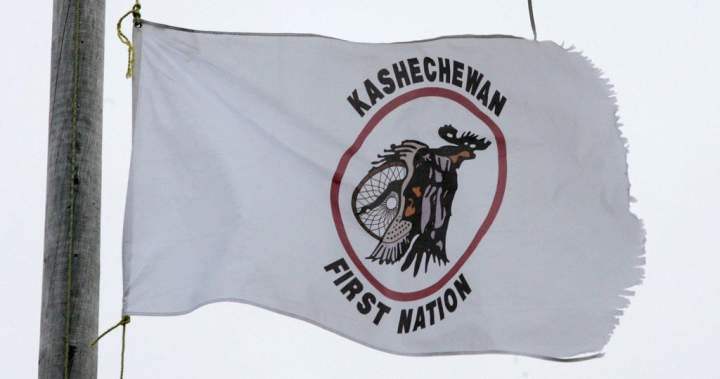
First Nation chiefs from northern Ontario are calling on the federal and provincial governments to hasten the evacuation of Kashechewan First Nation, as the community remains under a state of emergency and has no clean water.


The remote, fly-in Cree community’s water treatment plant and sewage system failed last week and a “do not consume” water advisory was put into place.
The state of emergency was declared Jan. 4 and leadership called on the Canadian military for a full-scale evacuation.
The only way to bring water into the community was by plane, Kashechewan Chief Hosea Wesley told Global News last Friday.
“We don’t have enough water bottles to accommodate these babies, newborn babies to take their baths,” Wesley said.
“We have no control of these old systems in place with these pumps. And we need to address these issues with the federal government.”
Since then, Mushkegowuk Council chiefs say just under 700 people have been evacuated from Kashechewan to nearby communities but estimate 1,600 to 1,700 remain.
Two members of council met with reporters in Ottawa on Wednesday to make what they called an “urgent plea.”
“Families, elders and children do not have safe drinking water,” Grand Chief Leo Friday said.
“Fire hydrants are all frozen. That community is not safe to live in. This is a serious public health and safety emergency.”
Meanwhile, the community’s been dealing with a gastrointestinal outbreak while the local health clinic was evacuated because of a sewage backup.


Get daily National news
Get the day’s top news, political, economic, and current affairs headlines, delivered to your inbox once a day.
Deputy Grand Chief Amos Wesley said two members of the community have already tested positive for E. coli infection.
“The urgency is real. It must be recognized,” he said.
“We are asking public health officials to increase water testing to ensure residents are safe, especially with E. coli concerns.”
Indigenous Services Canada said last week it was prioritizing the evacuation of 500 vulnerable people and it had enlisted a company that specializes in water and wastewater management to resolve the issues at the plant.
Ontario’s Ministry of Emergency Preparedness and Response has also said the province is working with the federal government, First Nations leadership and local partners to support the safe evacuation of residents.
But Wesley said that requests for military assistance have not been “fully met,” and Friday said aircraft sent by government have not been big enough to evacuate residents in a timely manner.
‘Evacuation is not a long-term solution’
The chiefs point out that Kashechewan has had long-standing water-quality issues and is repeatedly under water advisories or evacuated.
In 2005, the community drew international attention when it was evacuated after E. coli contaminated its water supply.
The chiefs told reporters Wednesday that the infrastructure at its aging water treatment plant must be fixed and properly maintained.
Kashechewan, which is located on James Bay, is also prone to flooding and residents have regularly been forced to evacuate for that reason as well.
“We’ve been evacuated yearly, sometimes twice in a year,” Friday said.
“Kashechewan cannot rebuild in the same place. It must relocate to safe and dry high ground. We need new homes, safe water, waste water system and a functioning [health] clinic.”
Talks of relocation go back decades. In 2006, the Liberal government at the time committed to moving the community but the plan fell through when the Conservatives came into power.
In 2019, the federal and provincial governments signed an agreement with Kashechewan First Nation to commit to moving the reserve.
The Indigenous services minister at the time, Seamus O’Regan, said the relocation process would likely take around eight years under the terms of the agreement.
NDP MPP Guy Bourgouin, who represents Mushkegowuk—James Bay, said there’s been little update on the relocation plan.
“The federal and the provincial [governments must] stop playing the political ping pong between themselves and move this community once and for all. Let’s build a road, build infrastructure and then once we’ve done that, we can start building a new water plant and moving the school,” Bourgouin said.
Friday urged the governments to fast-track relocation and to stop ignoring the community.
“Evacuation is not a long-term solution,” he said.
— with a file from The Canadian Press and Caryn Lieberman
© 2026 Global News, a division of Corus Entertainment Inc.
‘Not safe to live in’: Chiefs call for quicker evacuation of Kashechewan First Nation


