





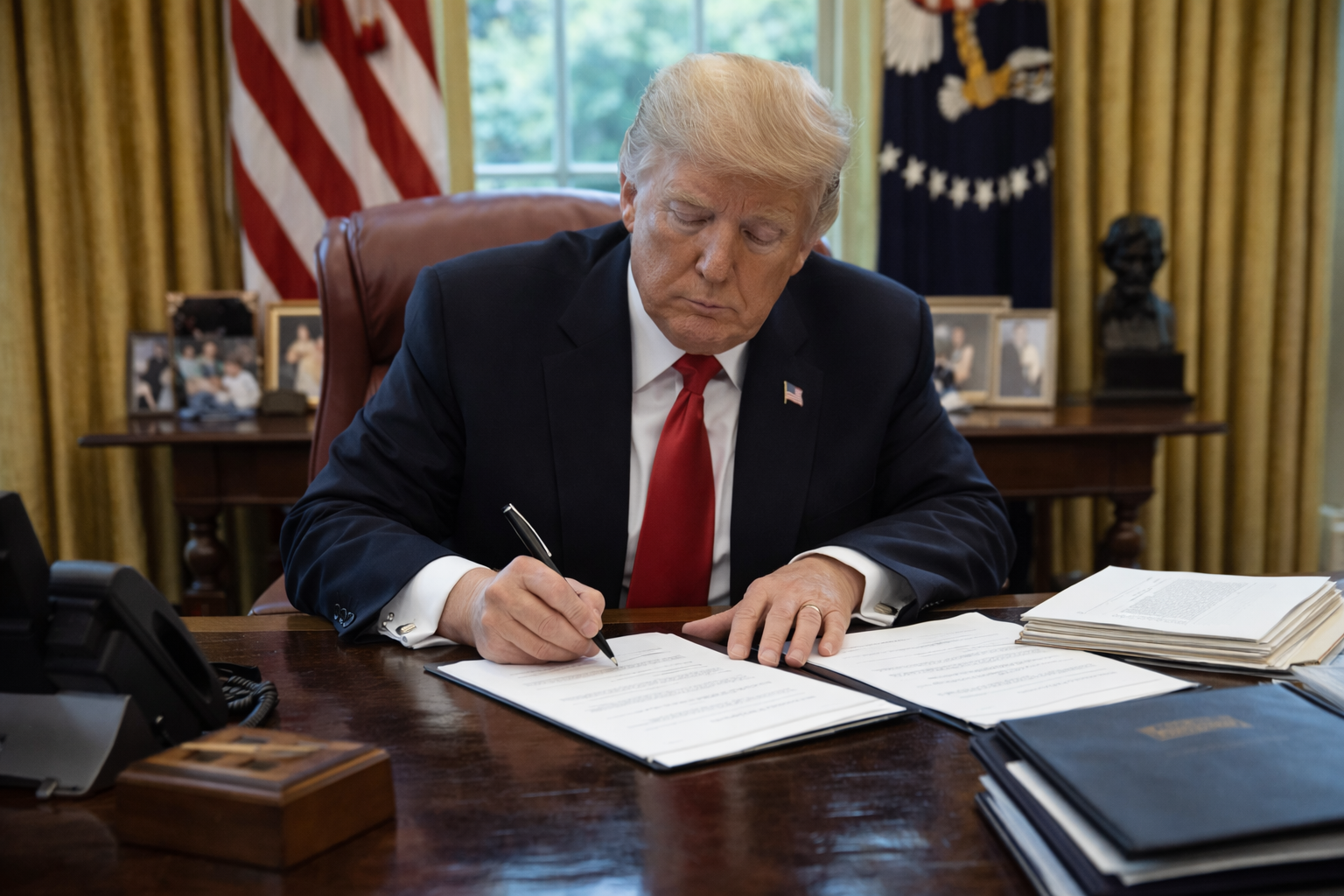

The United States’ new round of global tariffs at a rate of 10% took effect on Tuesday, reviving trade tensions only days after the Supreme Court struck down President Donald Trump’s sweeping “liberation day” tariffs from last year.
A notice from US Customs and Border Protection said an additional 10% ad valorem duty would apply to imports from all countries for 150 days from Tuesday, unless specifically exempt.
The rate is lower than markets had expected.
Trump said on Saturday that tariffs would be raised to 15%, but no formal directive has yet been issued to that effect.
Officials said the higher levy could still be implemented at any time.
Section 122 used to bypass Congress
The administration is applying the new tariffs under Section 122 of the Trade Act of 1974, which allows the president to impose temporary import restrictions without congressional approval in response to balance-of-payments pressures.
The 10% duty is being applied on top of existing most-favoured-nation tariffs.
Legal experts note that Section 122 limits such measures to 150 days unless Congress votes to extend them, raising questions about what comes next once the clock runs out.
Trump struck a defiant tone after the Supreme Court ruling, warning that countries seeking to exploit the decision would face tougher treatment.
In a social media post on Monday, he said any nation that “plays games” would be met with higher tariffs than those recently agreed.
Economists warn of rising uncertainty
Analysts said the rapid shifts in tariff policy risked plunging businesses and trading partners back into uncertainty.
“I think it simply adds to the chaos and mess,” said Carsten Brzeski, an economist at ING, referring to the pace and unpredictability of recent changes.
Speaking to the BBC, he said the level of uncertainty now resembled that seen last year, with a higher risk that US trading partners would retaliate.
“The risk of a real fully-fledged tariff war escalation is clearly higher than last year,” he added.
Financial markets showed early signs of unease.
The Japanese yen weakened on Tuesday as investors weighed the potential fallout for global trade from renewed turbulence around US tariff policy.
Stock futures in the US, however, were nearly flat.
US trading partners push for clarity
US trading partners moved quickly to seek clarity.
Japan’s trade minister, Ryosei Akazawa, urged Washington to ensure that Tokyo would not face tougher conditions than those agreed under last year’s bilateral deal.
According to Bloomberg, during a call with US Commerce Secretary Howard Lutnick, Akazawa stressed that Japan’s position should not be worsened by the new measures.
Under last year’s agreement, Japan committed to establishing a $550 billion investment vehicle in exchange for reduced US tariffs, including a cut in duties on Japanese auto imports to 15% from 27.5%.
Officials from both sides said they would continue working closely to ensure the smooth implementation of projects linked to that mechanism, according to Bloomberg.
Taiwan’s government also said it was seeking assurances that previously agreed favourable terms would remain intact.
Europe freezes ratification process for trade agreement
In Europe, the response was more cautious.
The European Union said it had frozen the ratification process for its trade agreement with the Trump administration while it sought clarity on the direction of US tariff policy.
“Pure tariff chaos from the US administration,” wrote Bernd Lange, a senior EU lawmaker from Germany.
“No one can make sense of it anymore — only open questions and growing uncertainty.”
The uncertainty comes as European exporters had begun the year on a slightly stronger footing.
A survey by Germany’s Ifo economic institute showed that export expectations improved in February, particularly among manufacturers of electronic and optical products.
“The export economy is starting the new year with some tailwind,” said Timo Wollmershaeuser, the institute’s chief economist.
However, he cautioned that the constantly shifting US tariff stance was undermining planning.
“If customs regulations are constantly changing, it makes planning difficult for companies,” he said.
Legal questions linger over new tariffs
Some economists warned that the new Section 122 tariffs could themselves face court scrutiny.
Atakan Bakiskan, a US economist at Berenberg, said the current US trade deficit might not meet the statutory threshold of a “large and serious” balance-of-payments problem required to justify such measures.
Even so, Bakiskan said it would be surprising if the administration retreated from its protectionist agenda once the 150-day period expires.
He said officials were likely to explore alternative legal routes to reimpose or replace the tariffs.
“There are several options available,” he said, pointing to other trade statutes that could be invoked.
National security route back on the table
Those options appear to be taking shape.
The administration is reportedly preparing a series of national security investigations under Section 232 of the Trade Expansion Act of 1962, which could pave the way for new tariffs justified on security grounds.
The probes would examine imports of batteries, cast iron and iron fittings, electrical grid equipment, telecommunications gear, plastics and industrial chemicals, Bloomberg said in a report.
Trump has already used the authority during his second term to impose tariffs on metals and automobiles and is widely seen as more legally durable than emergency powers.
While Section 232 tariffs are also time-limited, officials have indicated that Trump could use the investigation period to design additional import taxes that, in aggregate, would restore much of the tariff regime struck down by the courts.
https://invezz.com/news/2026/02/24/new-10-us-tariffs-come-into-effect-all-you-need-to-know/