






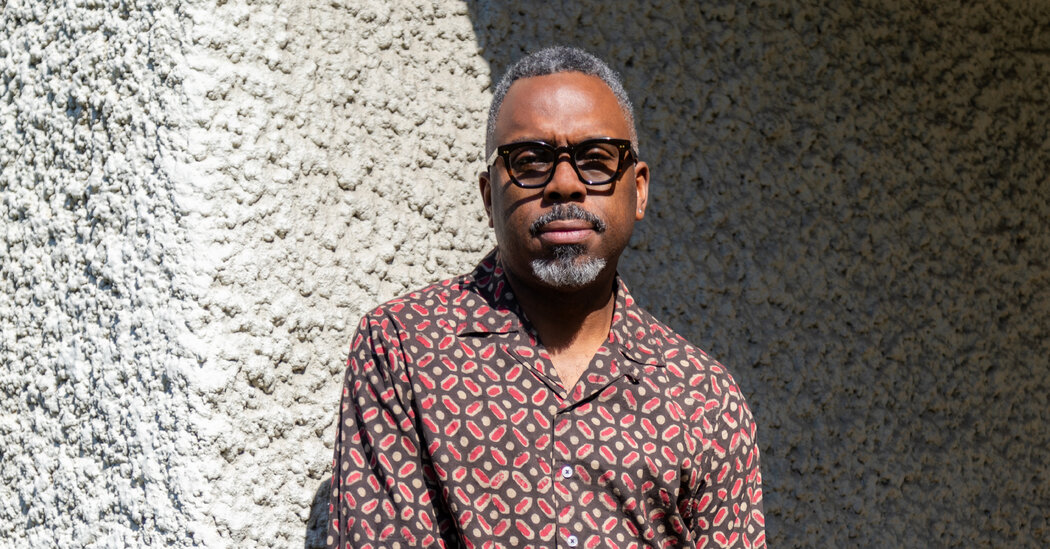
There’s a kindly, professorial air to Nate Smith, created as much by his salt-and-pepper curls and wire-rimmed glasses as his even-toned conversation. In February, as he collected one of two Grammys for “Live-Action,” his 2025 album that threaded funk, R&B and pop across collaborations with established and new artists, Smith laid out something of a thesis statement.
“Live music is our last stand,” Smith said in his acceptance speech, calling on the Recording Academy to protect the rights of artists against the encroachment of artificial intelligence.
That month, the Chesapeake, Va.-born drummer was also announced as the new artistic director of the Newport Jazz Festival, the oldest and perhaps most influential showcase of jazz and related idioms. As only the third man to hold the title in its 72-year history, after its longtime face George Wein and the gregarious bassist Christian McBride, Smith takes over as it prepares to celebrate the centennials of Miles Davis and John Coltrane, whose Newport appearances were pivotal to the event and their careers.
Smith’s career has taken shape in a different climate from that of his predecessors. Having written for Michael Jackson, toured with straight-ahead jazz acts as well as genre-blurrers like Alabama Shakes and led his own outfits, Smith, 51, has also made the most of his social media presence. He’s used YouTube and Facebook to build his following, sharing drum solos and programmed beats, and plied Instagram to reach out to prospective collaborators who, like him, treat genre distinctions as permeable.
That perspective made an impact on the executives who tapped Smith. “We were looking for someone who was not just playing, but they were paying attention to the environment in which they were playing,” said Bruce Gordon, chair of the Newport Festivals Foundation board. “They were looking at audience demographics. They were being observant.”
On Tuesday, the 2026 event’s full lineup was revealed, including Herbie Hancock, Flea, Thundercat, Leon Thomas and Little Simz.
Speaking on a video call in March, Smith described the qualities that define him as a bandleader, how Wein welcomed him as a young artist and what he hopes to impart to the next generation. These are edited excerpts from the conversation.
What’s it like to be taking over from Christian McBride, who is known as a wide collaborator and someone who brought to Newport some hard-core jazz acts and also surprising bookings?
Christian leaves behind some really big shoes. One of the things I always loved about Christian’s approach was he brought people into the music and some of the [after-hours] jams he put together. That kind of spirit of collaboration, I really want to keep that in my tenure as artistic director.
I obviously have played Newport as a sideman many times. My first bandleader gig was with Kinfolk, with my first band, in 2017, and I actually did get to meet George Wein earlier that year. He came to see Kinfolk play at the Blue Note and offered some very encouraging words that really kept me going at a critical moment in my career. So my coming into Newport, I always felt very welcomed and very encouraged. When I see young artists who are really doing the work, I want to encourage them and advocate for them.
You’ve worked with Brittany Howard and Alabama Shakes, and played with Betty Carter. What have you learned about being in bands led by women?
I didn’t get to play with Betty enough. I met her in 1996, and she passed away in 1998. I just marvel at how in charge she was onstage. She would conduct the band with her body. I’ve learned that Brittany’s imagination is undefeated. While we were on the road, every sound check she would write a song that could be on her next album. She would just freestyle, just make it up, just improvise. That spirit of openness — she’s such a warm and open person and a welcoming person and like genuinely kind. It really was like, “Oh, this is leadership.”
What pieces of that do you aim to bring to this role?
I’m thinking so much about how much stuff young jazz musicians — or regardless of age, emerging jazz musicians — have to deal with. Musicians are being tasked with doing the impossible. Starting a band, running a band, using your socials to engage your audience and all the while being paid a pittance from streaming. For me, the collaborative part is who do I see that’s out here ice skating uphill but still managing to make it work? Still managing to grow their audience? When I see those artists who are kind of still cutting through the noise, those are the people I want to fight for.
You joined the event after much of the 2026 lineup was set. Who were you able to push to add?
I came in in the fourth quarter and I was thinking OK, I really want to see Michael Mayo on the Newport stage. I’ve known Michael since 2012 or 2013. I was teaching at Betty Carter’s Jazz Ahead and he immediately impressed me — the clarity of his ideas.
I was thinking a lot about this dual project with Karriem Riggins and Liv.e called Gena. And I’ve known Karriem for 30 years: He’s a guy who really exists at the intersection of hip-hop and jazz. This album is sounding so fresh and so exciting, I was like, we have to get this on the stage.
Obviously, my boys, my Virginia compadres, Butcher Brown, I’m always rooting for them. And I kind of feel like the category of alternative jazz might not exist without a band like the Bad Plus. This is their farewell year of playing together. Like, man, they should be at Newport.
The performances at Newport live on, sometimes in some very famous recordings. Have you thought about how to maintain that as a tradition?
I really want the audience to form personal connections with the artists. My dream is that everyone who comes to Newport sees an artist they’ve never heard of, and they fall in love with that artist and they follow that artist for the rest of their career. That’s how you keep the music alive, you keep the music thriving and you keep your audience evolving and expanding, too. But the way that you get there are really unusual collaborations, like intergenerational collaborations or genre-blurring collaborations, where you might show up thinking you’re going to see artist X, but then artist Y walks out onstage and kills it. And then you’re like, I can’t believe I just saw that.
The Miles and Coltrane centennial celebrations must have been important to get right.
It’s fantastic that we have Kamasi [Washington] and Chief [Xian aTunde Adjuah] to carry that torch and to headline in that slot — it’s the centerpiece of the lineup. This is the enormity of the history of Newport, the enormity of the history of jazz. It can be overwhelming. Jazz has a lot of constituents. But if I draw a clear thread between what these musicians are doing and what the masters did? Can I draw a clear thread between Herbie Hancock, who’s closing on Sunday, and Robert Glasper who’s playing on Friday?
I think about Wayne Shorter. I think about Miles himself. Most of those musicians evolved over the course of their careers. Jazz was the information they brought to all these other genres of music. Miles Davis’s last record was a hip-hop record. And this is many, many years before [D’Angelo’s] “Voodoo” and before J Dilla. Miles heard it. He could say, yeah, put on this drum loop and let me play over top of it. He understood the texture of it. And I think that that’s really important to realize. We can honor our legends. We can honor our masters. But we also have to respect the fact that they were evolving artists, too.
Your appointment came on the heels of Jazz at Lincoln Center announcing that Wynton Marsalis is stepping down. At least institutionally, there’s a change happening in jazz. Is that something that you’re feeling?
Absolutely. Newport is going to be 72 years old this year. There is an enormous history and legacy to this festival and to the music itself. But I do think that as we see our masters aging, passing away, and as we have new masters sort of stepping in to take the mantle, grab the torch, there are going to be shifts. And as the demographic shifts, as the audience shifts, the audience is getting younger for the Newport Festival. It makes sense that there’s a shift in the leadership, too, and people who are kind of helping to shape what the experiences are going to be for the fans and for the artists.
This is a position that has some ties and has some opportunities to think about jazz education. What are you hoping for from that part of the role?
One of the greatest things George Wein ever did was create the student ticket at Newport. And it allows young musicians to come and see musicians who maybe are just a couple years older than them, playing this music at a really high level.
I think it is also important to tell the stories of the musicians so that these younger musicians can find a personal connection to some of their heroes. There were times when my heroes had tough times. They were dropped by their label or their record was a flop or they got panned by critics or they lost money on their tour. If we could pass those stories along to younger musicians, it’s encouragement for them to keep going. Just keep going, just keep going, you know, things do change, my career is proof of that.
https://www.nytimes.com/2026/04/21/arts/music/nate-smith-newport-jazz-festival-lineup.html


