








Just a few months before the great American avant-garde director Robert Wilson died — the last day of July 2025 — Wilson’s production of “Mary Said What She Said” came to N.Y.U. Skirball. Isabelle Huppert declaimed in French as the doomed Mary Stuart, a high Elizabethan collar framing a face painted chalk-white. She moved unnaturally yet smoothly, like a marionette suspended a centimeter above the floor, gliding through one of Wilson’s cold, gray limbos. “Mary Said What She Said” seemed to take as long as any Wilson show did — an eternity that became one vivid instant when it was compressed by the next day’s memory.
When Wilson died, I was tormented by the thought that we would never see anything he made again. But Wilson worked largely overseas, collaborating with European repertory companies that maintain shows for decades and, importantly, tour. So “Moby Dick,” which he directed and designed in 2024 for the Düsseldorfer Schauspielhaus, has landed, for just a precious few days, at the Brooklyn Academy of Music. Aspects of it have attached themselves to my understanding of Herman Melville’s classic forever. It’s extraordinary, a tight-beam message from outer space, Wilson’s final fully realized transmission from a life in art.
On the Wilson scale of esoteric experimentation, this half-German, half-English musical is downright accessible: It’s only 100 minutes long — his 1976 masterpiece with Philip Glass, “Einstein on the Beach,” lasted over four hours — and the British singer-songwriter Anna Calvi’s palatable guitar-rock score, with its jaunty doglegs into hornpipe and shanty, mostly scoots right along. (Chris Wheeler and Dom Bouffard wrote additional music.)
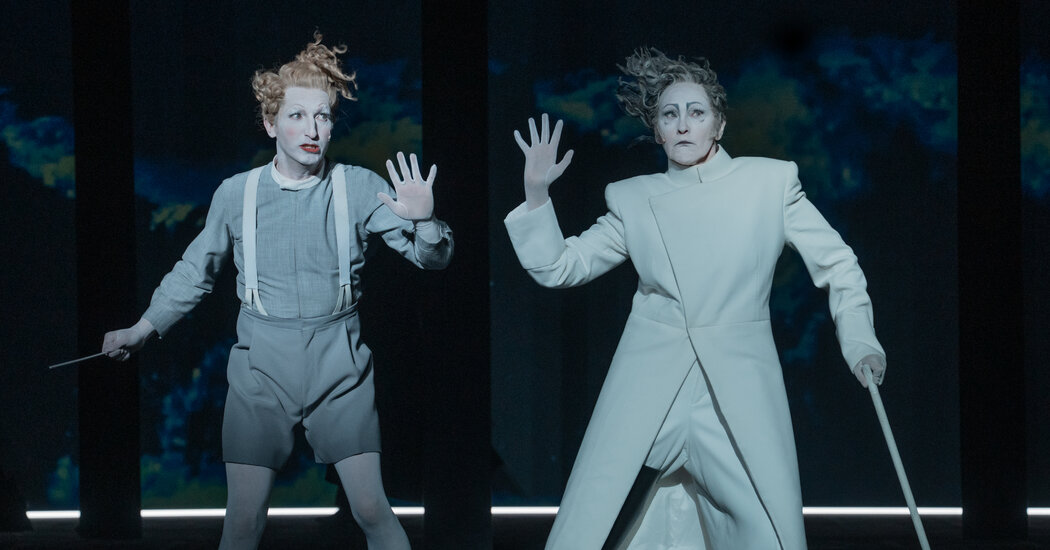
The adapter Robert Koall has stripped Melville’s story to its best-known elements. The rootless Ishmael (Raphael Gehrmann, endearingly naïve) yearns toward the sea; he grows fond of his tattooed ship- (and bed-) mate Queequeg (Yaroslav Ros, wearing glam-rock slashes of black paint); their whaling ship, the Pequod, is wrecked by the deranged Captain Ahab (Rosa Enskat) and his pursuit of the white leviathan Moby Dick. It’s no period production. Characters, typically for a Wilson show, look like German expressionist film stars: Faces painted white; hair in pompadours or flame-shaped quiffs; movements sudden and angular; mouths frozen in shocked, rictus O’s.
Choreographically, each moment extends (or repeats) to the point of hypnosis. Ishmael’s bed, for instance, is a shallow box, divided horizontally so that Queequeg lies in a compartment above him. They’re as rigid as two knives separated in a cutlery tray, while tiny spotlights find and fixate on the places where their hands want to touch. This electric contact clearly absorbed Wilson’s attention more than the book’s violence; the climactic battle with the whale is merely a long darkness, during which the guitars lose their minds in the orchestra pit.
Koall has added a boy-narrator (the sublime Christopher Nell), who complains “I am not Ishmael” in a superb countertenor as a long-bearded old man tries to tell him the story of “Moby Dick” again. The clown-like boy, in gray shorts and suspenders, his hair upright as a rooster’s comb, suggests the whole, tragic, adult affair is a child’s gleeful joke. “It is not a good end!” he shrieked, to stop our clapping, demanding a sweeter resolution. (I did regret his steering us into Calvi’s most sentimental song, a cloying ditty about the sailors being “too wild to die.”)
The eerie physics of “Moby Dick” is just like that of “Mary Said What She Said,” and, really, so much of what Wilson made. His signature use of a glowing backdrop transforms the theater space into a charged volume, as if we’re inside a Dan Flavin neon box. Objects float within the resulting prism like figures in a surrealist picture: Laws of nature don’t apply. The creepy child could appear flying impossibly high up against the proscenium; or a huge hovering beam — representing either the albino whale or the finger of a geometric God — might drift diagonally over Ahab’s head, pointing at his madness.
This time, Wilson used black-and-white video as sometime scenery, including gorgeous not-quite-stills from sources like the John Huston film of “Moby Dick,” grainy footage of waves and a ship’s rigging, fixed in micro-loops, so the images shudder and pulse. The Romantic sight of Ahab, standing lonely against one such ocean projection, hair blown permanently sideways, might be my favorite of the show’s many beautiful images, although I’ve changed my mind twice since last night.
Wilson’s vision was of another world. He knew about some alternate place, a pocket universe into which he could move an entire theater, audience and all. You would imagine that he would have created a galaxy of imitators, but somehow no one else has figured out how to do what he does. To do what he did, I should say, although I still refuse to believe it. For this one weekend at BAM, you too can live again in his strange solar system. His star’s gravity still operates there, just as if he were not gone.
Moby Dick
Through May 3 at the Brooklyn Academy of Music, Brooklyn; bam.org. Running time: 1 hour 40 minutes.
https://www.nytimes.com/2026/04/30/theater/moby-dick-review-robert-wilsons-bam.html


